
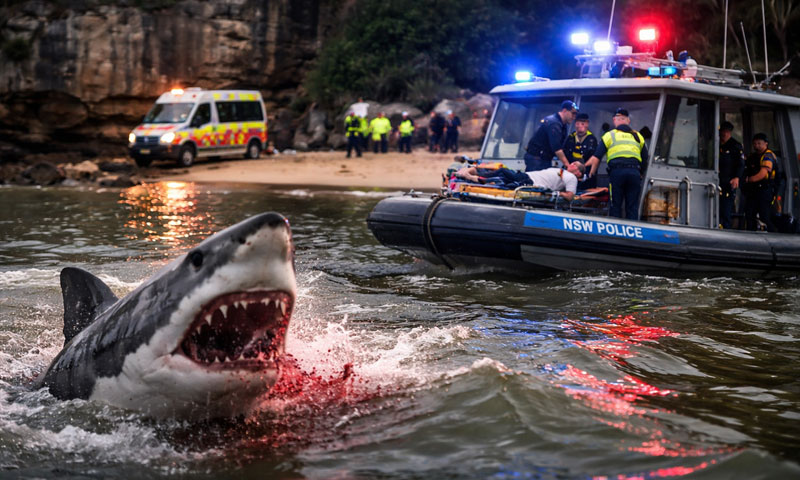
A young boy remains in critical condition after being attacked by a shark inside Sydney Harbour, authorities confirmed on Monday, with recent heavy rainfall believed to have created conditions conducive to the incident. The boy, estimated to be between 12 and 13 years old, was swimming with friends late Sunday afternoon near a beach in Vaucluse, around nine kilometres from Sydney’s central business district. Police said he had been jumping from a six-metre rock into the water when the shark struck. Emergency services were alerted shortly after the attack. The boy was pulled from the water by his friends, suffering severe injuries to both legs. He was later transported to hospital, where he remains in intensive care. New South Wales Police Superintendent Joseph McNulty said officers and paramedics acted swiftly, crediting their response — along with the actions of the boy’s friends — for saving his life. “He’s in for the fight of his life now, and the actions of emergency services yesterday gave him that chance,” McNulty told reporters. Police said days of heavy rainfall had caused large volumes of freshwater runoff to enter the harbour, reducing water clarity and creating brackish conditions. Authorities believe this environment may have attracted a bull shark, a species known to thrive in such waters. “We believe the combination of the brackish water, the fresh water, and the splashing created a perfect storm for this type of shark attack,” McNulty said. He also praised the boy’s friends for their bravery, describing their actions as “gallant” in the moments following the attack. Officers transferred the unconscious child onto a police vessel, where they administered first aid and applied two tourniquets to control severe bleeding. The boat then sped across the harbour to a nearby wharf, where ambulance paramedics were waiting to continue emergency treatment. The boy was taken to Sydney Children’s Hospital, where he remains surrounded by family and friends. Shark Attacks in Australia Australia has recorded more than 1,280 shark-related incidents since records began in 1791, with over 250 resulting in fatalities, according to national databases tracking human-shark encounters. On average, the country experiences around 20 shark attacks each year, with fewer than three proving fatal. Experts note that these figures remain small compared to other beach-related dangers, such as drownings. Scientists say a combination of increasingly crowded coastal waters and rising ocean temperatures may be influencing shark behaviour and migratory patterns, potentially contributing to a rise in encounters with humans. The latest incident comes amid heightened public concern following several recent fatal attacks off the New South Wales coast, including the death of a surfer at a popular northern Sydney beach in September and the killing of a woman by a bull shark at a remote beach north of the city two months later.
Elon Musk Backs Venezuelans as Starlink Offers Free Internet After Maduro’s Removal
Billionaire entrepreneur Elon Musk has voiced public support for the people of Venezuela as Starlink, operated by SpaceX, announced it would provide free broadband internet access across the country for a limited period amid dramatic political changes. In a post on X on Sunday, Musk wrote, “In support of the people of Venezuela,” while sharing Starlink’s official announcement. The company said it would offer free broadband service through February 3, aiming to maintain connectivity during a period of political uncertainty. In support of the people of Venezuela 🇻🇪 https://t.co/JKxOFWsikP — Elon Musk (@elonmusk) January 4, 2026 The announcement followed a stunning development in Caracas, where the United States confirmed the capture of Venezuelan leader Nicolás Maduro. Footage released by US authorities showed Maduro in handcuffs during a staged perp walk, where he appeared calm and briefly addressed reporters and US Drug Enforcement Administration agents before being taken into custody. The sudden removal of Maduro created an immediate leadership vacuum in Venezuela. Within hours, the country’s Supreme Court issued an emergency ruling assigning interim authority to Vice President Delcy Rodríguez. Reading the decision on state television channel VTV, Supreme Court Justice Tania D’Amelio said Maduro was in a “material and temporary impossibility to exercise his functions.” The court ordered Rodríguez to assume all presidential powers to ensure administrative continuity and what it described as the comprehensive defense of the state. The ruling cited provisions in Venezuela’s constitution that require the vice president to take over executive authority in the event of a president’s temporary or absolute absence. Musk reacted positively to Maduro’s arrest earlier, posting in Spanish: “Venezuela ahora puede tener la prosperidad que merece” (“Venezuela can now have the prosperity it deserves”). His comments quickly gained traction online, especially among Venezuelans who have long struggled with internet restrictions, censorship, and infrastructure breakdowns. Reliable internet access has been a persistent challenge in Venezuela, where outages and state control have limited digital communication. Starlink’s temporary intervention is expected to help citizens stay connected to news, emergency services, and family abroad during the transition period.

US Attack in Venezuela: What Happened, What We Know, and What Comes Next
Venezuela has been plunged into one of the most severe political and security crises in its modern history following US military action near the capital Caracas and extraordinary claims from Washington that President Nicolás Maduro and First Lady Cilia Flores were captured and taken to the United States. The developments have sharply escalated tensions between the two countries and triggered widespread concern across Latin America and the international community. JUST IN: 🇻🇪🇺🇸 Close up video of Nicolás Maduro being escorted out of a plane by US authorities in New York. pic.twitter.com/SNP9KHDBxO — BRICS News (@BRICSinfo) January 4, 2026 What unfolded overnight In the early hours of January 3, 2026, explosions and intense military movement were reported in Caracas and surrounding regions. Venezuelan authorities said multiple locations were hit, describing the incident as direct foreign military aggression. Security alerts were raised nationwide, and movement was restricted in parts of the capital as the situation rapidly deteriorated. Shortly afterward, US political leadership dramatically escalated the situation. Former US President Donald Trump publicly stated that American forces had carried out a large-scale operation inside Venezuela, claiming that Maduro and Flores had been detained and flown to the United States, where they would face legal proceedings. The US is bombing Venezuela in an actual unprovoked attack. Many excuses will be given over the next days: Narco-terrorism; Hezbollah, Hamas, Iran and others “operating” in Venezuela; democracy promotion backed by the Nobel Peace Prize etc. pic.twitter.com/qhiVq0OOZu — Glenn Diesen (@Glenn_Diesen) January 3, 2026 The US justification According to US statements, the operation was linked to long-standing criminal accusations against Maduro, including allegations involving narcotics trafficking and links to armed groups—claims that have been raised by US authorities for years. Trump framed the action as a decisive step to enforce accountability, though no detailed legal documentation or congressional authorization was immediately made public, fueling debate within the United States over the legality of the operation. Trump also went further, announcing that the United States would temporarily oversee Venezuela’s political and administrative system until a new government is established—an announcement that stunned diplomats and legal experts worldwide. Venezuela’s response Venezuela’s leadership has categorically rejected the US claims, calling the events an illegal attack, an abduction, and an attempted regime change. Officials insist the country’s sovereignty has been violated and accuse Washington of fabricating or exaggerating claims to justify intervention. Emergency measures were announced, and senior officials urged the population to remain calm while warning that Venezuela would resist any foreign-imposed authority. Casualties and damage: what is known Early reports suggest that people were killed and injured during the overnight strikes, though exact numbers remain unclear and vary across accounts. Venezuelan officials have spoken of fatalities and civilian harm, while US statements have focused on the scale of the operation and said American personnel were injured but not killed. Independent verification remains limited, and analysts caution that all casualty figures should be treated as provisional until further confirmation is available. Regional and global fallout The developments sparked immediate international reaction. Cuba strongly condemned the US action, describing it as an act of state terrorism, while reactions across Latin America have been sharply divided—reflecting deep political splits over Venezuela’s leadership. International concern has focused heavily on sovereignty, international law, and precedent, with growing calls for emergency discussions at global forums, including the United Nations. Wider impact beyond Venezuela The crisis has also disrupted regional travel and commerce. Heightened security measures and airspace restrictions led to widespread flight cancellations and delays across parts of the Caribbean and northern South America, affecting thousands of passengers. What happens next Several critical questions remain unresolved: Governance in Caracas: Venezuelan institutions say they remain in control, but the balance of power is uncertain amid conflicting claims. Legal battle ahead: If Maduro is indeed in US custody, the case is expected to trigger a major legal and diplomatic confrontation over jurisdiction and international norms. Risk of escalation: Analysts warn that further military action or retaliatory measures could destabilize the region and deepen an already volatile crisis. While many details remain contested, one reality is clear: US–Venezuela relations have entered an unprecedented and dangerous phase, with consequences that could reshape regional politics and global debates on intervention and sovereignty.
