
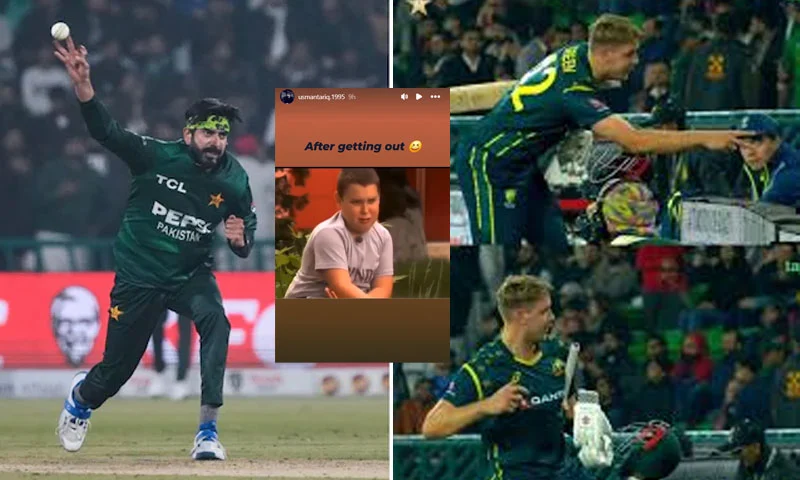
Pakistan’s rising spinner Usman Tariq sparked fresh controversy during the ongoing T20 series against Australia after posting a “crybaby” meme on social media following a heated exchange with Australian all-rounder Cameron Green over his bowling action. The incident has ignited debate over sportsmanship, bowling legality and player conduct amid Pakistan’s dominant display in the series. The meme appeared on Tariq’s social accounts shortly after Green appeared to mimic his bowling action as Green walked off the field after being dismissed. The gesture was widely interpreted as an accusation that Tariq’s action was illegal, drawing sharp reactions from fans, analysts and former players. Green’s Gesture Causes Stir The moment unfolded during the second T20I at Gaddafi Stadium, where Pakistan thumped Australia by a massive margin. After Green was dismissed, video footage and fan posts on social media showed him gesturing in a way that many interpreted as suggesting that Tariq’s bowling was “chucking” — a term used when a bowler’s arm extends illegally during delivery. While some commentators described the gesture as frustration on Green’s part, others saw it as unprofessional, especially given the context of a heavy defeat for Australia. Australia’s top order struggled on a spin-friendly pitch, and Tariq finished with key wickets that helped bowl Australia out. Cameron Green publicly expressed concerns regarding the legality of Usman Tariq’s bowling action. pic.twitter.com/nX7q6CRahM— Cricketopia (@CricketopiaCom) January 31, 2026 Tariq’s Response and History of Clearance Rather than let the controversy die, Tariq responded by sharing a meme depicting a crying child — which many perceived as a direct jab at Green’s reaction following his dismissal. The meme went viral across social media platforms, intensifying discussions among cricket fans. Tariq’s bowling action has been scrutinised before, but he has consistently defended it and cleared official testing on two separate occasions after being reported for suspect action. During his time in franchise leagues, English batter Tom Banton once raised concerns about Tariq’s action, prompting public discussion. Tariq responded at the time by explaining: “There are two corners on my (elbow) which make it hard for me to straighten. That makes confusion for the spectators. I have given two tests at labs in Pakistan, and my action was cleared.” Cricket broadcaster Paul Dennett also weighed in, criticising the online backlash and expressing support for Tariq. “Usman Tariq deserves better. His action has twice been tested — and cleared. Today should be a day to celebrate contributing to a win, not getting blasted on social media,” Dennett wrote on X, adding: “Cricket needs to handle this issue better. And people need to stop being cruel.” Rules and Reactions Under International Cricket Council (ICC) regulations, a bowler’s elbow extension must not exceed 15 degrees, and bowlers with unusual actions are often biomechanically tested to ensure compliance. Critics argue that cricket must balance fair play with respect for players’ natural abilities, especially when actions have been formally cleared. The episode has overshadowed Pakistan’s dominant 90-run victory, which put them 2–0 up in the series ahead of the final match. Australia’s captain acknowledged his team’s struggles: “Pakistan outplayed us… we weren’t able to build partnerships today, so there are some really good lessons for us,” he said after the second loss. As the controversy continues to trend online, the debate over bowling actions and on-field conduct remains a key talking point among cricket enthusiasts worldwide.

Pat Cummins Ruled Out of T20 World Cup; Australia Makes Bold Squad Changes
Australia has confirmed a significant shake-up to its squad for the ICC Men’s T20 World Cup 2026, with captain Pat Cummins ruled out of the tournament due to injury. The decision comes ahead of their campaign in Sri Lanka, where Australia will begin their title defence later this month. Cummins, who captained Australia to victory in the 2021 edition of the T20 World Cup, suffered a knee injury during the 2025–26 Big Bash League and has been unable to regain full fitness. Cricket Australia stated that the fast bowler will focus on rehabilitation and is unlikely to feature in the shortest format until later in the year. Cummins’ absence leaves a leadership and bowling void in the squad, prompting selectors to fine-tune their lineup. In a notable selection move, Matt Short, who impressed in the Big Bash and was in strong form earlier in the year, was dropped from the final T20 World Cup squad despite being named in initial training squads. Selectors cited a combination of balance, team composition and match conditions as reasons behind his omission, saying they “felt the team needed a different mix of skills for Sri Lanka’s pitch conditions.” Also missing out is experienced top-order batter Matt Renshaw, who has not played limited-overs international cricket since 2021. Renshaw was part of Australia’s Test setup and strong first-class performances had put him in contention, but selectors opted for other options in the 15-member side. The exclusion of Steve Smith, a world-class batters and former captain, has attracted particular attention. Smith is not part of the T20 World Cup selection, even as he continues to feature prominently in Australia’s Test and ODI teams. Cricket pundits have noted that Smith’s skillset is traditionally more suited to longer formats and that selectors preferred players with explosive skills tailored to T20 cricket’s demands. Australia has named a balanced squad that includes dynamic all-rounders, pace-bowling depth, and power hitters suited to spin-friendly Sri Lankan pitches. James Faulkner and Pat Cummins’ vice-captain backup and pace spearhead replacements are expected to shoulder leadership and bowling duties in the fast bowler’s absence. Cricket Australia’s head coach reiterated confidence in the group, saying that while losing Cummins is “disappointing,” the side has the depth and experience to compete at the highest level. Australia’s campaign begins against West Indies in Colombo, and fans will be watching closely to see how the team adapts without its inspirational skipper and veteran match-winners.

More Than Just a Match: What’s at Stake in Pakistan vs India U19 World Cup Game
The Pakistan Under-19 cricket team is set to face traditional rivals India Under-19 in a high-pressure Super Sixes encounter at the ICC Men’s Under-19 World Cup 2026 on 1 February, a match that could determine both teams’ paths to the knockout stages. The tournament is being held in Zimbabwe and Namibia, featuring 16 of the world’s best young cricket teams. This fixture pits two youth powerhouses against each other at the Queens Sports Club in Bulawayo. Pakistan currently sits third in Super Six Group 2 with four points from three matches, while India leads the group with a perfect record, boasting six points and an impressive net run rate (NRR) of 3.337. India U19’s Form and Momentum India’s U19 side has looked formidable throughout the tournament. They have won all their Super Six matches so far, including a dominant 204-run victory over Zimbabwe, showcasing an explosive batting lineup and consistent bowling. Earlier in the Super Six stage, India routed Bangladesh by 18 runs and beat New Zealand comfortably, highlighting depth and balance in their squad. The team’s ability to win big has marked them as tournament favorites and a major challenge for Pakistan. Pakistan U19’s Road So Far Pakistan’s road to this marquee clash has been strong. They have won two of their three Super Six matches, defeating New Zealand by eight wickets and Zimbabwe by eight wickets in commanding fashion. Earlier in the tournament, Pakistan qualified for the Super Sixes by finishing in the top three of their initial group, led by spirited performances and well-timed partnerships. The U19 side is also buoyed by recent success, having won the 2025 ACC Under-19 Asia Cup by defeating India in a dominant final. Strategic Importance of the Showdown This Ind-Pak U19 clash carries significant implications. A win for Pakistan could secure their place in the semi-finals while maintaining momentum before the knockout stages. For India, a victory would cement their position at the top of the Super Six table and reinforce their status as title contenders. Fans around the cricket world have marked this fixture as one of the highlights of the tournament, with demand for tickets and viewership high. The match is live-streamed and broadcast globally for supporters across the cricketing nations. As the two rivals prepare for battle in Bulawayo, all eyes will be on how Pakistan’s young guns respond to India’s dominant form. With semi-final spots at stake, this match promises intensity, skill, and the drama typical of Indo-Pak cricket at any level.

From Yorkers to Mystery Spin: The Highest Wicket-Takers in T20 World Cup History
In a tournament built for sixes and superstars, the ICC Men’s T20 World Cup has repeatedly shown one constant: the teams that win big moments usually have bowlers who can take wickets under pressure. And no one has done it more often than Bangladesh all-rounder Shakib Al Hasan, who sits at the top of the all-time wicket-taking list. Shakib became the first bowler to reach 50 wickets in Men’s T20 World Cup history when he dismissed India captain Rohit Sharma during the Super Eight match at the 2024 tournament. The ICC match report described it as Shakib’s 50th T20 World Cup wicket, a milestone that underlines how long he has remained effective across different conditions and eras. What makes Shakib’s record stand out is the type of wickets he takes. He has often struck in the middle overs, breaking partnerships and forcing batters to take risks against the spinners at a time when teams try to “stabilise” an innings. That ability to flip momentum is exactly what wins World Cup games—especially on surfaces where grip, pace changes and accuracy matter more than raw speed. The leaders at the top: wicket-takers who shaped tournaments The list behind Shakib includes several specialists whose spells became part of T20 World Cup folklore. Shahid Afridi (Pakistan) – long celebrated as a match-winner with the ball as much as the bat, Afridi is one of the tournament’s most prolific wicket-takers. The ICC previously highlighted him among the tournament’s “leading lights,” crediting him with 39 wickets in the competition. Lasith Malinga (Sri Lanka) – the original T20 death-overs icon. Malinga’s yorkers and dipping slower balls made him a nightmare in knockout cricket, and he remains among the top wicket-takers historically. The ICC’s tournament stats have listed him among the leaders with 38 wickets. Saeed Ajmal (Pakistan) – in his peak years, Ajmal’s control and variations turned powerplays and middle overs into wicket opportunities. He is also listed among the top wicket-takers in ICC’s historical tournament numbers. Why wickets matter more than ever in modern T20 World Cups T20 batting has evolved fast: deeper line-ups, higher strike rates, and more “all-out attack” even in the powerplay. That makes wicket-taking bowling even more valuable. A team can survive an expensive over; it struggles to survive losing key batters at the wrong time. That is also why upcoming tournaments often see teams investing in: powerplay wicket-takers (swing/seam, hard lengths, new-ball pace), and middle-overs strike spinners (who don’t just “contain,” but actually remove set batters). As venues and pitches change from match to match, the bowlers who adapt—mixing pace, angle, length and variations—are usually the ones who climb these all-time lists.

T20 World Cup 2026: Haris Rauf Says Captain Can Make or Break Selection
Pakistan fast bowler Haris Rauf has underlined the importance of strong captaincy in modern cricket, saying a captain plays a decisive role in unlocking a player’s potential and shaping careers. He stressed that criticism hurts players deeply, adding that national team members feel the pain of defeat just as much as fans do. Speaking in a special interview, Rauf said he does not consider Australian pitches his personal preference but acknowledged that beginning his professional career in Australia proved pivotal to his growth as a cricketer. He explained that early exposure to Australian conditions, culture, and competitive standards helped him mature both on and off the field. Rauf credited Marnus Stoinis, captain of the Melbourne Stars, for playing a key role in shaping his Big Bash League journey. According to Rauf, Stoinis’ trust and leadership gave him the confidence to bowl aggressively and express himself as a fast bowler. Comparing leagues, Rauf said there is a noticeable difference between the Big Bash League and the Pakistan Super League. He described the BBL as one of the world’s top T20 leagues, featuring elite international players, while noting that the PSL continues to grow and is expected to attract more overseas stars following future auctions. Addressing criticism faced by players, Rauf said there is a fine line between constructive criticism and outright disrespect — a boundary that is often crossed. He emphasised that he has always given his 100 percent while representing Pakistan, adding that his primary role as a fast bowler is to take wickets rather than focus solely on restricting runs. Rauf described bowling in the death overs as the most demanding responsibility in T20 cricket, a role he is frequently assigned. He revealed that Melbourne Stars management encouraged him to attack batters instead of bowling defensively, telling him that top-class batters are often uncomfortable facing him at full pace. The fast bowler also dismissed suggestions that he is going through a rough phase, stating that he has delivered consistent performances since the Asia Cup. He noted that criticism tends to persist regardless of form, once again highlighting that a captain’s support can either elevate a player or undermine their confidence.
