

Honda Atlas Cars (Pakistan) Limited (HCAR) reported a strong financial turnaround in the first nine months of Market Year 2026 (9MFY26), driven by robust sales of its Honda HR-V Hybrid and renewed interest in the Honda City sedan. The company’s profit after tax jumped 117% to PKR 2.22 billion, compared with PKR 1.02 billion in the same period last year, according to a recent industry report. Earnings per share (EPS) also showed significant improvement, more than doubling to PKR 15.59 in 9MFY26, up from PKR 7.19 in 9MFY25, signaling renewed investor confidence and stronger bottom-line performance. This rebound comes as Honda Atlas leverages its updated product lineup to capture demand in Pakistan’s recovering automotive market. The Honda HR-V e:HEV hybrid SUV, launched in August 2025, has been a key contributor to sales volumes, appealing to buyers seeking fuel-efficient crossover options in a segment that was traditionally limited to petrol variants. In addition, the Honda City 1.5L Aspire S CVT, introduced in September 2025, helped invigorate interest in the compact sedan segment, long a strong category for Honda across Pakistan’s major urban centres. Despite the strong top-line momentum and surging sales, Honda Atlas faces some ongoing cost and margin challenges. A stronger Pakistani rupee against the Japanese yen aided gross margins, which remained stable at 7.9%, but marketing and distribution expenses went up three-fold due to aggressive nationwide promotions. Finance costs also surged by 157%, as the company increased borrowings to PKR 14.3 billion to support operations and growth initiatives. Heavy taxation remains a hurdle for the auto industry, with Honda Atlas recording an effective tax rate of 43.1% during the period. Nonetheless, the company’s ability to expand earnings while navigating these headwinds has been notable. Pakistan’s broader automotive sector is showing signs of recovery, supported by lower interest rates, easier financing and rising consumer demand. Car sales in the market recently surged 76% to over 17,800 units, and the sector’s profit projection climbed to roughly PKR 6.6 billion in Q2 FY26, highlighting industry-wide growth. Analysts say sustained demand for SUVs, hybrids and reliable compact cars — combined with supportive policy measures — are key to continued momentum. Honda Atlas, a joint venture between Honda Motor Co. and Atlas Group with decades of presence in Pakistan, is positioned to benefit from this uptrend as it expands its hybrid offerings alongside traditional models. As the company heads into the final quarter of FY26, the focus will be on maintaining profitable growth while managing cost pressures and capitalising on evolving consumer preferences in an increasingly competitive auto market.
UBL Overtakes OGDC to Become Pakistan’s Most Valuable Listed Company
United Bank Limited (UBL) has climbed to the top of Pakistan’s stock market, becoming the largest listed company by market capitalisation after its valuation reached Rs1.28 trillion (USD 4.6 billion) on Tuesday. The surge allowed UBL to overtake Oil & Gas Development Company (OGDC), which now ranks second with a market capitalisation of Rs1.26 trillion (USD 4.53 billion), marking a rare shift at the top of the Pakistan Stock Exchange. Market analysts say UBL’s rise reflects strong investor confidence and the broader resilience of the banking sector, particularly as macroeconomic conditions improve. Share price rallies sharply UBL’s stock has delivered an exceptional run over the past month. Its share price jumped 37 percent, rising from Rs375.57 on December 8, 2025, to Rs514.49 by Tuesday. Analysts attribute the rally to the bank’s strong earnings performance and its effective positioning amid changing interest rate dynamics. “The improvement in profitability is largely driven by how well the bank has utilised the interest rate environment,” said Samiullah Tariq, Head of Research at Pak-Kuwait Investment Company Limited. Interest rate tailwinds Pakistan’s benchmark interest rate has declined significantly, falling from a peak of 22 percent in April 2024 to 10.5 percent in December 2025 — a reduction of 1,150 basis points. The easing cycle has helped banks manage spreads more efficiently while supporting credit growth and profitability. Strong financial performance and dividends According to its latest financial results, UBL reported a profit after tax of Rs34.7 billion for 9MCY25, marking a 36 percent increase year-on-year. Earnings per share rose to Rs13.86 during the period. The bank also announced another interim cash dividend of Rs8 per share, taking its total dividend payout for the year to Rs27.5 per share — one of the highest distributions in Pakistan’s banking sector. UBL operates as a subsidiary of Bestway Holdings Limited, which is wholly owned by Bestway Group Limited. Market leadership shifts, but sectors remain dominant While OGDC has slipped to second place, analysts note that the shift does not weaken its standing as a market heavyweight. Instead, the development highlights how Pakistan’s equity market continues to be dominated by the financial and energy sectors, with leadership rotating based on earnings momentum and investor sentiment. For now, UBL’s ascent underscores the renewed appeal of banking stocks as economic stability gradually returns.
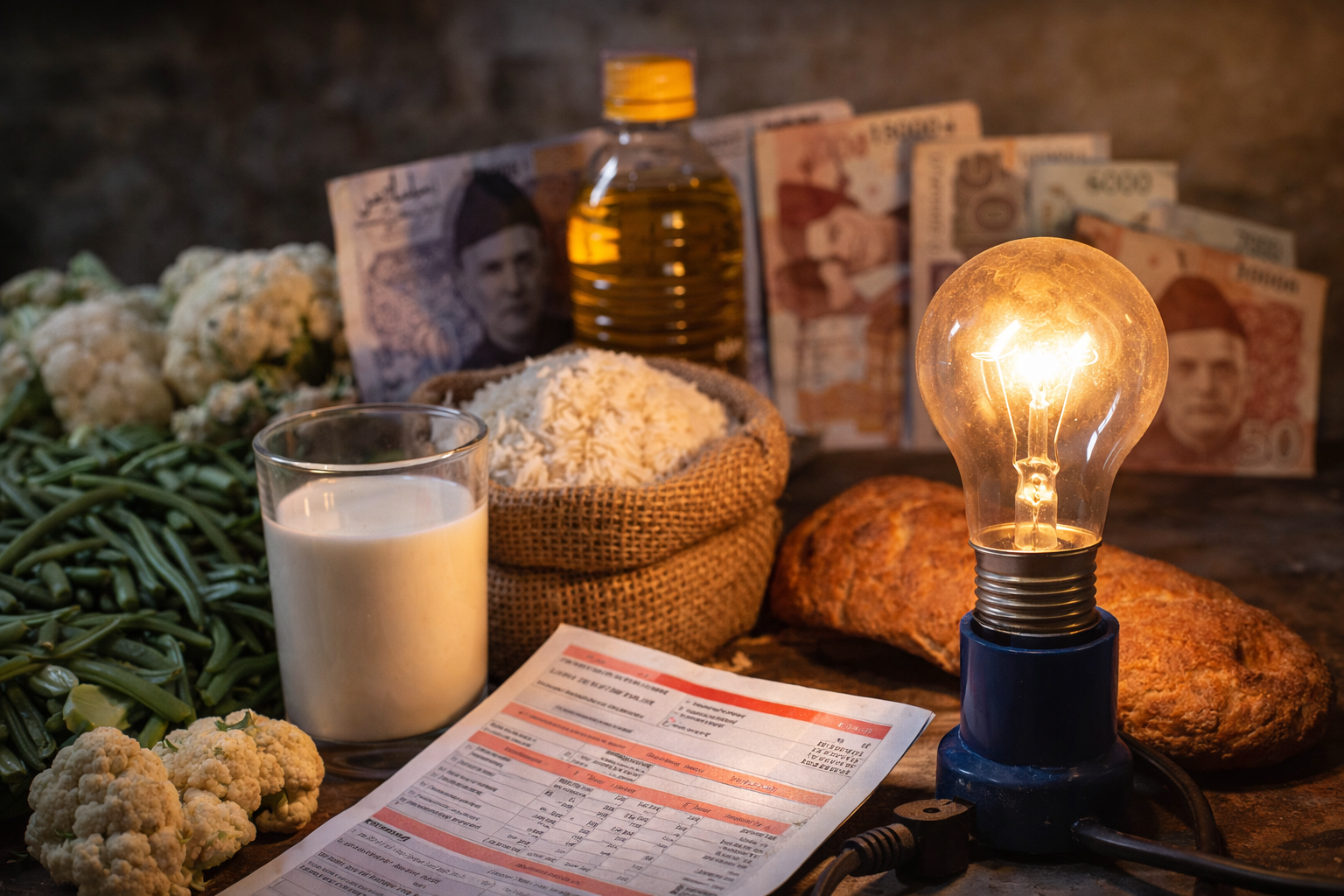
Pakistanis Now Spend Two-Thirds of Their Income on Food and Electricity: Survey
Pakistan’s households are spending nearly two out of every three rupees on just food and electricity, highlighting how sharply rising living costs are reshaping daily life across the country, according to a new government survey. The findings come from the Household Integrated Economic Survey (HIES) 2024–25, released by Planning Minister Ahsan Iqbal. Conducted after a gap of more than six years, the survey paints a stark picture of how inflation has eroded household purchasing power. The survey shows that while incomes have increased, expenditures have grown even faster, leaving families with little room for savings or investment in education and health. On average, households now spend 63 percent of their total monthly expenses on food and housing-related costs, including electricity and gas. Food alone accounts for 37 percent of household spending, while 26 percent goes toward housing, electricity, and gas. In contrast, spending on education has fallen to just 2.5 percent, less than half of what households spend on housing and utilities. Combined spending on education, health, and recreation stands at only 7 percent. The report also highlights a growing dependence on external income sources. The share of foreign remittances in household income has climbed from below 5 percent six years ago to nearly 8 percent today. Gifts and financial assistance have also surged, more than doubling to 4.6 percent, signaling increased reliance on informal support networks. According to officials at the Pakistan Bureau of Statistics, rural households show an even sharper rise in dependence on remittances, reflecting fewer domestic job opportunities. Independent economists link this trend to the steady outflow of young and skilled workers seeking employment abroad. Income inequality remains pronounced. While the average monthly household income has nearly doubled from Rs41,545 to Rs82,179 over six years, the poorest 20 percent earn Rs41,851 per month, compared with Rs139,317 earned by the richest quintile. Urban households earn significantly more than rural ones, with average monthly income rising to Rs96,767 in cities. Household expenses have risen faster than earnings. Monthly consumption spending jumped from Rs37,159 to Rs79,150, growing at an average rate of 19 percent per year, compared to a 16 percent annual rise in income. Within food spending, milk accounts for the largest share at 22 percent, followed by wheat (12 percent) and cooking oil (6 percent). The survey also notes that spending at restaurants now exceeds spending on education, especially among higher-income households. The findings reflect years of economic strain marked by double-digit inflation, currency depreciation, and fiscal tightening under IMF-backed reforms, which have placed the heaviest burden on middle- and lower-income families.
