
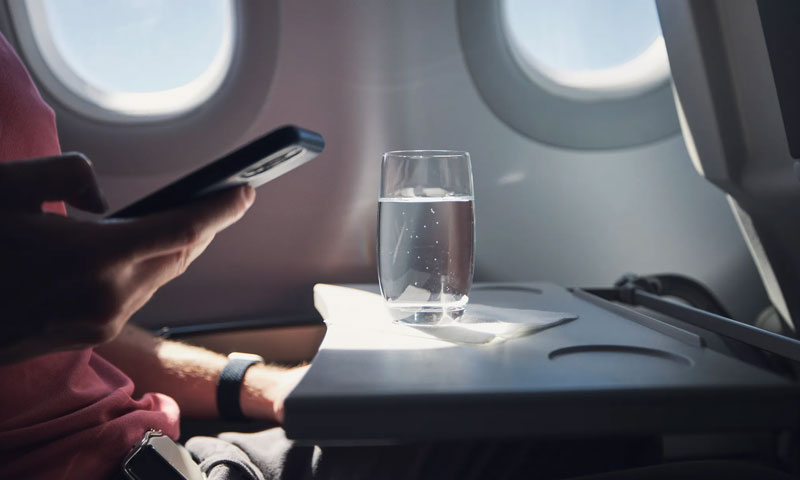
Airline passengers may want to rethink what they drink on board. A new study has warned that water served on many flights could be potentially unhealthy, prompting researchers to advise travelers to stick to bottled water and avoid coffee or tea prepared using aircraft water systems. The findings come from the Center for Food as Medicine & Longevity, which analyzed more than 35,000 water samples collected from 10 major and 11 regional airlines over a three-year period. Based on the results, the nonprofit also recommends avoiding washing hands with airplane tap water and instead using hand sanitizer with at least 60% alcohol. While water quality may not rank high among passengers’ safety concerns, the organization described it as an important public health issue. Drinking contaminated aircraft water, it warned, can lead to gastrointestinal illness and potential exposure to harmful pathogens. What the study found The analysis showed that 2.7% of samples tested positive for total coliform bacteria, an indicator that disease-causing organisms may be present in the water system. More alarmingly, E. coli was detected 32 times across the 21 airlines reviewed. “Testing for coliform bacteria is critical because its presence suggests that pathogens could enter the drinking water supply,” the group said. In the United States, onboard water systems are regulated under the Environmental Protection Agency’s Aircraft Drinking Water Rule (ADWR), introduced in 2011. The rule requires airlines to regularly test water, flush and disinfect tanks multiple times a year, and monitor for contamination. However, the study noted that enforcement is inconsistent and penalties for violations are rarely imposed. Airlines respond Several airlines pushed back against the findings. American Airlines said it is reviewing the study but stressed that its potable water program complies fully with EPA rules and has passed recent audits without violations. JetBlue Airways said it follows EPA, FDA, and FAA standards and primarily serves bottled drinking water onboard.Spirit Airlines said it maintains a comprehensive testing and maintenance program and has improved procedures in recent years. Industry group Airlines for America said passenger and crew safety remains the sector’s top priority, adding that U.S. airlines follow federal guidelines to ensure onboard water safety. Major airlines ranked: best to worst The study scored airlines on a five-point scale, with points deducted for violations such as detecting contaminants in water samples. Delta Air Lines — 5.00 (Grade A) Frontier Airlines — 4.80 (Grade A) Alaska Airlines — 3.85 (Grade B) Allegiant Air — 3.65 (Grade B) Southwest Airlines — 3.30 (Grade C) Hawaiian Airlines — 3.15 (Grade C) United Airlines — 2.70 (Grade C) Spirit Airlines — 2.05 (Grade D) JetBlue Airways — 1.80 (Grade D) American Airlines — 1.75 (Grade D) Regional airlines ranked: best to worst GoJet Airlines — 3.85 (Grade B) Piedmont Airlines — 3.05 (Grade C) Sun Country Airlines — 3.00 (Grade C) Endeavor Air — 2.95 (Grade C) SkyWest Airlines — 2.40 (Grade D) Envoy Air — 2.30 (Grade D) PSA Airlines — 2.25 (Grade D) Air Wisconsin — 2.15 (Grade D) Republic Airways — 2.05 (Grade D) CommuteAir — 1.60 (Grade D) Mesa Airlines — 1.35 (Grade F) What passengers should do Until oversight improves, researchers advise travelers to avoid aircraft tap water entirely—including coffee and tea—and rely on sealed bottled beverages. For hygiene, alcohol-based hand sanitizer is considered safer than washing hands with onboard water. The study concludes that while many airlines meet basic regulatory requirements, stronger enforcement and greater transparency are needed to ensure that something as simple as a glass of water at 35,000 feet does not pose a health risk.
Philippine Airlines Turns Flight Safety Into a Telenovela — and the Internet Is Loving It
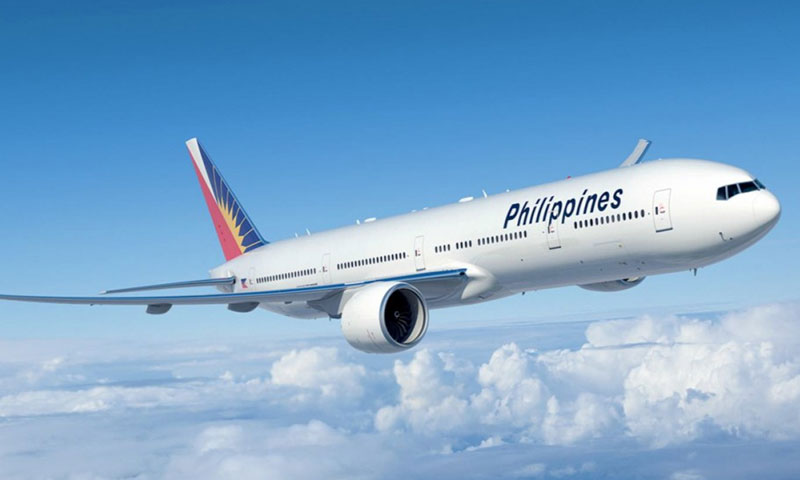
Philippine Airlines has found an unexpected way to make passengers actually watch an in-flight safety video: by turning it into a full-blown drama. Titled “Care That Comes From the Heart,” the airline’s new safety video made its debut aboard its first Airbus A350-1000, delivered on December 22, 2025, before being released online on December 31. Within just four days, the video crossed 200,000 views on YouTube, proving that safety instructions can go viral when storytelling takes center stage. Produced in a mix of Filipino and English, with English subtitles throughout, the video immediately signals that this is not a routine pre-flight briefing. Its thumbnail alone hints at something unusual, teasing drama rather than demonstrations. A love story at 35,000 feet The video opens with a standard cabin crew greeting, but quickly shifts to a visually rich hacienda-style setting, inspired by traditional Philippine estates with Spanish colonial influence. What follows is a melodramatic tale straight out of a classic “novela.” Viewers are introduced to Anton, a poor estate worker, and Luisa, a young woman from a wealthy family. Their forbidden romance forms the emotional core of the story. The plot thickens when Luisa is pressured into an arranged marriage with Diego, a wealthy suitor backed by her family. As the drama unfolds, flight safety instructions appear at unexpected moments. When Diego offers to vape instead of smoke, a flight attendant abruptly intervenes to remind him that smoking and vaping are prohibited. Later, when Anton storms into the church to stop the wedding, the calm voice of the cabin crew announces, “Should there be a rapid change in cabin pressure…” as oxygen masks descend and the stunned wedding guests dutifully put them on. Humor through surreal contrast These deliberate anachronisms — mixing 19th-century-style drama with modern aviation rules — are what viewers say make the video memorable. Life vests appear during emotionally charged scenes, and safety demonstrations interrupt heartbreak and confrontation, creating moments that are both absurd and hilarious. The reaction online has been overwhelmingly positive. In Esquire Magazine, award-winning writer Christa I. De La Cruz famously wrote, “I Finally Watched an In-Flight Safety Video All the Way to the End.” YouTube comments echo that sentiment, with viewers pointing out scenes where characters argue passionately while wearing life jackets. A carefully crafted production The 6-minute-25-second video is co-presented by Mastercard, created in collaboration with BBDO Guerrero, produced by Arcade Film Factory, and directed by Marius Talumpas. Together, the team transformed mandatory safety instructions into entertainment that holds attention without compromising clarity. For Philippine Airlines, the success of the video shows that safety messages do not have to be ignored. Sometimes, all it takes is a compelling story — and a little drama — to keep passengers watching until the very end.
