
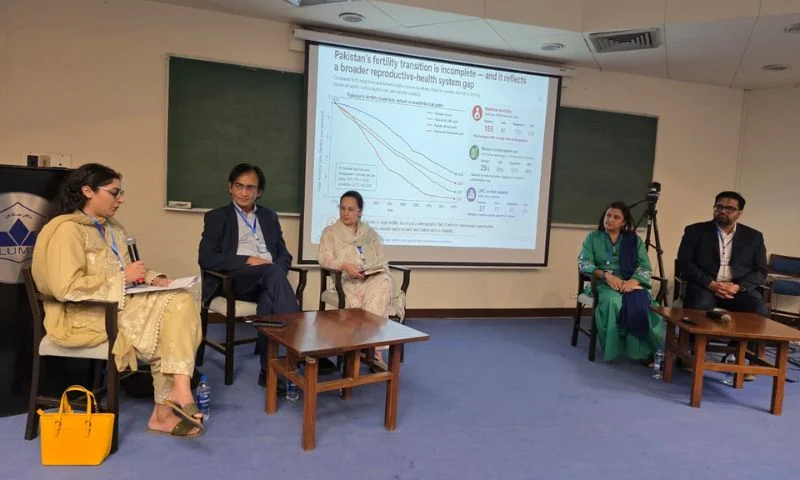
Experts at a gender and economy conference in Lahore warned that artificial intelligence could either unlock major economic opportunities for women or deepen existing inequalities if Pakistan fails to expand digital education and skills training. The discussion took place during a panel on “Health & Gender” moderated by Warda Riaz at LUMS. Panelists included Fyeza Jehan, Usman Ali, Adnan Khan and M. Farhan Majid. Speakers stressed that women’s economic empowerment depends heavily on education, access to information and bargaining power within society. One panelist said affordable learning opportunities and digital skills programmes could help women overcome structural barriers that continue to limit workforce participation and entrepreneurship. “There is a risk that communities with lower skills will be unable to benefit from new technologies,” the panel noted during the discussion. The experts warned that countries failing to invest in digital capacity-building may fall further behind in productivity and global competitiveness. AI Could Transform Women-Led Businesses The panel highlighted how digital tools and AI systems are rapidly reshaping business operations around the world. Referring to survey findings conducted with the Asher Blair Foundation, speakers said women entrepreneurs from nearly 80 countries showed strong interest in adopting generative AI tools. According to the findings, many women business owners wanted to use AI for accounting, payroll management and routine administrative work. Experts said AI could help women-led enterprises reduce time-consuming manual tasks while improving efficiency and productivity. The panel also referenced estimates suggesting Pakistan’s women-focused digital economy could represent a market worth nearly $500 million. That estimate is linked to Pakistan’s female population of around 73 million, highlighting the scale of untapped economic potential. Pakistan has one of the lowest female labor force participation rates in South Asia. The World Bank estimates female participation remains below 25 percent, despite rising smartphone and internet usage. Digital access for women also remains uneven, particularly in rural areas where internet access, digital literacy and educational opportunities remain limited. Digital Divide Could Hurt Long-Term Growth Experts warned that Pakistan’s weak education indicators and low literacy rates could limit the country’s ability to benefit from AI-driven economic transformation. They argued that unequal access to technology may create broader macroeconomic problems in the future. According to the discussion, economies with lower digital adoption could face slower productivity growth and greater dependence on imports. Meanwhile, digitally advanced economies may continue scaling faster through automation and AI integration. The panelists urged policymakers, educational institutions and private companies to invest urgently in women’s digital education and technology-focused training. They said inclusive access to AI skills would play a critical role in ensuring equitable economic growth across Pakistan. Analysts worldwide have increasingly warned that AI may widen social and economic inequality if governments fail to invest in education and workforce adaptation. For Pakistan, experts said the challenge now lies in ensuring women are not excluded from the next phase of technological and economic change.
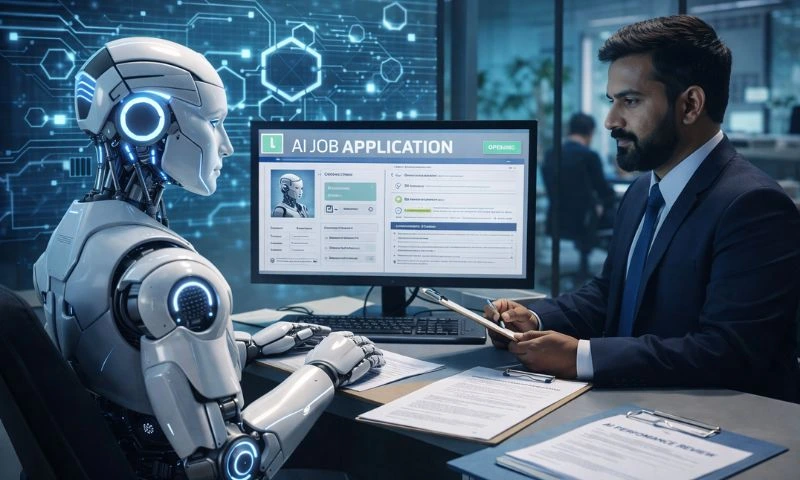
G42 Opens Jobs to AI Agents in World-First Hiring Move
Abu Dhabi-based artificial intelligence leader G42 has launched a pioneering initiative that formally opens jobs to AI agents, software systems capable of autonomous decision-making and task execution within enterprise environments. This marks a bold shift from traditional human-only workforces to blended systems where both humans and AI agents are evaluated against enterprise standards. G42’s Structured Hiring for AI The recruitment process invites AI agents to apply for roles that meet strict enterprise requirements. Agents must undergo technical validation, performance testing and reliability assessments before gaining acceptance. If successful, they enter a defined probation phase during which their sustained value delivery is assessed against pre-set metrics before being deployed more widely across business functions. This process mirrors human hiring with structured reviews and accountability. Human leaders retain final decision-making authority over all AI systems. Group Chief Augmented Human Capital Officer Maymee Kurian said, “The future of work is being shaped by how intelligently we design the relationship between human talent and intelligent systems.” She added that the initiative was not about incremental gains, but “rethinking enterprise workforce design for the AI era.” Kurian emphasised that governance structures ensure AI agents operate within clear performance standards with robust human oversight so responsible scaling can occur. What Sets This Apart This hiring model reframes how AI tools are used. Traditionally, companies deploy AI systems as support tools to assist humans. G42’s framework positions AI agents as contributors accountable for measurable outcomes and tied to value-linked compensation models that reflect performance. This move highlights a future where AI systems could partner with human teams on complex enterprise tasks, from automation to insight generation. The Broader AI Ecosystem at G42 G42’s AI workforce initiative comes amid other ambitious projects the company is driving. Earlier this year, its leadership announced plans to build a national-scale “agent factory” — infrastructure designed to manage autonomous AI systems and operate within an “intelligence grid” that links compute capacity with governance and real-world deployment across sectors. This factory would automate the creation and orchestration of AI agents, aligning with national objectives around AI governance and scalability. G42’s global strategy also includes partnerships and joint ventures that will extend AI services to other geographies. For example, the company signed a Memorandum of Understanding with Publicis Sapient to accelerate AI adoption across enterprise digital transformation projects in the UAE and Global South, further reinforcing its commitment to practical AI integration. Workforce Transformation and the Future Industry analysts say G42’s move could inspire other organisations to rethink workforce design, blending human expertise with agent-driven execution. By giving AI agents clear pathways through qualification and probation, companies may test new standards for productivity measurement and accountability that blend computing performance with human context. This could reshape enterprise hiring norms as AI matures into strategic partners rather than auxiliary tools.

Return-to-Office Is Back So Why Are Remote Jobs Still Spreading?
Many big employers have tried to pull people back to the office. Some have gone all-in. Amazon told staff it would require five days a week in the office starting in 2025, tightening rules that already demanded in-person time. JPMorgan also moved toward five days a week for many roles, part of a wider return-to-office push across corporate America. Yet remote work keeps expanding in daily life, even when policies get stricter. The reason is simple: the remote-capable workforce has changed its expectations. Gallup’s tracking shows remote-capable workers make up about half of the U.S. workforce, and hybrid remains the dominant setup for most of them. In Gallup’s latest reporting, hybrid work “barely” retreated, and in tech, 47% of remote-capable employees are fully remote while 45% are hybrid. Preferences also stay strong. A Pew Research Center survey found many remote workers would rethink their job if they lost the option to work from home, highlighting how flexibility has become a retention issue, not a perk. Globally, researchers see the same pattern. A 2025 paper using the Global Survey of Working Arrangements across dozens of countries found work-from-home rates fell after the pandemic peak, then stabilized after 2022 among college-educated employees. In other words, the world did not “snap back” to 2019. So why does remote work keep growing even under pressure? One driver is distributed teams. Once companies hired across cities, it became harder to justify a full-time return for everyone. Another driver is competition for talent. Even when executives prefer offices, many still offer hybrid options to avoid losing skilled staff to more flexible rivals. That tension shows up in company messaging. In its return-to-office memo, JPMorgan said, “What is not changing is our support for flexibility in the workplace.” There is also a lifestyle pull. Remote and hybrid work reduce commute time, make family logistics easier, and let workers live farther from expensive office hubs. That mix explains why remote work can spread even when some headline companies tighten rules. The result is a new compromise: more badge scans in big cities, but more remote days everywhere else. Office comeback pushes are real. But so is the market reality that flexibility now shapes where people work—and which employers win.
