

Global food giant Nestle has announced a fresh $60 million investment in Pakistan, signalling a major expansion of its local operations and reaffirming its long-term commitment to the country. The announcement was made during a meeting between Finance Minister Muhammad Aurangzeb and Nestle executive vice president and CEO for Asia, Oceania and Africa Remy Ejel, held on the sidelines of the World Economic Forum annual meeting in Davos, according to a statement issued by the Ministry of Finance. The meeting took place during a high-level business roundtable chaired by Aurangzeb, which brought together chief executive officers and senior leaders from leading multinational corporations to discuss Pakistan’s reform agenda, investment climate, and long-term growth prospects. Nestlé Announces USD 60 Million Additional Investment in Pakistan at WEF Business Roundtable Federal Minister for Finance and Revenue, Senator Muhammad Aurangzeb, today chaired a high-level Business Roundtable on the sidelines of the World Economic Forum (WEF) Annual Meeting in… pic.twitter.com/NB5Vp3vOTK— Ministry of Finance, Government of Pakistan (@Financegovpk) January 22, 2026 According to the ministry, the roundtable was part of the government’s broader engagement with global investors aimed at improving policy predictability, accelerating economic formalisation, and promoting sustainable, export-oriented growth. “A key highlight of the discussion was the announcement by Remy Ejel of an additional investment of $60 million in Pakistan,” the statement said. “Nestle will undertake a robust expansion of its operations in the country, reaffirming its long-term commitment to Pakistan.” Ejel also revealed that Nestle plans to use Pakistan as a regional manufacturing and export hub, with the company set to export products to 26 countries from its Pakistani facilities. Expressing confidence in Pakistan’s economic outlook, he said Nestle expects strong growth in its local business in the coming years. The finance ministry noted that the announcement builds on recent engagements between Nestle and the government in Islamabad, where the company outlined a strategy focused on localisation, advanced manufacturing, sustainability, and agricultural transformation. Ejel highlighted that Pakistan’s large and youthful population, rising nutrition needs, and underdeveloped value-added food segments closely resemble growth patterns seen in Southeast Asian markets where Nestle has successfully expanded. Welcoming the announcement, Aurangzeb described the investment as a “strong vote of confidence” in Pakistan’s economic reforms and formalisation drive. He reaffirmed the government’s commitment to strengthening the tax ecosystem, ensuring policy consistency, and facilitating responsible long-term investment. The minister also underscored Pakistan’s potential in affordable nutrition, climate-resilient dairy, local sourcing, and export-oriented manufacturing, reiterating the government’s goal of positioning the country as a competitive base for regional production and global value chains.
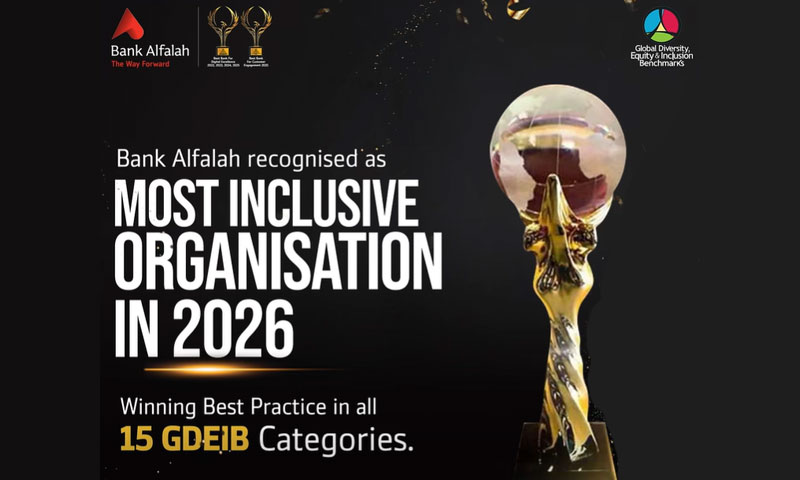
Bank Alfalah Named Among World’s Most Inclusive Companies for 2026
Bank Alfalah has been recognised as one of the “Most Inclusive Companies in 2026” at the Global Diversity, Equity and Inclusion Benchmarks (GDEIB) Awards, following a comprehensive and evidence-based evaluation conducted by an independent international jury. The recognition came after a rigorous disclosure process in which 44 multinational and national organisations submitted detailed documentation assessing their policies, workplace culture, and people practices. Bank Alfalah emerged as the top overall performer, earning the title of Most Inclusive Company in 2026. In addition to the overall honour, the Bank secured wins across 15 GDEIB benchmark categories, reflecting its holistic approach to embedding diversity, equity, and inclusion across business operations. These categories include vision and strategy, leadership accountability, recruitment and retention, learning and development, compensation structures, flexible work practices, DEI communications, responsible sourcing, community engagement, sustainability integration, and inclusive product and service development. The GDEIB Awards are anchored in the Global Diversity, Equity and Inclusion Benchmarks, an internationally recognised framework that enables organisations to measure, strengthen, and sustain inclusive practices through structured and measurable standards. Beyond workplace inclusion, Bank Alfalah’s recognition also reflects its broader role in social impact and corporate responsibility. Positioning itself as a “Caring Bank,” the institution has consistently combined national relief efforts with long-term community development initiatives. Following Pakistan’s devastating floods in 2022, Bank Alfalah contributed USD 10 million towards relief and rehabilitation efforts. In response to the floods in 2025, the Bank pledged an additional USD 5 million, bringing its total commitment to USD 15 million. These funds are directed towards infrastructure rehabilitation, climate-smart agriculture, and sustainable recovery initiatives aimed at strengthening affected communities. The Bank also collaborates with more than 30 partner non-governmental organisations, supporting projects in education, women’s empowerment, healthcare, environmental protection, and social inclusion. These initiatives are aligned with the 17 United Nations Sustainable Development Goals, reinforcing Bank Alfalah’s commitment to long-term, measurable impact. According to the Bank, the global recognition underscores its ongoing efforts to foster a workplace culture built on opportunity, representation, and belonging, while integrating DEI principles into governance frameworks and everyday decision-making. As Pakistan’s corporate sector increasingly aligns with global standards, Bank Alfalah’s achievement positions it as a regional leader in inclusive growth, responsible banking, and sustainable development.
