
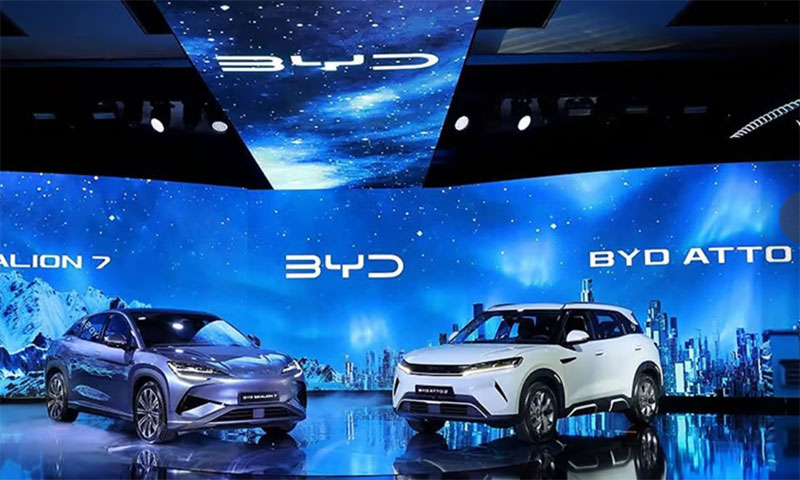
Mega Motor Company (MMC), in partnership with BYD, the world’s leading New Energy Vehicle (NEV) manufacturer, has introduced two new all-electric SUVs — the BYD Sealion 7 and BYD Atto 2 — in Pakistan, signalling a significant expansion of the country’s electric mobility landscape. The vehicles were unveiled at an exclusive dealership launch in Lahore, with bookings now open nationwide. The additions broaden BYD-MMC’s growing electric portfolio, targeting both premium performance buyers and everyday urban drivers as Pakistan gradually transitions towards cleaner transportation. BYD Sealion 7: Performance-Driven Luxury Electric SUV Positioned as a luxury, performance-focused electric SUV, the BYD Sealion 7 is designed to compete with high-end global EVs in terms of power, technology and safety. One of BYD’s strongest sellers across the Asia-Pacific region, the Sealion 7 delivers 308 horsepower (230 kW) and 380 Nm of torque, accelerating from 0 to 100 km/h in 6.7 seconds. The SUV also features a strong braking capability, coming to a halt from 100 km/h in 37 metres, while offering a driving range of up to 567 kilometres on a single charge. Built for drivers seeking both refinement and excitement, the Sealion 7 blends performance with advanced ride comfort and safety systems. BYD Atto 2: Smart Electric SUV for Urban Pakistan The BYD Atto 2 is positioned as a practical, technology-oriented electric SUV tailored for daily commuting and city use. Designed with efficiency and convenience in mind, it features keyless NFC access, a 50W wireless charging pad, electric and ventilated seats, and a clean, user-friendly interior layout. The Atto 2 accelerates from 0 to 100 km/h in 7.9 seconds, making it one of the quickest in its category, while offering a driving range of up to 380 kilometres. According to BYD-MMC, the model delivers up to 75 per cent lower running and maintenance costs compared to comparable internal combustion engine vehicles. Core BYD Technology Across Both Models Both the Sealion 7 and Atto 2 are built on BYD’s e-Platform 3.0 and feature the brand’s 8-in-1 electric powertrain, designed to enhance efficiency, performance and driving comfort. They are also equipped with BYD’s Blade Battery, known globally for its high safety standards, thermal stability and durability, making it one of the most trusted battery technologies in the EV sector. What BYD Pakistan Says Speaking at the launch, Lei Jian, Country Head of BYD Pakistan, said the introduction of the two models reflects the company’s long-term vision for the local market. “As the world’s No.1 NEV brand, we are proud to bring our globally proven technology to Pakistan. With the Sealion 7 and Atto 2, we are making the transition to electric vehicles both practical and rewarding for Pakistani consumers.” Danish Khaliq, Vice President – Sales and Strategy at BYD Pakistan (MMC), said the new models cater to different stages of the EV transition. “From a value-driven electric SUV for daily urban use to a premium, performance-led vehicle, these launches address a wide spectrum of customer needs. Electric mobility in Pakistan is no longer a future concept — it is happening now.” Prices and Booking Details BYD Atto 2 Price: PKR 7.29 million Booking amount: PKR 1.4 million BYD Sealion 7 Price: PKR 15.49 million Booking amount: PKR 3 million A limited-time introductory offer is available for bookings made until February 28, which includes a complimentary 7 kW wall-mounted home charger. Prices are inclusive of freight and inland transit insurance. The offer also includes: 10-year warranty on the low-voltage LFP battery Two free charging sessions at HubcoGreen stations for Atto 2 customers Free installation of a 7 kW charger for Sealion 7 customers Building Pakistan’s First EV Charging Corridor Beyond vehicle launches, BYD-MMC, in collaboration with HubcoGreen, is developing Pakistan’s first nationwide NEV charging corridor, spanning approximately 1,300 kilometres from Karachi to Peshawar, connecting major cities and motorway networks.
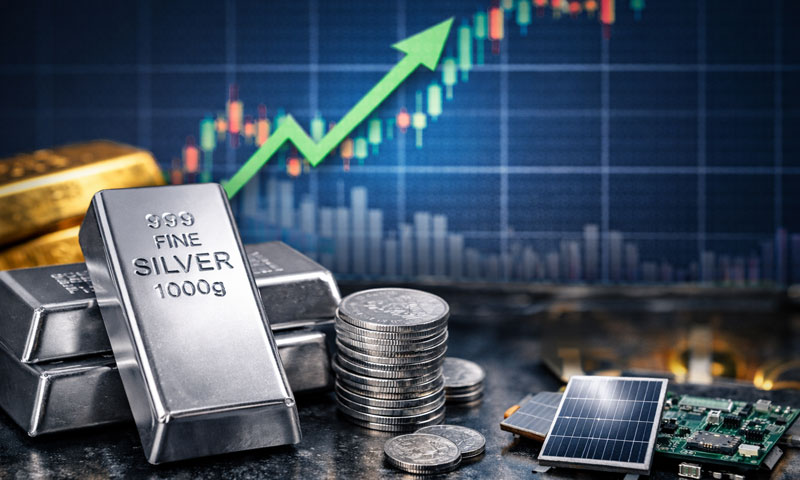
Silver Price Surge: Global Demand, Supply Pressures and What Comes Next
As gold prices continue to rise across international markets, silver has also entered a strong upward cycle, drawing renewed attention from investors, analysts, and industrial users. Traditionally viewed as both a precious and industrial metal, silver’s recent performance reflects a convergence of structural supply constraints, rising industrial demand, and evolving global economic conditions. Silver Gains Momentum Alongside Gold Over the past year, silver prices have risen sharply, broadly tracking gold’s rally while also benefiting from dynamics unique to its own market. Analysts note that silver historically tends to lag gold during the early phase of precious-metal rallies but can accelerate later due to its smaller market size and heavier exposure to industrial demand. Market indicators show that silver reached multi-year highs in early 2026, supported by sustained investor interest and continued demand from manufacturing and technology sectors. This price strength has revived debate over whether silver is entering a longer-term structural uptrend rather than a short-lived speculative phase. Persistent Supply Constraints Remain a Key Driver One of the most significant forces supporting silver prices is a prolonged imbalance between supply and demand. Global mine production has struggled to expand at the pace required to meet rising consumption for several consecutive years. Unlike gold, where large above-ground stocks exist and can re-enter the market, a substantial portion of silver supply is consumed in industrial processes and becomes difficult or uneconomical to recover. Industry assessments indicate that bringing new silver mining projects online requires long development timelines, regulatory approvals, and significant capital investment. As a result, output growth is expected to remain limited in the near term, reinforcing supply-side pressure on prices. Industrial Demand Provides Structural Price Support Silver’s role as a critical industrial metal distinguishes it from other precious metals. A large share of global demand originates from electronics, solar photovoltaic systems, electric vehicles, medical equipment, and advanced manufacturing. The expansion of renewable energy infrastructure has been particularly influential. Solar panels rely on silver for high-efficiency electrical conductivity, and global solar deployment has continued to grow as countries pursue long-term energy transition goals. Analysts widely agree that this industrial demand creates a durable base for silver prices, even during periods when investment demand softens. Investor Interest and Safe-Haven Appeal Alongside industrial consumption, investment demand for silver has increased. Heightened geopolitical uncertainty, concerns over currency stability, and shifting expectations around interest-rate policy have encouraged investors to diversify into precious metals. Silver-backed exchange-traded products and physical bullion purchases have recorded steady inflows, underscoring silver’s dual identity as both an industrial input and a financial hedge. However, market participants caution that silver typically exhibits greater price volatility than gold, as it responds simultaneously to financial sentiment and industrial economic cycles. What Forecasts Indicate About Silver’s Future Forecasts for silver prices vary among institutions, reflecting different assumptions regarding global growth, monetary policy, and industrial expansion. Most mainstream outlooks suggest that silver prices are likely to remain elevated through 2026 relative to historical averages, supported by supply constraints and steady industrial demand. More optimistic scenarios emphasize the potential for further gains if supply deficits persist and demand from clean energy and technology sectors continues to expand. At the same time, analysts stress that rapid price advances are often followed by consolidation phases, particularly if global financial conditions tighten or economic growth slows. When Could the Rally Lose Momentum? Market analysts identify several factors that could moderate silver’s upward trend. A sustained increase in real interest rates, a stronger US dollar, or a slowdown in industrial production could reduce demand and trigger price corrections. Nonetheless, many assessments suggest that any pullbacks may be limited as long as structural demand from renewable energy, electronics, and advanced manufacturing remains intact. Silver’s current trajectory reflects more than short-term market enthusiasm. Persistent supply limitations, expanding industrial usage, and renewed investor participation have reshaped the metal’s fundamentals. While price volatility is likely to remain a feature of the market, most credible analyses indicate that silver’s longer-term outlook is underpinned by structural factors rather than temporary trends. As global economic and energy transitions continue, silver is expected to remain a closely watched indicator of both industrial activity and investor sentiment within the broader commodities landscape.
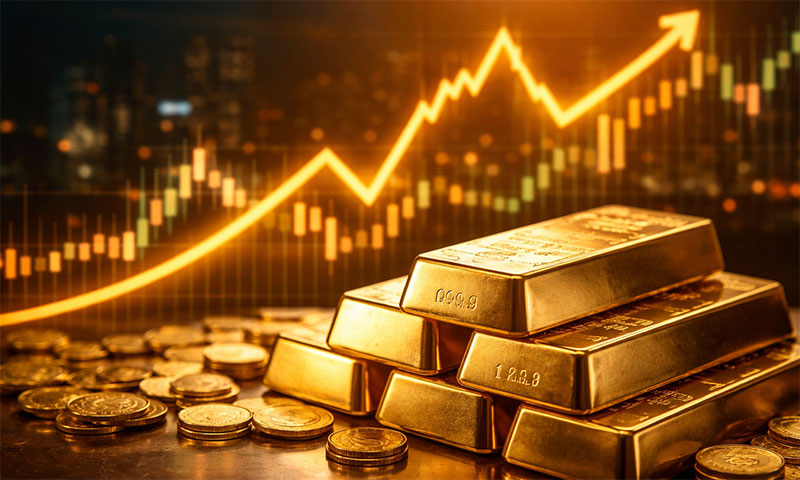
From Safe Haven to Strategic Asset: Gold’s Outlook for 2026 Explained
Gold prices have entered 2026 at record levels, reinforcing the metal’s role as a global safe haven amid persistent geopolitical uncertainty, shifting monetary policy expectations, and strong institutional demand. Market analysts and major financial institutions broadly agree that gold still has room to rise this year, though they caution that volatility is likely to remain a defining feature of the market. Spot gold climbed above $4,600 per ounce in January, extending a powerful rally from 2025. The surge has pushed several leading banks to revise their forecasts, with some now projecting that gold could approach — or even breach — the $5,000 per ounce mark before the end of 2026. Where gold prices could head Among the most optimistic forecasts, J.P. Morgan expects gold prices to average around $5,055 per ounce by the fourth quarter of 2026, citing sustained investor demand and supportive macroeconomic conditions. HSBC has also stated that gold could reach $5,000 per ounce in the first half of 2026, though it warns that price swings may be sharp and frequent, with a wide trading range likely throughout the year. Meanwhile, Morgan Stanley projects gold prices to rise toward $4,800 per ounce by late 2026, supported by easing global monetary conditions and continued buying from central banks. While forecast levels vary, the overall consensus suggests that prices are likely to remain elevated through most of the year, with further upside possible if current trends persist. Key drivers behind the rally Analysts point to several interconnected factors driving gold’s strength: First, geopolitical and political uncertainty continues to boost safe-haven demand. Ongoing conflicts, fragile regional stability, and election-related risks in major economies have encouraged investors to seek protection in gold. Second, interest rate expectations remain a crucial driver. Anticipation that major central banks — particularly the U.S. Federal Reserve — may cut interest rates later in the year has lowered the opportunity cost of holding non-yielding assets like gold, making the metal more attractive. Third, central bank demand has provided a strong structural support. Many central banks, especially in emerging markets, have continued to add gold to their reserves as part of long-term diversification strategies, reinforcing demand even at high price levels. Finally, investment flows, including inflows into gold-backed exchange-traded funds (ETFs), have added momentum to the rally. Institutional investors have increasingly treated gold as a strategic hedge rather than a short-term trade. How long can the rally last? Based on current forecasts, analysts believe gold could continue to show strength through most of 2026, with key price milestones potentially reached in the first or second half of the year. However, few expect a straight upward move. Several institutions caution that price corrections are possible, particularly if geopolitical tensions ease, inflation proves more persistent than expected, or central banks delay or scale back rate cuts. A stronger U.S. dollar could also weigh on prices by making gold more expensive for non-U.S. buyers. Despite these risks, gold’s overall outlook for 2026 remains constructive. With prices already at historic highs and multiple global banks projecting further gains, gold is likely to retain its appeal as a hedge against uncertainty and financial market stress. While the pace of gains may slow and volatility may increase, analysts broadly agree that gold is expected to remain well supported throughout 2026, with the possibility of new record levels if global economic and political risks intensify.
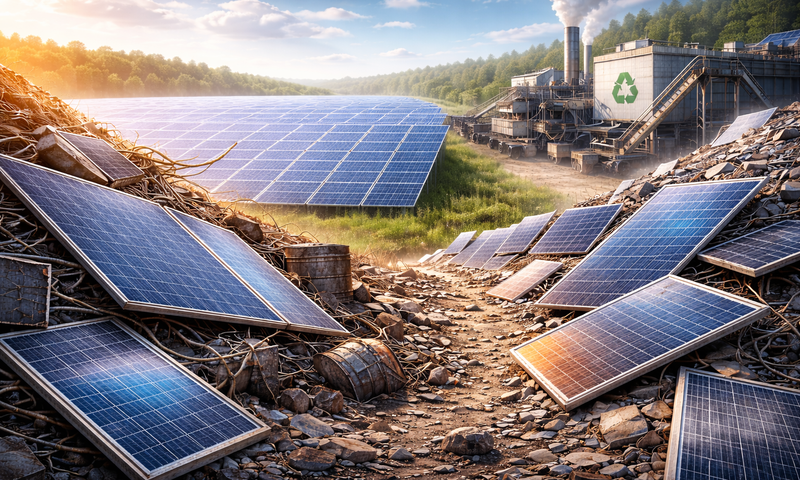
Solar Boom Today, Waste Crisis Tomorrow? The Hidden Challenge of Solar Panels
The global shift toward solar energy is accelerating at an unprecedented pace — and Pakistan is no exception. Rising electricity prices, frequent power outages, and falling solar panel costs have pushed households, businesses and industries across the country to embrace rooftop and utility-scale solar power. For millions, solar energy has delivered cheaper, uninterrupted electricity and relief from the national grid. However, experts warn that behind this clean-energy success story lies a slow-building environmental challenge: solar panels do not last forever. Solar panels are not lifetime assets Most solar panels have an operational lifespan of 25 to 30 years. After that, their efficiency drops sharply, making them uneconomical to use. While today’s installations are still relatively new, the first wave of large-scale solar panels installed globally is already approaching retirement. International energy and environmental agencies caution that once these panels reach end-of-life, they become complex electronic waste — bulky, difficult to recycle, and potentially hazardous if dumped improperly. According to global energy assessments, millions of tonnes of solar panel waste are expected to accumulate worldwide over the next two decades. Countries that adopted solar early, including parts of Europe, the United States and East Asia, are already beginning to face disposal and recycling challenges. Why solar panel waste is difficult to manage Solar panels are made from glass, aluminium frames, silicon cells, plastics, and trace amounts of toxic materials such as lead and cadmium. While much of the material is recyclable, the process is neither simple nor cheap. Unlike conventional scrap, solar panels require specialised facilities to safely separate and process their components. Without proper recycling systems, panels risk ending up in landfills, where broken glass and toxic substances can contaminate soil and groundwater. Environmental analysts warn that if unmanaged, today’s green solution could become tomorrow’s e-waste crisis. Pakistan’s growing risk Pakistan’s solar market has expanded rapidly in recent years, with imported panels flooding the market and rooftop systems multiplying across urban and rural areas. Yet, there is currently no comprehensive national policy to handle solar panel waste once these systems reach the end of their life. Experts say Pakistan risks repeating the mistakes seen with plastic waste and electronic scrap, where lack of planning led to environmental and health hazards. Given the scale of current installations, the country could face thousands of tonnes of retired panels in the coming decades. The global response: recycling and regulation Some countries have already started addressing the issue. In parts of the European Union, solar panels are legally classified as electronic waste, making manufacturers responsible for collection and recycling. Dedicated recycling plants can now recover up to 90 percent of panel materials, including glass and aluminium, and reuse silicon for new panels. Researchers are also developing next-generation panels that are easier to recycle and use fewer toxic components. Others are exploring circular economy models, where old panels are refurbished, repurposed, or broken down into raw materials for reuse. In Germany, one of Europe’s largest solar markets, solar panels have been covered under the WEEE framework since 2014. Panel producers must register with a national waste authority and participate in approved recycling schemes. Germany now operates specialised facilities that can recover: Glass and aluminium frames Silicon from solar cells Other reusable materials Recycling rates for solar panels in Germany can exceed 85–90 percent by weight, according to industry and regulatory data. What can be done in Pakistan Energy and environmental experts argue that Pakistan still has time to act — but only if planning begins now. Key recommendations include: Introducing solar waste regulations alongside renewable energy policies Encouraging producer responsibility, making importers and manufacturers part of recycling solutions Investing in local solar recycling facilities Promoting research into panel reuse and second-life applications Raising public awareness that solar panels are not permanent assets A choice before the crisis Solar energy remains a vital tool in reducing carbon emissions and easing Pakistan’s energy crisis. But specialists stress that sustainability does not end at installation. Without foresight, the panels powering homes today could become an environmental burden tomorrow. With proper policy, technology, and regulation, however, solar waste can be transformed into a managed resource rather than a looming crisis.
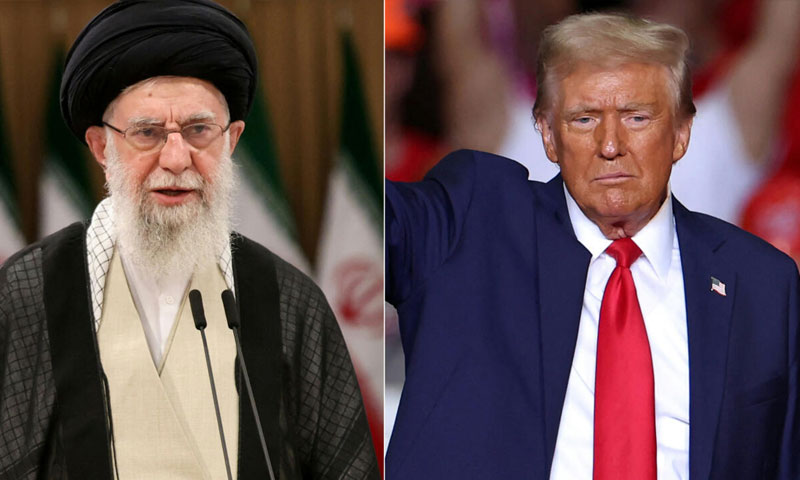
Khamenei Blames Iran Unrest on US Influence, Warns of Tougher Crackdown
Iran’s Supreme Leader Ayatollah Ali Khamenei on Friday signalled a harder line against ongoing anti-government protests, accusing demonstrators of acting in the interests of foreign powers — particularly the United States — as unrest persisted across several Iranian cities under a sweeping communications blackout. In a short address broadcast on state television, the 86-year-old leader said some protesters were “destroying their own streets to please the president of another country,” a clear reference to Donald Trump. Responding to chants of “Death to America” from the audience, Khamenei warned that the Islamic Republic would not tolerate individuals he described as “mercenaries” working on behalf of external forces. Khamenei also lashed out at Trump directly, urging him to focus on domestic challenges in the United States rather than commenting on Iran’s internal affairs. Iranian officials have repeatedly accused Washington, Israel, and their allies of encouraging instability inside the country. Defiant Rhetoric and Historical Warnings Striking a defiant tone, Khamenei dismissed what he described as threats from Trump, drawing comparisons with historical figures he said were removed from power despite their dominance. He named Pharaoh, Nimrod, Reza Khan, and Mohammad Reza Pahlavi as examples of rulers who, he claimed, fell at the height of their authority — adding that Trump would meet a similar fate. The remarks underscored the leadership’s determination to frame the unrest as a foreign-backed plot rather than a domestic uprising. Protests Continue Despite Blackout The true scale of the demonstrations remains difficult to verify due to extensive internet shutdowns and restrictions on international phone services. However, the unrest is widely seen as the most serious challenge to Iran’s leadership in several years. The protests began on December 28 over rising prices, unemployment, and economic hardship. Since then, they have evolved into broader expressions of political anger, with demonstrators openly challenging the ruling system. Exiled Royal Figure Reappears in Public Discourse The protests have also revived debate over the influence of exiled crown prince Reza Pahlavi, who has urged Iranians to sustain demonstrations. Some rallies reportedly featured chants supporting the former shah — a taboo act in the past that once carried severe punishment — highlighting the depth of public frustration. Scenes of Unrest and Official Response Short video clips shared by activists online showed crowds chanting anti-government slogans around bonfires, with debris scattered across streets in Tehran and other cities. State media later acknowledged the unrest but blamed what it called “terrorist elements” linked to the US and Israel for setting fires and inciting violence, reporting casualties without providing details. Despite official warnings and an increased security presence, protesters were reported to have continued marching into Friday morning, defying authorities as international scrutiny of Iran’s response intensified.
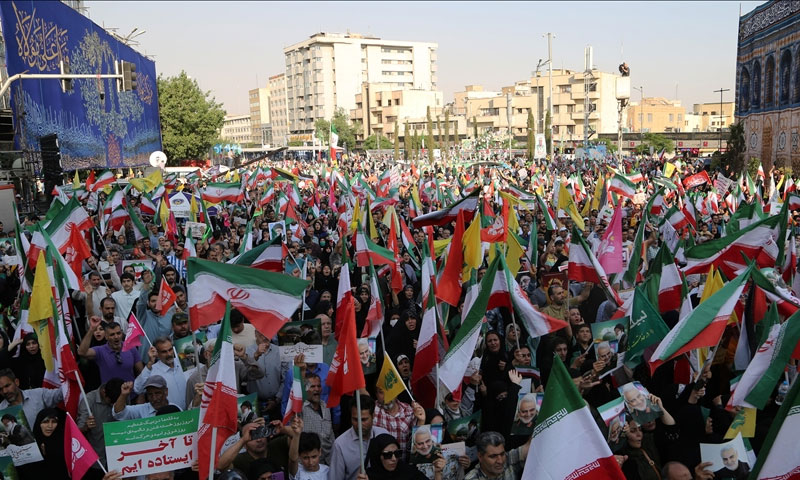
At Least Six Dead as Cost-of-Living Protests Spread Across Iran
At least six people have been killed as demonstrations against soaring living costs widened across Iran, according to Iranian media and officials. The deadliest incident was reported in the city of Azna, in Lorestan province, where clashes during protests left at least three people dead and 17 others injured, the semiofficial Fars News Agency said on Thursday. Azna lies about 300 kilometres southwest of Tehran. Videos circulating online from the area appeared to show fires burning in the streets and the sound of gunfire as protesters chanted slogans accusing officials of being “shameless”. Earlier reports said two people were killed during demonstrations in Lordegan, a city in Chaharmahal and Bakhtiari province, around 470 kilometres south of the capital. According to Fars, some protesters threw stones at government buildings, banks and a mosque, prompting police to respond with tear gas. State television also reported that a member of the security forces was killed overnight in the western city of Kouhdasht. Officials said the 21-year-old belonged to the Basij, a paramilitary force linked to the Islamic Revolutionary Guard Corps. The unrest follows a wave of anger over a sharp fall in Iran’s currency and rapidly rising prices. Shopkeepers began protesting earlier this week, with demonstrations later spreading to Tehran and other major cities. Students from at least 10 universities joined the protests on Tuesday, giving the movement fresh momentum. Iran’s economy has been under severe strain, with inflation hovering around 40 percent amid long-standing Western sanctions. Tensions have been further heightened after recent air strikes by Israel and the United States targeted Iran’s nuclear facilities and senior military figures. President Masoud Pezeshkian has attempted to defuse the situation by acknowledging protesters’ grievances. Speaking on state television, he said people’s demands over livelihoods were legitimate and urged the government to act quickly to ease economic pressure. Government spokesperson Fatemeh Mohajerani said authorities would hold direct talks with representatives of trade unions and merchants, though no timetable was announced. At the same time, officials warned that any attempt to turn economic protests into violence or sabotage would be met with a firm legal response. Iran last witnessed mass nationwide demonstrations in 2022 and 2023 following the death of Mahsa Amini, who died in police custody after being arrested for allegedly violating the country’s dress code. While the current protests began peacefully, the growing death toll underscores the volatility of public anger over Iran’s deepening economic crisis.

XPENG Enters Pakistan: Official Prices Revealed for G6 SUV and X9 Electric MPV
Pakistan’s electric vehicle landscape continues to expand as Tesla Industries, the group behind brands like GuGo GiGi and the recently introduced AION UT and AION V, has officially launched XPENG in the local market. The Chinese EV manufacturer has entered Pakistan with two all-electric models: the XPENG G6 SUV and the XPENG X9 MPV. The official prices were announced during the PakWheels New Wheels Expo, marking XPENG’s first formal step into the country’s rapidly growing EV segment. The XPENG G6 will be offered in three variants to cater to different performance and range preferences. The rear-wheel-drive Standard Range version has been priced at Rs. 14.5 million, while the Rear-Wheel-Drive Long Range variant comes in at Rs. 15.5 million. For buyers seeking higher performance, the All-Wheel-Drive Performance variant is priced at Rs. 18.5 million. All prices are ex-factory. To make ownership more flexible, Tesla Industries has introduced two booking and delivery plans for the G6. Customers opting for a faster 45-day delivery will need to pay 40 percent of the vehicle’s price upfront, whereas those choosing a 90-day delivery option can secure their booking with a 20 percent payment. Alongside the G6, the company has also introduced the XPENG X9, a fully electric premium MPV aimed at buyers looking for space, comfort, and long-range capability. The X9 will be available in a single top-spec variant, the Long Range 2WD Pro+, with an ex-factory price of Rs. 28.5 million. The booking structure for the XPENG X9 mirrors that of the G6, with 40 percent required for 45-day delivery and 20 percent for 90-day delivery. Tesla Industries has noted that the announced prices are introductory and may be revised in the future, depending on market conditions and demand. With this launch, XPENG becomes one of the latest global EV brands to enter Pakistan, further intensifying competition and offering consumers more premium electric mobility options than ever before.
