
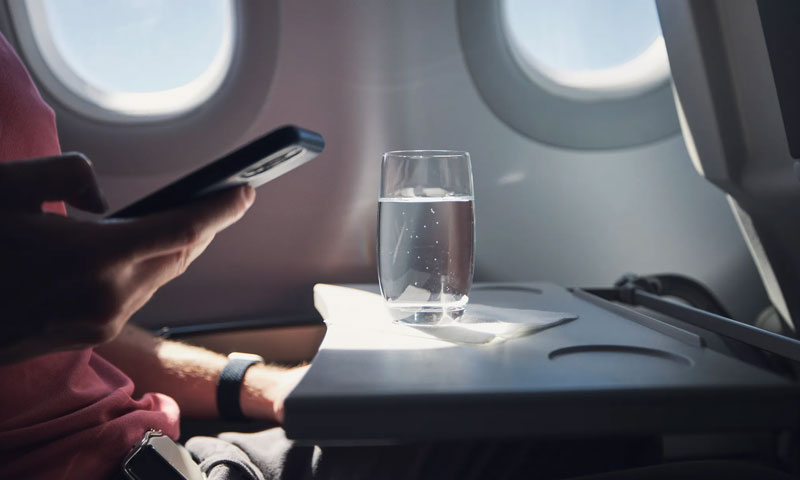
Airline passengers may want to rethink what they drink on board. A new study has warned that water served on many flights could be potentially unhealthy, prompting researchers to advise travelers to stick to bottled water and avoid coffee or tea prepared using aircraft water systems. The findings come from the Center for Food as Medicine & Longevity, which analyzed more than 35,000 water samples collected from 10 major and 11 regional airlines over a three-year period. Based on the results, the nonprofit also recommends avoiding washing hands with airplane tap water and instead using hand sanitizer with at least 60% alcohol. While water quality may not rank high among passengers’ safety concerns, the organization described it as an important public health issue. Drinking contaminated aircraft water, it warned, can lead to gastrointestinal illness and potential exposure to harmful pathogens. What the study found The analysis showed that 2.7% of samples tested positive for total coliform bacteria, an indicator that disease-causing organisms may be present in the water system. More alarmingly, E. coli was detected 32 times across the 21 airlines reviewed. “Testing for coliform bacteria is critical because its presence suggests that pathogens could enter the drinking water supply,” the group said. In the United States, onboard water systems are regulated under the Environmental Protection Agency’s Aircraft Drinking Water Rule (ADWR), introduced in 2011. The rule requires airlines to regularly test water, flush and disinfect tanks multiple times a year, and monitor for contamination. However, the study noted that enforcement is inconsistent and penalties for violations are rarely imposed. Airlines respond Several airlines pushed back against the findings. American Airlines said it is reviewing the study but stressed that its potable water program complies fully with EPA rules and has passed recent audits without violations. JetBlue Airways said it follows EPA, FDA, and FAA standards and primarily serves bottled drinking water onboard.Spirit Airlines said it maintains a comprehensive testing and maintenance program and has improved procedures in recent years. Industry group Airlines for America said passenger and crew safety remains the sector’s top priority, adding that U.S. airlines follow federal guidelines to ensure onboard water safety. Major airlines ranked: best to worst The study scored airlines on a five-point scale, with points deducted for violations such as detecting contaminants in water samples. Delta Air Lines — 5.00 (Grade A) Frontier Airlines — 4.80 (Grade A) Alaska Airlines — 3.85 (Grade B) Allegiant Air — 3.65 (Grade B) Southwest Airlines — 3.30 (Grade C) Hawaiian Airlines — 3.15 (Grade C) United Airlines — 2.70 (Grade C) Spirit Airlines — 2.05 (Grade D) JetBlue Airways — 1.80 (Grade D) American Airlines — 1.75 (Grade D) Regional airlines ranked: best to worst GoJet Airlines — 3.85 (Grade B) Piedmont Airlines — 3.05 (Grade C) Sun Country Airlines — 3.00 (Grade C) Endeavor Air — 2.95 (Grade C) SkyWest Airlines — 2.40 (Grade D) Envoy Air — 2.30 (Grade D) PSA Airlines — 2.25 (Grade D) Air Wisconsin — 2.15 (Grade D) Republic Airways — 2.05 (Grade D) CommuteAir — 1.60 (Grade D) Mesa Airlines — 1.35 (Grade F) What passengers should do Until oversight improves, researchers advise travelers to avoid aircraft tap water entirely—including coffee and tea—and rely on sealed bottled beverages. For hygiene, alcohol-based hand sanitizer is considered safer than washing hands with onboard water. The study concludes that while many airlines meet basic regulatory requirements, stronger enforcement and greater transparency are needed to ensure that something as simple as a glass of water at 35,000 feet does not pose a health risk.
Toyota Launches Shockingly Affordable Electric Sedan in China — Here’s What Makes It Special
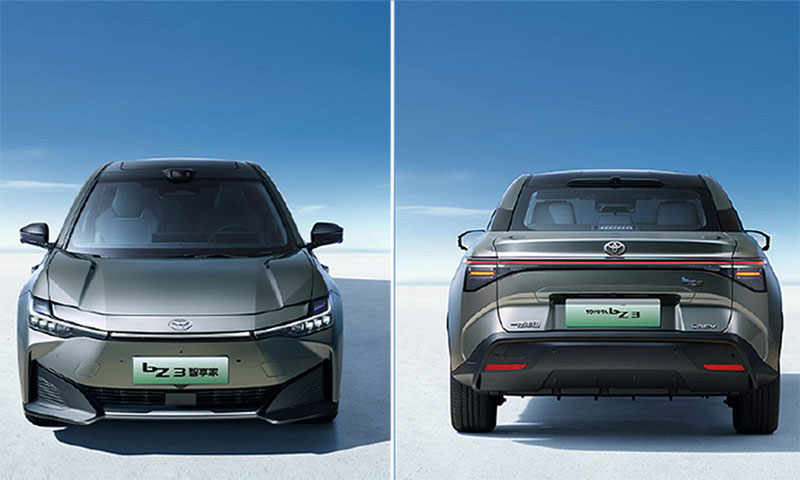
Toyota has taken a bold step in the electric vehicle race by launching the bZ3 Smart Home Edition in China—an electric sedan that is turning heads primarily because of its unexpectedly low price. The new model is priced from 109,800 yuan (roughly Rp262 million), positioning it as one of the most affordable electric sedans in its class. The bZ3 is the result of Toyota’s partnership with China’s FAW Group and has been developed exclusively for the Chinese market. Originally introduced in 2022 and refreshed in 2024, the Smart Home Edition represents the most advanced and cost-competitive version of the bZ3 so far. Two variants, aggressive pricing Toyota is offering the bZ3 Smart Home Edition in two variants. The Joy version starts at 109,800 yuan, while the more powerful Pro variant is priced at 129,800 yuan (around Rp309 million). At this price point, industry observers note that if the bZ3 were sold in the United States, it could easily undercut every new electric car currently on sale there—especially as the sub-$20,000 new car segment has nearly disappeared. For comparison, Nissan recently discontinued the Versa, once the cheapest new car in the US at $18,330, while Mitsubishi ended production of the Mirage in late 2024. Advanced tech at a budget price Despite its affordability, the bZ3 Smart Home Edition comes packed with technology. It features the Momenta 5.0 driving assistance system, offering Level 2 autonomous capabilities. To support this, Toyota has equipped the car with 32 sensors, including a roof-mounted LiDAR unit, millimeter-wave radars, ultrasonic sensors, and multiple cameras. These are powered by a high-performance computing chip delivering up to 544 TOPS of processing power. Design, dimensions, and performance Visually, the bZ3 has been refreshed with Toyota’s latest “hammerhead” front-end design, while the rear now features vertical taillights instead of the earlier horizontal layout. A new exterior color, Dark Cloud Green, has also been added. Dimensionally, the car remains unchanged, measuring 4,725 mm in length, 1,835 mm in width, and 1,475 mm in height, with a 2,880 mm wheelbase—typical proportions for a modern electric sedan. The Joy variant uses a front-mounted electric motor producing 181 horsepower, paired with a 49.9 kWh lithium iron phosphate Blade battery supplied by BYD, offering a claimed range of 517 km under Chinese testing standards. The Pro version steps up to 241 horsepower and a larger 65.3 kWh battery, extending the range to 616 km on a single charge. Cabin and launch timeline Inside, the bZ3 Smart Home Edition offers a futuristic cabin featuring a 15.6-inch horizontal touchscreen, an additional 12.8-inch display, a digital instrument cluster, ambient lighting, and an AI-powered voice assistant. Toyota says the model will soon enter mass production, with sales to begin in China in the first quarter of 2026. With its aggressive pricing, long range, and advanced technology, the bZ3 Smart Home Edition signals how serious Toyota has become about making electric cars affordable—at least in China.
