
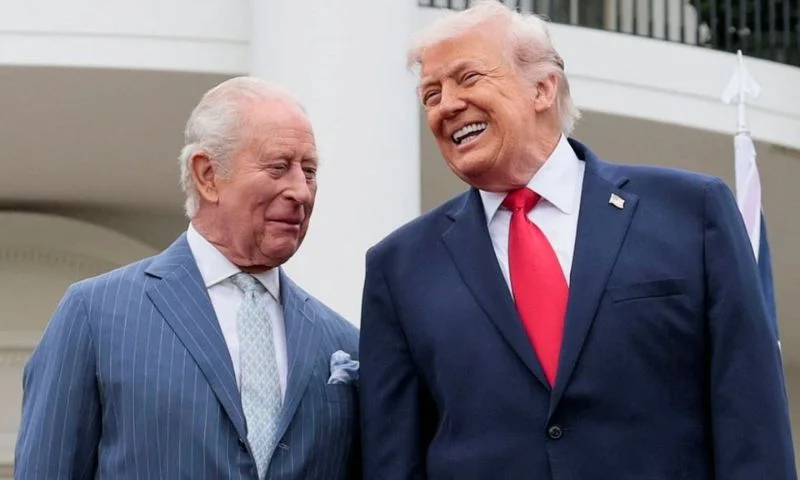
King Charles jokes about Trump at White House dinner during a high-profile state visit, as the British monarch used humor to reference past comments by Donald Trump and underline the long-standing alliance between the United States and the United Kingdom. Speaking at a formal dinner in the East Room of the White House on April 28, King Charles III responded to Trump’s earlier remarks about World War II. “You recently commented, Mr. President, that if it were not for the United States, European countries would be speaking German,” Charles said. He added, “Dare I say that, if it wasn’t for us, you’d be speaking French.” The comment drew laughter from the audience and echoed Trump’s statement at the Davos summit in January, where he said that without US help in World War II, “you’d be speaking German and a little Japanese.” Read More: “He’s So Cute”: Trump Says His Mother Had a Crush on King Charles Jokes reflect history and diplomacy Charles framed his remarks within a historical context, referring to British and French colonial influence in North America before US independence. Britain and France competed for control of the continent, shaping early cultural and linguistic influences. The monarch continued with further lighthearted references. He joked about renovations at the White House, noting recent structural changes linked to Trump’s plans for a $400 million ballroom. “I am sorry to say that we British, of course, made our own attempt at real estate redevelopment of the White House in 1814,” Charles said, referencing the burning of the building by British troops during the War of 1812. He also described the evening as “a very considerable improvement on the Boston Tea Party,” referring to the 1773 protest that became a defining moment in American history. Despite the humor, the tone of the evening emphasized the “special relationship” between London and Washington. Both sides highlighted shared history and cooperation, even as tensions persist over issues such as Iran. Gift and political undertones Charles presented Trump with a symbolic gift during the dinner. He handed over the bell from the British submarine HMS Trump, which was launched in 1944 during World War II. “May it stand as a testimony to our nations’ shared history and shining future,” Charles said. He added, “And should you ever need to get hold of us, well, just give us a ring.” Trump responded with his own remarks, praising the monarch’s earlier speech to Congress. “I want to congratulate Charles on having made a fantastic speech today at Congress,” he said. “He got the Democrats to stand – I’ve never been able to do that.” The exchange took place against a backdrop of geopolitical tension, particularly over the conflict involving Iran. Trump has criticized European allies in recent months, including British Prime Minister Keir Starmer, over defense cooperation. Analysts say the humor displayed at the dinner served a diplomatic purpose. It reinforced personal rapport while signaling continuity in US-UK relations. The evening combined symbolism, history, and politics, illustrating how ceremonial events often carry deeper strategic meaning. The exchange between Charles and Trump captured global attention, blending wit with diplomacy at a moment of international focus.
“He’s So Cute”: Trump Says His Mother Had a Crush on King Charles
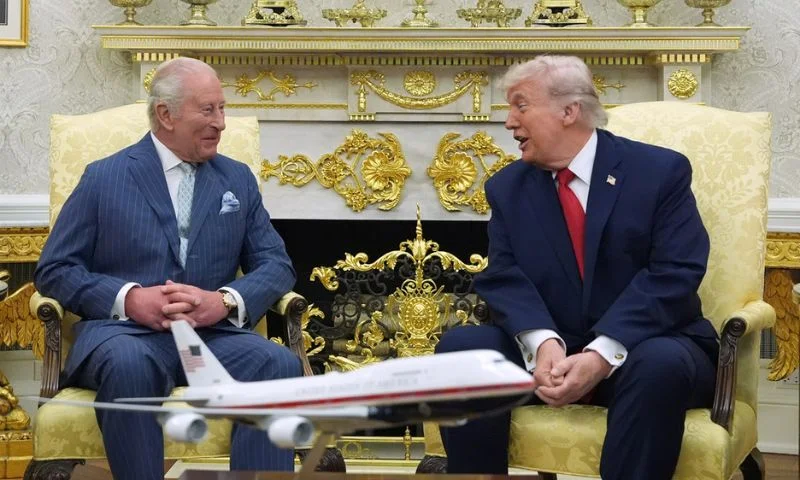
Trump recalls mother crush on King Charles during a formal welcome ceremony at the White House, where Donald Trump shared a personal story about his Scottish-born mother while hosting King Charles III and Queen Camilla. Speaking on the South Lawn on Tuesday, Trump said his late mother, Mary Anne MacLeod, “loved the royal family” and closely followed appearances by Queen Elizabeth II. “Any time the Queen was involved in the ceremony or anything, my mother would be glued to the television,” Trump said. He added that she would often remark, “Look, Donald, how beautiful that is.” Recalling her reaction to a younger Prince Charles, Trump said, “I also remember her saying, very clearly, ‘Charles, look, young Charles. He’s so cute’.” He then told the audience, “My mother, my mother, had a crush on Charles. Can you believe it? Amazing.” Read More: New Epstein Revelations Draw Rare Royal Response From Prince William, Kate Ceremony Marks Royal Visit and Personal Reflection Trump made the remarks while welcoming the British monarch and Queen Camilla during their official state visit to the United States. The event formed part of a broader diplomatic engagement between Washington and London. During his speech, Trump also spoke about his family background. He noted that his mother was born in Stornoway in Scotland’s Outer Hebrides and moved to the United States at the age of 19. The US president used the occasion to pay tribute to Queen Elizabeth II, who died in 2022. He described her as a “very, very special woman who is very greatly missed on both sides of that mighty Atlantic.” Observers said the anecdote added a personal tone to a ceremony that otherwise focused on diplomatic ties. The British royal family has long held symbolic significance in US-UK relations, often featuring in state visits and public events. Read More: New Passport Design in US to Include Trump Picture Political Remarks Surface During Speech Trump also briefly shifted to foreign policy during his address. He referred to tensions involving Iran and said the issue had been discussed in the context of ongoing diplomatic engagement. “We’re doing a little Middle East work right now,” Trump said, adding, “we’re doing very well.” He went on to claim that both he and King Charles shared concerns about Iran’s nuclear ambitions. “We’re never going to let that opponent have a nuclear weapon,” he said, adding, “Charles agrees with me even more than I do.” The comment introduced a political dimension to the ceremony, highlighting ongoing geopolitical discussions between allies. Despite that, Trump’s remarks about his mother remained the most widely shared moment from the event. Clips of the anecdote circulated quickly online, drawing attention for their informal tone during an otherwise formal occasion. The story underscores how personal narratives can intersect with diplomacy, especially when involving globally recognized figures such as the British monarch.
