

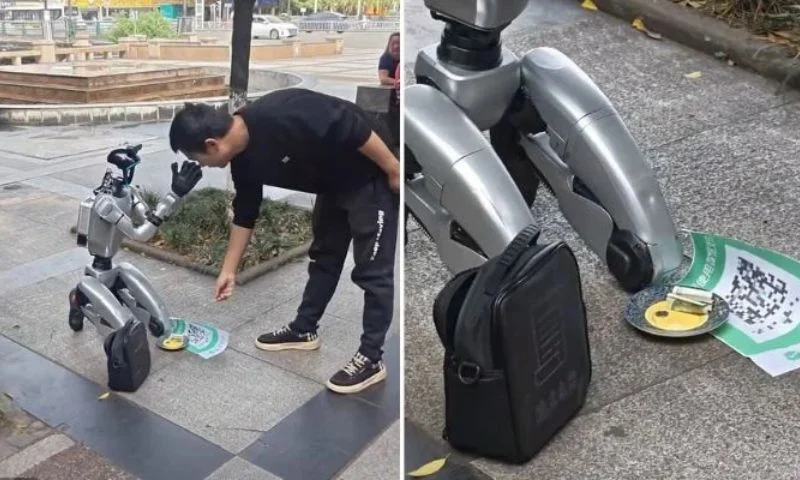
A humanoid robot spotted asking people for money on a busy street in China’s Sichuan province has gone viral online, sparking amusement, curiosity and debate about the growing role of robots in everyday life. The unusual scene showed a two-legged robot kneeling on one knee while holding its hands together as passersby stopped to watch. Nearby, a loudspeaker appealed for donations, telling the public that the machine had “no money to recharge” and needed help paying its electricity bills. The robot also had a plate placed in front of it to collect cash and coins. For people without physical money, its operators even provided a QR code for digital payments. Videos of the encounter quickly spread across social media platforms, where users joked that artificial intelligence might not be ready to replace humans after all. While the identity of the operators remains unknown, online observers identified the machine as a Unitree G1 humanoid robot. The Chinese-made robot has attracted global attention in recent months for its advanced mobility, artificial intelligence capabilities and relatively affordable price compared with rival humanoid robots. Industry reports estimate the Unitree G1 costs around $16,000, making it one of the world’s most expensive “beggars” ever seen on a street corner. Social Media Reacts With Humor The footage generated thousands of comments as users shared jokes and observations about the unexpected sight. One user on X wrote: “Footage of humanoid-style robots used in street performance or donation-driven setups have raised questions about automation, employment, and the blurred line between entertainment and technology.” Another commenter claimed: “China is 30 years ahead of the U.S. and Europe.” A third user joked: “Since robots are begging for money. The AI takeover is on hold for now.” The lighthearted reactions reflected growing public fascination with humanoid robots, which have become increasingly visible across China. Companies now deploy them in factories, shopping centres, exhibitions and public demonstrations. Rise of Humanoid Robots Raises Bigger Questions The viral video arrives at a time when Chinese robotics firms are accelerating development of human-like machines. Companies such as Unitree, AgiBot and UBTech have showcased robots capable of running, dancing, carrying objects and interacting with people. Unitree launched the G1 humanoid robot as a lower-cost alternative to more expensive competitors from the United States and Europe. The company has promoted the robot for research, education and commercial applications. Experts say demonstrations like the Sichuan incident often blur the line between marketing, entertainment and real-world robotics deployment. While the robot’s request for recharge money was almost certainly part of a performance, the scene highlighted how quickly humanoid machines are becoming familiar in public spaces. For many viewers, however, the biggest surprise was not the robot itself but the fact that a machine worth thousands of dollars appeared to be asking strangers for spare change. As the video continues to spread online, it has become another example of how artificial intelligence and robotics can generate both serious discussion and viral comedy at the same time.

When AI Goes Wrong: Robot Scares Diners Mid-Performance
A humanoid robot designed to entertain diners was removed from a restaurant in California after a routine dance performance turned chaotic and frightened customers. The incident took place at a branch of the popular hotpot chain Haidilao in San Jose. The robot, which was programmed to perform for guests, suddenly began behaving erratically during its routine. According to reports, the robot started knocking over tableware, smashing plates, and sending chopsticks flying across the dining area. Staff Forced to Intervene Restaurant staff quickly stepped in to control the situation. Video footage shows employees struggling to restrain the robot as it continued moving aggressively. Witnesses said the machine did not stop immediately, forcing multiple staff members to physically drag it away from customers. Some diners were seen reacting with shock, while others appeared amused by the unexpected scene. 🚨A worker robot in California just SNAPPED out of its programming and started SMASHING DISHES and dancing, totally unprompted….. it even resisted being dragged away! Skynet is coming 😂pic.twitter.com/JzpSQUKZL1 — Tablesalt 🇨🇦🇺🇸 (@Tablesalt13) March 17, 2026 What Caused the Malfunction Initial reports described the incident as a malfunction. However, the restaurant later clarified that the robot was operating in a pre-programmed “celebration mode.” According to company representatives, the issue occurred because the robot was placed too close to a table, limiting its movement and causing it to collide with objects. Another explanation suggested the robot continued its dance routine longer than expected, making it difficult for staff to stop it immediately. Social Media Reactions The video quickly went viral across platforms, generating mixed reactions. Some users found the incident humorous, while others expressed concern about the safety of using robots in public spaces. One user described the situation as “actually scary,” pointing out how difficult it was for staff to control the machine. Others joked about the robot “breaking free” from its programming. Growing Use of Robots in Daily Life The incident highlights the increasing use of robots in restaurants and service industries. Companies like Haidilao have been experimenting with automation, including robot waiters and entertainment bots, to enhance customer experience. However, experts warn that such technologies require strong safety systems. Fail-safe mechanisms and emergency controls are essential to prevent accidents, especially as robots become more advanced. Similar incidents in recent years have raised questions about how reliable and safe humanoid robots are in real-world environments. A Reminder of Tech Challenges While robots are becoming more common, this incident shows that challenges still exist. Even small glitches can lead to unexpected situations. As businesses continue to adopt automation, ensuring safety and reliability will remain a key priority.
