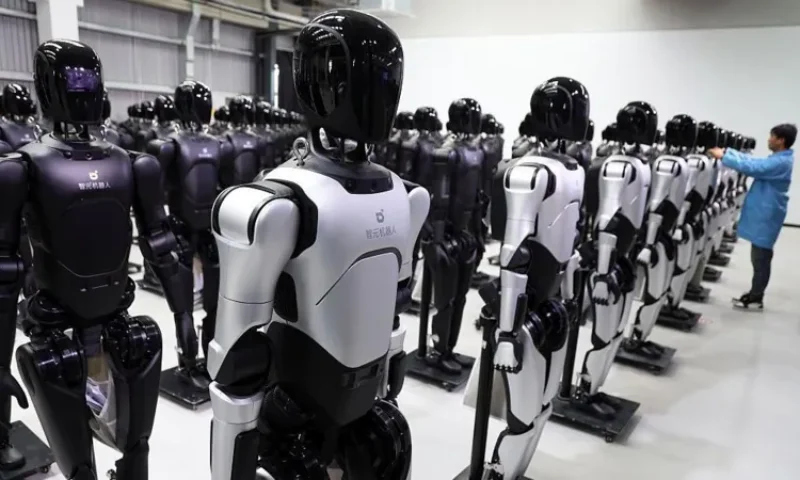
Chinese-made warehouse robots are rapidly becoming part of Britain’s retail infrastructure, helping major companies process online orders faster while raising fresh questions about productivity, labour and the future of work. Geek+, a Chinese warehouse robotics company, now supplies technology used by major UK retailers including Tesco, Asda and Next. More than 2,000 of its robots operate across 10 British warehouse sites through UK partner MotionTech. The squat autonomous machines can travel underneath storage racks, lift entire shelves and carry them directly to workers. Geek+ says this reduces walking, speeds up picking and allows warehouses to use storage space more efficiently. Its systems can also integrate into existing warehouses with relatively limited structural changes. UK retailers turn to flexible warehouse automation Unlike fixed conveyor belts, autonomous mobile robots can work with QR floor markers, software and designated safety areas. This makes deployment faster and allows retailers to change warehouse layouts more easily. “Customers want fast deployable solutions,” MotionTech account director Barry Pemberton said. “They want high volume, high storage, fast picking… ultimately on a smaller footprint with a reduced headcount.” He also pointed to Britain’s labour shortages. Read More: AI Startup Records Every Corner of Homes to Train Future Robots “We seem to have a very big shortage of labour in the UK at the moment. These technologies are really important to keep businesses thriving and meet demand.” Geek+ listed in Hong Kong in July 2025. Industry data cited during its listing ranked it as the world’s largest warehouse fulfilment AMR solutions provider by 2024 revenue. Britain offers significant room for further expansion. An OECD report published in April found that UK companies perform relatively well in mature technologies such as cloud computing. However, adoption drops sharply for advanced technologies including robotics and automation. Workers and unions raise concerns over jobs The Trades Union Congress argues that automation should improve jobs and productivity rather than simply reduce headcount. “Working with technologists, workers and unions can help steer the UK’s research and innovation towards workers’ priorities for automation… avoiding job-cutting, low-productivity automation,” the TUC said. The union movement has also called for greater worker involvement and stronger retraining programmes as companies introduce AI and automation. China, meanwhile, has made robotics a strategic industrial priority. Analysts say its strength in electric vehicles has created overlapping supply chains for batteries, motors, cameras, sensors and semiconductors that robotics companies can also use. XPeng is among the Chinese EV companies expanding into humanoid robots. Founder He Xiaopeng said: “We want XPeng to be a high-tech company. In the future, any car company will transform into a car and robotics company.” Humanoid robots could be the next step Geek+ already wants to move beyond transporting shelves and pallets. “We are working on… end-to-end unmanned warehouse solutions,” Geek+ communications head Yanyu Liu said. That ambition includes automating picking, handling and eventually packing. Chinese companies such as Unitree and AgiBot are also pushing humanoid robots, although current machines still struggle with tasks requiring greater dexterity. China already has a dominant position in global humanoid deployments, while the US recently restricted imports of new foreign-made advanced robots on national security grounds. Read More: Is This the Beginning of the Age of Robot Soldiers? Pemberton expects humanoids to support existing systems rather than replace them. “I don’t think [humanoids] will change the landscape of the types of technology or the automation that’s going to be put into place,” he said. “They’re definitely going to be complementary.” For Britain, pressure to improve productivity and overcome labour shortages is making its warehouses an early testing ground for China’s expanding robotics industry.