

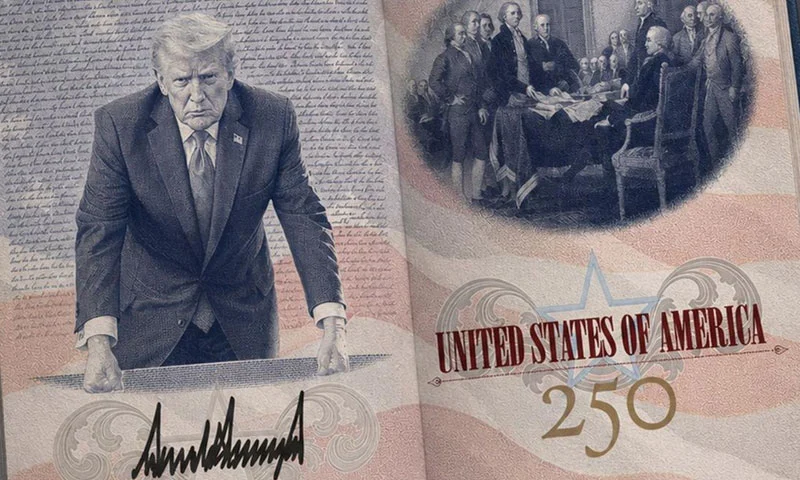
U.S. President Donald Trump has revealed the design of a limited edition commemorative passport that celebrates the 250th anniversary of American independence. The proposed travel document features Trump’s portrait and signature, making it one of the most distinctive passport designs introduced in the country’s history. Trump shared a digital rendering of the passport on his Truth Social platform on Friday, describing it with the message: “The U.S.A.’s New Passport, which says, ‘Welcome, but be good!’” The design combines patriotic imagery with historical references linked to the United States’ founding. One page features Trump’s portrait alongside his signature, while the text of the Declaration of Independence appears in the background. The image resembles an official White House portrait photographed by White House photographer Daniel Torok. Another page displays artwork depicting the signing of the Declaration of Independence in 1776. It also includes the words “United States of America 250,” highlighting the country’s semiquincentennial celebrations. Commemorative Passport The White House also published the passport rendering on social media, referring to it as the “PATRIOT PASSPORT.” The U.S. State Department had previously announced plans to issue a commemorative passport featuring custom artwork beginning on July 6 as part of nationwide celebrations marking the nation’s 250th birthday. PATRIOT PASSPORT. pic.twitter.com/RYvLKloC7d— The White House (@WhiteHouse) June 26, 2026 Officials have indicated that the commemorative edition will be available only in limited quantities. Earlier statements suggested interested applicants would need to visit designated passport facilities in Washington while supplies last. The State Department has not publicly provided additional details about the final design or confirmed whether the rendering shared by Trump reflects the finished product. Part of a Broader Branding Strategy The passport announcement continues Trump’s effort to place a visible personal imprint on government institutions during his presidency. His administration has introduced presidential branding across several official settings. Government buildings have displayed banners featuring the president, while the Treasury Department previously announced plans to place Trump’s signature on the one dollar bill. Trump also sought to associate his name with the John F. Kennedy Center for the Performing Arts. However, a court later ruled that the name should be removed. If released in the form presented, the commemorative passport would mark another symbolic milestone. Trump would become the first sitting U.S. president to appear in an American travel document issued during his time in office. The proposed passport has already generated public discussion online, with supporters describing it as a patriotic tribute to America’s 250th anniversary while critics have questioned the inclusion of a sitting president’s image on an official government document. The commemorative passport forms part of a wider programme of events planned across the United States to mark the country’s historic anniversary in 2026.
Trump’s 80th Birthday UFC Showdown Sparks Political Storm
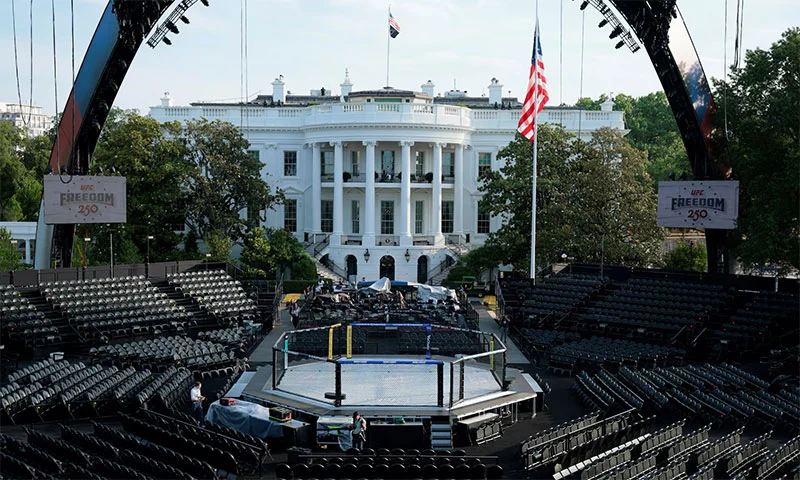
President Donald Trump will celebrate his 80th birthday by hosting an unprecedented Ultimate Fighting Championship (UFC) event on the White House lawn, transforming the historic South Lawn into a giant fighting arena for the $60 million “UFC Freedom 250” tournament. The event, which also forms part of celebrations marking America’s 250th anniversary, has drawn both excitement and criticism across the United States. The event will feature 14 Ultimate Fighting Championship contestants competing inside the iconic Octagon cage. Organizers expect around 4,000 spectators inside the arena. More than 125,000 people could watch from a giant screen on the Ellipse, the public park just outside the White House. Trump has described the event as a unique way to mark the nation’s milestone anniversary. He has repeatedly stressed that UFC is covering the costs of the event, which media reports estimate at around $60 million. Speaking to the New York Post, Trump said: “They’re the roughest people you’ll ever meet. If you haven’t seen it much, you’re not going to believe it.” The president has maintained close ties with UFC President Dana White for years. White was among Trump’s most prominent supporters during recent election campaigns and frequently appeared at campaign events. ‘The Claw’ Becomes Center of Political Debate Preparations have transformed the South Lawn into a major sporting venue. According to organizers, the arena weighs about 600 tons, spans 154 feet across and reaches 92 feet in height. The structure stands taller than parts of the White House itself. The site carries deep historical significance. Former presidents used the same lawn for major diplomatic events, including the signing of the Oslo Accords in 1993 and presidential farewell ceremonies. Critics, however, argue that the event reflects misplaced priorities. The tournament comes as the United States faces economic pressures linked to rising prices and tensions in the Middle East following the conflict with Iran. Several advocacy groups challenged the event in court. They argued that the White House should not host a private sporting spectacle that could benefit the president’s political allies. The administration rejected those claims and defended the event as a public celebration. Secretary of State Marco Rubio strongly backed the initiative. After signing a partnership agreement with UFC aimed at promoting mixed martial arts internationally, Rubio said: “That’s what Sunday is about, it’s a gift to the American people.” He added that the tournament would attract “probably a billion people all over the world.” Trump’s Showmanship on Full Display Political analysts say the event reflects Trump’s long-standing approach to politics and public image. Peter Loge, director of George Washington University’s School of Media, told AFP: “Donald Trump has built a public persona throughout his life by being the Donald Trump show.” “It’s loud, it’s glitzy, it’s glossy, that’s what this is.” Loge said the event projects an image of strength and control during a turbulent period. “It’s gladiators,” he said. “In a time of chaos in the US, it is to say that the US is strength, it is force, and it is in control. There’s fireworks and two guys beating each other up.” Despite speculation that the arena could remain on White House grounds, officials insist it will not become a permanent feature. Joshua Fisher, Director for White House Management and Administration, said in court documents that “The Claw will be disassembled immediately after the event concludes.”
Senate Report Reveals ‘Inexcusable Failures’ in Trump Assassination Attempt
A U.S. Senate investigation has concluded that a series of “inexcusable” and preventable failures by the Secret Service allowed the assassination attempt on Donald Trump during a campaign rally in Pennsylvania, raising serious concerns about the agency’s ability to protect high-profile political figures. The report, issued by the Senate Homeland Security and Governmental Affairs Committee, described the July 2024 shooting as the result of a “cascade of preventable failures” that nearly cost Trump his life. The attack took place during a rally in Butler, Pennsylvania, where Trump was struck in the ear by a bullet. One attendee was killed and two others were injured before the gunman was shot dead by security forces. Read More: Trump Rushed to Safety After Shooting at White House Dinner Security lapses and communication breakdown According to the Senate findings, the incident was not the result of a single mistake but a broader breakdown across multiple layers of security planning and execution. “This was not a single lapse in judgment. It was a complete breakdown of security at every level,” the committee’s chairman Senator Rand Paul said. The report pointed to failures in communication, coordination and response, including the inability to act on direct threats and warnings ahead of the rally. It also highlighted that requests for additional security measures were either delayed or denied, despite an elevated threat environment. Investigators said intelligence about potential risks was not effectively shared among agents and local law enforcement, leaving critical personnel unaware of the threat landscape at the time of the event. The gunman, identified as Thomas Matthew Crooks, managed to access a rooftop outside the secured perimeter and open fire before being neutralised by a Secret Service counter-sniper team. Read More: Serena, Marriott Asked to Vacate as Strong Security Plan Finalised for Key Peace Talks Questions over accountability and reforms The Senate report also criticised the response of the Secret Service after the attack, arguing that disciplinary actions taken against personnel were insufficient given the severity of the failures. “What happened was inexcusable and the consequences imposed for the failures so far do not reflect the severity of the situation,” the report said. Six agents were suspended for periods ranging from 10 to 42 days, but no one was dismissed, prompting criticism from lawmakers who called for stronger accountability. Then-director Kimberly Cheatle resigned shortly after the incident amid mounting political pressure, while the agency pledged reforms to address operational shortcomings. Trump, who survived the attack with a minor ear injury, later said “mistakes were made” but expressed satisfaction with the investigation. Security experts say the incident represents one of the most serious lapses in U.S. presidential protection in decades and underscores the need for structural reforms within the Secret Service. The Senate inquiry, based on interviews and extensive document reviews, concluded that systemic negligence, poor coordination and a lack of urgency contributed to a situation that could have been prevented. Read More: Trump Health Speculation Explodes After Sudden Disappearance, White House Responds
Trump Rushed to Safety After Shooting at White House Dinner
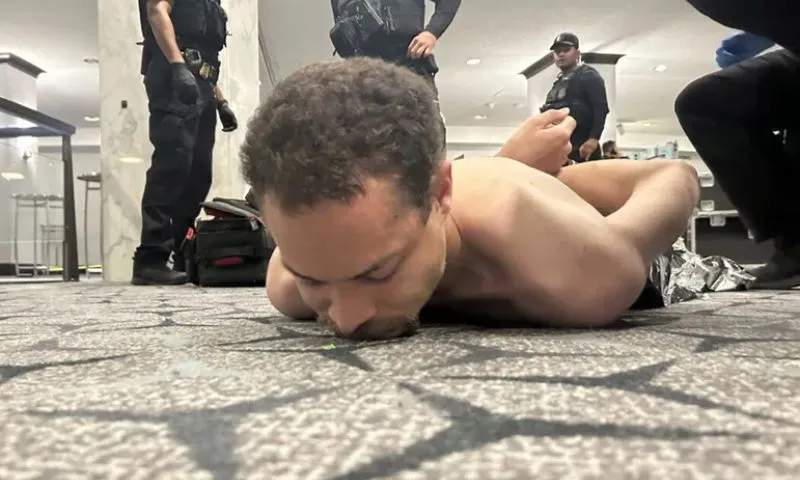
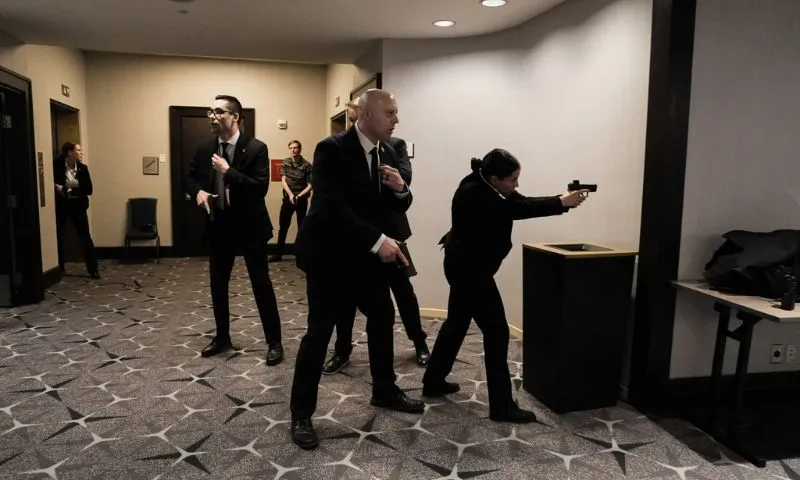
U.S. President Donald Trump was safely evacuated after a shooting incident disrupted the annual White House Correspondents’ Dinner in Washington, triggering panic among thousands of attendees and prompting an immediate security response. The incident unfolded late Saturday at the Washington Hilton hotel, where a gunman attempted to breach a security checkpoint and opened fire near the entrance to the high-profile event, according to officials and law enforcement sources. A suspect armed with a shotgun, handgun and knives was quickly apprehended by Secret Service personnel and is now in custody, authorities confirmed. Chaos at high-profile event Witnesses described scenes of confusion and fear as gunshots rang out, with hundreds of guests taking cover under tables while security agents rushed into the ballroom. Attendees were heard shouting “Get down, get down!” as law enforcement moved swiftly to secure the venue and evacuate key officials. President Trump and First Lady Melania Trump were escorted off stage by Secret Service agents, along with senior members of the administration including cabinet officials and the vice president. Officials said a Secret Service agent was struck by gunfire but was protected by a bulletproof vest and did not suffer serious injuries. The dinner, attended by around 2,600 guests including journalists, politicians and celebrities, was ultimately cancelled following the incident. Read More: America on the Streets: Why Rising Protests Are Testing Trump’s Grip on the Presidency Investigation underway Authorities said the suspect is believed to have acted alone, though investigations are ongoing to determine motive and any possible connections. President Trump later confirmed the situation was under control, writing that a “shooter had been apprehended” and praising the swift response of security forces. “Quite an evening in D.C. Secret Service and Law Enforcement did a fantastic job,” he said. In a subsequent briefing, officials said the suspect faces multiple charges, including assault on a federal officer and firearms violations, with further charges under consideration. The White House Correspondents’ Dinner, a longstanding tradition celebrating the relationship between the presidency and the press, has rarely faced such security threats. The incident has raised fresh concerns about safety protocols at major public events attended by top political leaders. Analysts say the attack underscores the persistent risks facing public officials in the United States, particularly in a politically charged environment where high-profile gatherings can become potential targets. Despite the disruption, officials indicated the event may be rescheduled in the coming weeks once security reviews are completed. Read More: A Timeline of contradictions: Trump’s Most Confusing War Comments Against Iran
