

US President Donald Trump’s approval rating has fallen to 33%, the lowest level of his presidency, as concerns grow over the Iran war and rising gasoline prices. The four-day Reuters/Ipsos survey found that 64% of Americans disapprove of Trump’s performance in the White House. His approval rating fell from 35% earlier in August and now matches the lowest point of his first presidential term in December 2017. Trump returned to the White House in 2025 with approval from just under half of Americans. His ratings have since weakened as the Iran conflict has dragged on and disrupted global energy markets. Americans expect prolonged Iran conflict The poll found widespread doubts that US involvement in Iran will end soon. Around 80% of Americans believe US involvement “will go on for an extended period of time.” That includes 87% of Democrats and 71% of Republicans. Only 16% expect the conflict to end within a few weeks. Trump initially suggested the conflict could last only weeks. However, Iran has continued to restrict oil traffic through the Strait of Hormuz. Read More: Birth Tourism Banned as Trump Signs Fresh Citizenship Orders The disruption has affected roughly one-fifth of global oil trade and pushed fuel prices higher. It has also increased financial pressure on American households ahead of the November 3 midterm elections. Only about one in five Americans believe the Iran war has been worth its costs. Even among Republicans, support stands at only around half. Trump defends higher gasoline prices Trump defended the economic impact of the conflict during a political rally in Garden City, New York, on Friday. He said paying “a tiny little bit more for your gasoline” was worth preventing what he called “a very evil country” from obtaining a nuclear weapon. Higher energy costs have become a political challenge because Trump campaigned on controlling inflation and avoiding prolonged foreign wars. Public opinion on the economy has also shifted. The latest poll found that 38% of voters believe Democrats have the better approach to the economy. Republicans received 35%. Reuters/Ipsos polling earlier this month showed Democrats leading Republicans on the economy for the first time in about a decade. Democrats also hold an advantage when voters consider which party can better manage the cost of living. Republican immigration advantage narrows Immigration remains a relatively stronger issue for Republicans, but their lead has fallen sharply. Around 40% of registered voters said Republicans have the better approach to immigration. Democrats received 38%, leaving only a two-point gap. That represents a dramatic shift from January 2025, when Republicans held a 26-point advantage on immigration. Read More: Iran-Backed Group Offers Millions for Trump’s Killing The narrowing gap follows months of aggressive immigration enforcement under Trump. Border crossings have fallen, but deadly confrontations and growing numbers of detainees have increased scrutiny of the administration’s policies. The political numbers could worry Republicans as they prepare to defend their narrow House majority in November. Democrats also increasingly view the Senate as competitive. The Reuters/Ipsos poll surveyed 1,166 US adults online nationwide. It has a margin of error of three percentage points in either direction.
Birth Tourism Banned as Trump Signs Fresh Citizenship Orders
US President Donald Trump signed two executive orders on August 6, renewing his attempt to restrict birthright citizenship after the Supreme Court rejected his earlier policy on June 30. The White House said the measures target “birth tourism”, where foreigners travel to the United States to give birth and secure citizenship for their children. Trump urged Congress to act after the Supreme Court’s 6-3 ruling but later returned to executive action. Executive orders direct federal agencies but lack the force of laws passed by Congress. His 2025 order told agencies to deny citizenship to US-born children when neither parent was a citizen or lawful permanent resident. The policy covered children of immigrants living in the country illegally or temporarily. The administration says the new orders address narrow historical exceptions and therefore fall outside the Supreme Court ruling. Birth Tourism Targeted “That practice of birth tourism is, as of the signing of this order, hereby banned,” White House aide Stephen Miller said at the Oval Office ceremony. The Center for Immigration Studies estimated in 2020 that between 20,000 and 25,000 mothers came to the US for birth tourism during 2016 and 2017. The US recorded 3.6 million births in 2025. The orders also restrict rights for children of foreign government employees and people the government classifies as alien enemies. They could affect US territories if Congress approves a proposed law ending automatic citizenship there. Read More: $37.5 Billion Spent on Iran War as Trump Seeks $90 Billion More Trump called the Supreme Court ruling a “very unfortunate decision” and said “people are building businesses around” birth tourism. “That’s not the way it’s supposed to work. It’s a disgrace. They’re buying their way in, and we’re not going to let it happen,” Trump said. “This was done for a different reason.” Trump continued: “This was done right after the Civil War.” He then asked: “This was for the babies of slaves, and what’s happening now?” Fresh Court Fight Expected Legal experts expect fresh challenges to the orders. The ACLU predicted they would fail in court. “Just five weeks ago, the Supreme Court made clear that birthright citizenship is not subject to a president’s whims, it is a constitutional guarantee that has stood for more than 150 years. Today’s executive orders are nothing more than an attempt to get around that ruling,” said Deborah Fleischaker, a former Biden administration official now with UnidosUS. Zain Lakhani of the Women’s Refugee Commission said the measures could trample pregnant women’s rights “in one of the most vulnerable moments of their lives”. She urged the government to establish guidelines honoring the Supreme Court ruling. Courts have long interpreted the 14th Amendment as guaranteeing citizenship to nearly everyone born in the United States. Narrow exceptions cover children of foreign diplomats and members of an enemy occupying force. Read More: Birthright Citizenship Stays: Supreme Court Rejects Trump’s Executive Order Chief Justice John Roberts wrote: “Citizenship, then and now, was the right to have rights – to freely participate in our political community. We keep that promise today.” The Citizenship Clause states: “All persons born or naturalized in the United States, and subject to the jurisdiction thereof, are citizens of the United States and of the state wherein they reside.” US authorities have no official figures showing how many foreigners enter the country specifically to give birth or what the practice costs taxpayers.
Trump’s Face on a US Passport? New Design Sparks Buzz
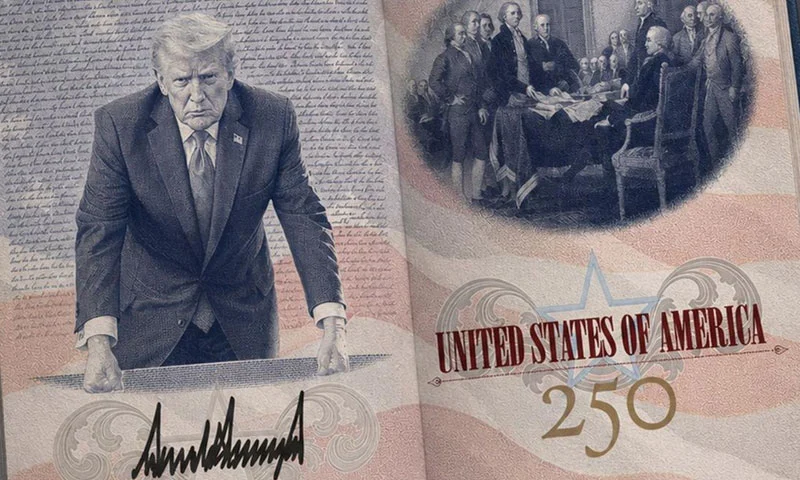
U.S. President Donald Trump has revealed the design of a limited edition commemorative passport that celebrates the 250th anniversary of American independence. The proposed travel document features Trump’s portrait and signature, making it one of the most distinctive passport designs introduced in the country’s history. Trump shared a digital rendering of the passport on his Truth Social platform on Friday, describing it with the message: “The U.S.A.’s New Passport, which says, ‘Welcome, but be good!’” The design combines patriotic imagery with historical references linked to the United States’ founding. One page features Trump’s portrait alongside his signature, while the text of the Declaration of Independence appears in the background. The image resembles an official White House portrait photographed by White House photographer Daniel Torok. Another page displays artwork depicting the signing of the Declaration of Independence in 1776. It also includes the words “United States of America 250,” highlighting the country’s semiquincentennial celebrations. Commemorative Passport The White House also published the passport rendering on social media, referring to it as the “PATRIOT PASSPORT.” The U.S. State Department had previously announced plans to issue a commemorative passport featuring custom artwork beginning on July 6 as part of nationwide celebrations marking the nation’s 250th birthday. PATRIOT PASSPORT. pic.twitter.com/RYvLKloC7d— The White House (@WhiteHouse) June 26, 2026 Officials have indicated that the commemorative edition will be available only in limited quantities. Earlier statements suggested interested applicants would need to visit designated passport facilities in Washington while supplies last. The State Department has not publicly provided additional details about the final design or confirmed whether the rendering shared by Trump reflects the finished product. Part of a Broader Branding Strategy The passport announcement continues Trump’s effort to place a visible personal imprint on government institutions during his presidency. His administration has introduced presidential branding across several official settings. Government buildings have displayed banners featuring the president, while the Treasury Department previously announced plans to place Trump’s signature on the one dollar bill. Trump also sought to associate his name with the John F. Kennedy Center for the Performing Arts. However, a court later ruled that the name should be removed. If released in the form presented, the commemorative passport would mark another symbolic milestone. Trump would become the first sitting U.S. president to appear in an American travel document issued during his time in office. The proposed passport has already generated public discussion online, with supporters describing it as a patriotic tribute to America’s 250th anniversary while critics have questioned the inclusion of a sitting president’s image on an official government document. The commemorative passport forms part of a wider programme of events planned across the United States to mark the country’s historic anniversary in 2026.
Trump Rejects Senate Vote to End Iran War, Calls It ‘Meaningless’
US President Donald Trump on Tuesday brushed aside a congressional resolution seeking to end American military involvement in Iran, calling the measure “poorly timed and meaningless” and insisting that his administration would continue efforts to secure a long-term agreement with Tehran. Trump’s remarks came shortly after the US Senate approved a resolution directing the president to withdraw American forces from hostilities with Iran unless Congress explicitly authorises military action. The Senate passed the measure in a narrow 50-48 vote. The House of Representatives had already approved the resolution earlier, creating a rare bipartisan challenge to the White House’s handling of the conflict. Although the resolution does not carry the force of law and does not require presidential approval, it places both chambers of Congress on record against continued military involvement in the conflict. The vote reflects growing concern among lawmakers over a war that began after US and Israeli strikes on Iran in late February and later expanded into a broader regional confrontation involving Lebanon and several Gulf states. Congress Challenges Trump’s Iran Strategy The resolution emerged as the Trump administration pursues a 60-day diplomatic initiative aimed at transforming a preliminary understanding with Iran into a comprehensive agreement. The proposed framework covers Tehran’s nuclear programme, sanctions relief and the future security of the Strait of Hormuz, one of the world’s most important oil shipping routes. pic.twitter.com/FfIDbx8RQe— Rapid Response 47 (@RapidResponse47) June 24, 2026 Senate Democratic Leader Chuck Schumer forced the vote after several Republican lawmakers expressed concerns about both the conflict and the administration’s approach to ending it. “Republicans can complain about Trump’s war, his secrecy, and his disastrous deal with Iran all they want behind closed doors, but the only way to ensure this war ends once and for all is for Republicans to act,” Schumer said before the vote. The House earlier approved the measure with support from all Democrats and four Republicans. The outcome highlighted growing divisions within Congress over the conflict and the president’s war powers. Democrats argue that Trump bypassed Congress when he authorised military operations against Iran. Under the 1973 War Powers Act, presidents must seek congressional approval within 60 days after introducing US forces into hostilities. That law has long been the subject of disputes between Congress and successive administrations. White House Defends Presidential Authority The White House rejected criticism of the president’s actions and argued that efforts to restrict his authority could undermine sensitive negotiations with Tehran. Officials maintain that the conflict effectively ended following an April ceasefire ordered by Trump. House Speaker Mike Johnson also defended the administration’s position. Before the House vote, Johnson warned that limiting the authority of the commander-in-chief during ongoing negotiations would be a “very dangerous prospect.” Many lawmakers point to Trump’s repeated warnings that the United States could launch new strikes if negotiations collapse. The conflict has also triggered economic concerns in Washington. Lawmakers from both parties have raised alarms about disruptions to trade routes and rising energy prices. The Strait of Hormuz remains central to those concerns. The waterway handles a significant share of global oil shipments and plays a critical role in international energy markets. Analysts say uncertainty surrounding the conflict has contributed to inflation concerns ahead of November’s midterm elections. Despite congressional opposition, Trump signalled that he intends to continue pursuing his Iran strategy. He argued that lawmakers had complicated the process but insisted the administration would ultimately achieve its objectives. Calling the resolution “poorly timed and meaningless,” Trump said he would “get it done, one way or the other.” The vote nevertheless marks one of the most significant congressional challenges to the president’s foreign policy since the conflict began and underscores the political risks surrounding America’s involvement in the Middle East.
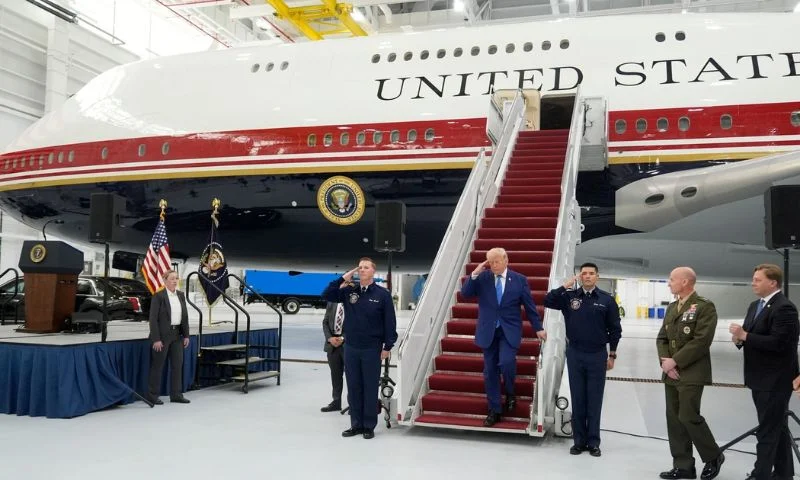
Trump Unveils Qatar-Gifted Air Force One Amid Ethics Questions
US President Donald Trump on Friday unveiled a converted Boeing 747 gifted by Qatar, introducing it as a temporary Air Force One while Boeing completes a delayed replacement program. Speaking at Joint Base Andrews in Maryland, Trump praised the aircraft and defended the decision to accept it. “This is considered the world’s most luxurious plane. When it was built, it was built at a level that will probably never be seen again,” Trump told supporters. The aircraft will serve as a “bridge” plane until Boeing delivers two new presidential Boeing 747-8 jets. Boeing secured the $3.9 billion contract during Trump’s first administration. However, repeated production delays pushed delivery to 2028. The revised timeline could leave Trump without a new purpose-built presidential aircraft before his term ends in January 2029. Trump said the United States needed a modern presidential fleet to match aircraft used by other world leaders. Critics Question Acceptance of Foreign Gift The Qatari aircraft has sparked criticism from lawmakers, ethics groups and legal experts. Critics argue that accepting such an expensive gift from a foreign government raises legal and constitutional concerns. Some experts have pointed to the Emoluments Clause, which limits gifts from foreign states to US officeholders without congressional approval. Trump rejected those concerns and defended the decision. He previously said it would be “stupid” to refuse the aircraft. The president argued that taxpayers would benefit because the aircraft fills a gap while Boeing completes its delayed project. The US Air Force carried out extensive modifications to transform the aircraft into a presidential transport platform. Officials have not disclosed the full upgrade cost. However, the Air Force previously estimated security modifications would cost less than $400 million. The aircraft features a new design. A navy-blue lower fuselage replaces the traditional light-blue scheme. A red stripe runs along the body, while a large American flag covers the tail. The presidential seal appears near the main boarding area used by the president. NATO Summit to Mark First Overseas Trip Trump confirmed he will use the aircraft for next month’s NATO summit in Ankara, Turkey. The trip will mark the jet’s first major international mission as Air Force One. He also signaled plans to return to China and attend the Asia-Pacific Economic Cooperation summit later this year. Earlier this week, Trump returned from Europe aboard the aging Boeing 747-200 that has carried US presidents for more than 30 years. He described that journey as the aircraft’s final presidential mission. Trump said officials will eventually place the retired jet in a museum. “The rest of the Air Force One fleet will have the new design,” he said. Trump also repeated that he will not use the Qatari aircraft after leaving office. Instead, he said it will become part of a future presidential library. The move aims to end speculation that he could retain access to the aircraft after his presidency.
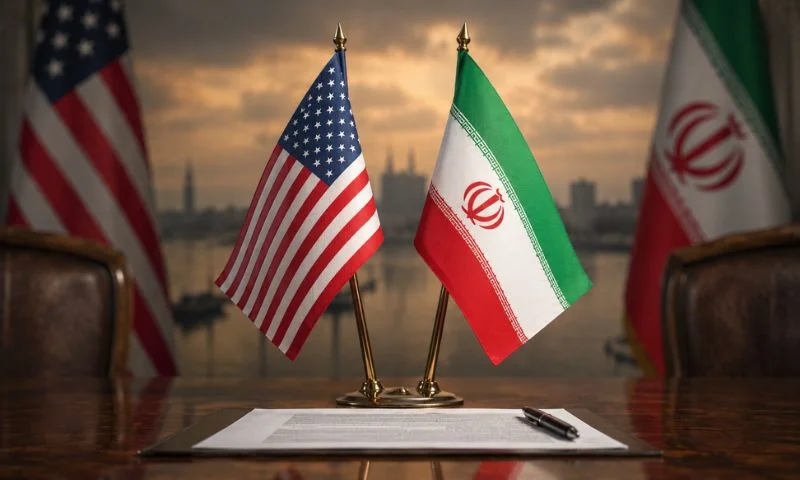
US and Iran Agree to End Hostilities? Full 14-Point Text Revealed
A senior US official has disclosed what the official described as the full text of a draft agreement between the United States and Iran. The proposed agreement aims to end hostilities, reopen key maritime routes and launch a new round of nuclear negotiations. The official read the text during a conference call with reporters. According to the official, the document outlines a 14-point Memorandum of Understanding between Washington and Tehran. The draft would serve as the foundation for a broader final agreement. Both sides would aim to complete that agreement within 60 days. The proposal comes after months of military tensions that raised concerns about regional security, energy markets and Iran’s nuclear programme. At its core, the draft calls for an immediate ceasefire. It also outlines steps on sanctions relief, economic cooperation and future nuclear talks. Ceasefire, Hormuz Reopening and Economic Measures Under the proposed agreement, the United States and Iran, along with their allies, would immediately stop military operations. Both sides would also commit not to launch future military action against one another. The draft places significant focus on the Strait of Hormuz. The waterway handles a large share of global oil shipments. The United States would begin removing its naval blockade and related restrictions immediately after signing the MOU. It would complete the process within 30 days. Meanwhile, Iran would facilitate the safe passage of commercial vessels through the Strait of Hormuz and nearby waters. The agreement also calls for discussions with Oman and other Gulf states. Those talks would focus on future administration and maritime services in the strategic waterway. The draft includes a major economic component as well. The United States would work with regional partners on a reconstruction and development plan worth at least $300 billion for Iran. In addition, the agreement outlines a pathway for lifting sanctions. The proposed framework covers US primary and secondary sanctions. It also includes restrictions linked to the United Nations Security Council and the International Atomic Energy Agency. Furthermore, Washington would issue waivers for exports of Iranian crude oil, petroleum products and related services. Nuclear Commitments and Final Agreement Nuclear issues remain central to the proposed framework. Iran reaffirms that it will not seek or develop nuclear weapons. Both sides would negotiate the future handling of enriched nuclear material. The International Atomic Energy Agency would supervise the process. Until a final agreement is reached, Iran would maintain the current status of its nuclear programme. Likewise, the United States would avoid imposing new sanctions. It would also refrain from deploying additional forces in the region. The draft further provides for the release of frozen Iranian assets. In addition, both sides would establish a mechanism to monitor implementation and future compliance. According to the text, negotiations on a final agreement would begin after key provisions enter into force. These provisions include ceasefire measures, maritime access, sanctions waivers and asset releases. Finally, the draft states that a binding United Nations Security Council resolution would endorse the final agreement if both sides reach a deal. Full Text of the 14 Points 1. The United States of America and the Islamic Republic of Iran and their allies in the current war by signing this MOU declare the immediate and permanent termination of military operations on all fronts, including in Lebanon, and undertake from now on not to initiate any war or any military operation against each other, and to refrain [from] the threat or use of force against each other and ensuring the territorial integrity and sovereignty of Lebanon. The final deal will confirm the permanent termination of the war on all fronts, including in Lebanon and other provisions of this paragraph. 2. The United States of America and the Islamic Republic of Iran undertake to respect each other’s sovereignty and territorial integrity, and to refrain from interfering in each other’s internal affairs. 3. The United States of America and the Islamic Republic of Iran commit to negotiating and achieving the final deal in maximum 60 days extendable with mutual consent. 4. Immediately upon the signing of this MOU, the United States of America will begin the removal of its naval blockade and any disturbances or impediments against the Islamic Republic of Iran, and will fully end the naval blockade within 30 days. During this period, the traffic of vessels will be in proportion to the numbers of prewar traffic being restored by the Islamic Republic of Iran. The United States of America further undertakes to remove its forces from the proximity of the Islamic Republic of Iran within 30 days after the final deal. 5. Upon the signing of this MOU, the Islamic Republic of Iran will make arrangements using its best efforts for the safe passage of commercial vessels with no charge for 60 days only from the [Arabian] Gulf to the Sea of Oman, and vice versa. The traffic of commercial vessels will immediately start, and considering the need for removing the technical and military obstacles and demining by the Islamic Republic of Iran, will be instated within 30 days. The Islamic Republic of Iran will conduct dialogue with the Sultanate of Oman to define the future administration and maritime services in the Strait of Hormuz, in discussion with other [Arabian] Gulf littoral states in line with the applicable international law and the sovereign rights of coastal states of the Strait of Hormuz. 6. The United States of America undertakes with regional partners to develop a definitive, mutually agreed plan with at least $300 billion for the reconstruction and economic development of the Islamic Republic of Iran. The mechanism for the implementation of this plan will be finalized as part of a final deal within 60 days. All required licenses, waivers and permissions needed for the relevant financial transactions will be granted by the United States of America. 7. The United States of America undertakes to terminate all types of sanctions against the Islamic Republic of Iran, including the United Nations Security Council resolutions, IAEA Board of Governors resolutions, and
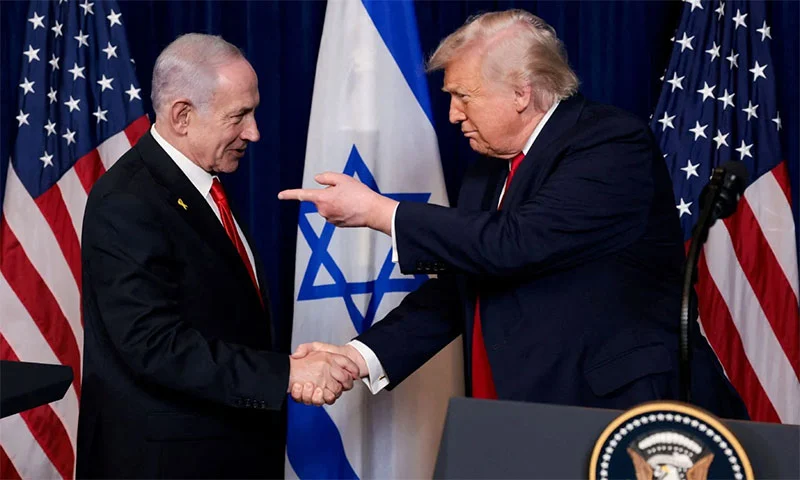
Trump to Netanyahu: ‘There Would Be No Israel Without Me’
US President Donald Trump on Tuesday intensified his criticism of Israeli Prime Minister Benjamin Netanyahu, declaring that “there would be no Israel” without American support and his own leadership, as tensions grow over Israel’s military operations in Lebanon. Speaking at the G7 summit in Évian-les-Bains, France, Trump suggested that Israel’s actions risk undermining ongoing diplomatic efforts between Washington and Tehran aimed at ending months of conflict across the region. “Without the US, there would be no Israel. Without me, there would be no Israel because no other president was willing to do what I did. I have had a great relationship with Bibi. Now Bibi has to be more responsible with respect to Lebanon,” Trump said. The comments marked some of the strongest public criticism Trump has directed at Netanyahu since returning to the White House. The disagreement comes at a sensitive moment. Washington recently announced a preliminary agreement with Iran designed to extend a ceasefire and lay the groundwork for broader negotiations on regional security, sanctions and Tehran’s nuclear programme. However, Israel has continued military operations against Hezbollah in Lebanon despite the diplomatic progress. Lebanon Strikes Spark Tensions Between Allies Trump’s frustration reportedly escalated after an Israeli airstrike targeted a suburb of Beirut on Sunday. The strike took place on the same day Trump announced that a new agreement with Iran would be signed electronically. According to the Israeli military, the operation came in response to Hezbollah firing three projectiles into northern Israel. Netanyahu defended Israel’s position and made clear that his government would continue military operations in Lebanon. “The struggle has not ended,” Netanyahu said on Monday. “I want to make clear: We will remain in the security zones as long as required in order to defend our country.” The remarks highlighted a growing gap between Washington’s diplomatic approach and Israel’s security strategy. Trump: “Without me, there would be no Israel … I’ve had a great relationship with Bibi, but now Bibi has to be more responsible with respect to Lebanon … I’m not happy with the way Israel has handled themselves with Lebanon and Hezbollah.” pic.twitter.com/xvLlEhYqWj — Aaron Rupar (@atrupar) June 16, 2026 Trump later expressed his anger during an interview with Axios. “Why did Bibi have to do a f—ing attack?” Trump said. “I was so p—ed off. I let him know. He has no f—ing judgment. I let him know that.” The unusually blunt language underscored the strain between the two longtime political allies. Peace Efforts Face Fresh Challenges The dispute comes as negotiators work to transform the recently announced US-Iran framework into a broader and more durable agreement. The proposed deal includes extending the ceasefire, reopening the Strait of Hormuz and launching further discussions on Iran’s nuclear activities. Regional diplomats view the agreement as the most significant diplomatic breakthrough since the conflict began earlier this year. Yet Lebanon remains one of the biggest obstacles. Iran has insisted that any long-term settlement must include a halt to hostilities involving Hezbollah, while Israeli officials continue to argue that military pressure remains necessary to protect national security. Analysts say Trump’s latest comments reflect growing concern within the White House that continued military escalation could jeopardise a fragile diplomatic opening. Despite the public disagreement, US officials stressed that Washington remains committed to Israel’s security while pursuing a broader regional peace framework. For now, attention has shifted to upcoming negotiations and whether the ceasefire can survive amid continuing tensions on Israel’s northern border.
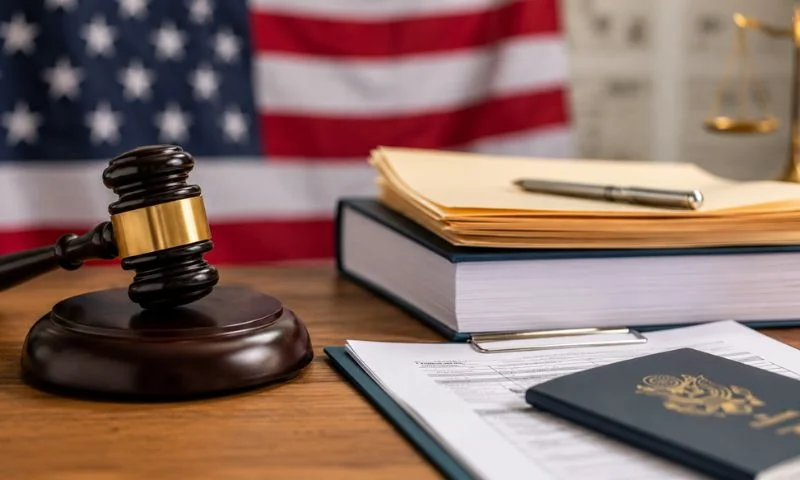
US Judge Blocks Trump’s $100,000 H-1B Visa Fee in Major Legal Defeat
A federal judge struck down US President Donald Trump’s controversial $100,000 H-1B visas fee on Monday. The ruling marks a major setback for the administration’s efforts to restrict legal immigration. US District Judge Leo Sorokin issued the decision in Boston. Twenty Democratic state attorneys general filed the lawsuit after Trump announced the fee in September. The H-1B programme allows US employers to hire highly skilled foreign workers. It offers 65,000 visas each year. Another 20,000 visas go to applicants with advanced degrees. Successful applicants can work in the United States for three to six years. Before Trump announced the policy, employers usually paid between $2,000 and $5,000 in fees. The new charge increased costs more than twentyfold. Businesses, universities and healthcare institutions quickly criticised the move. Sorokin rejected the administration’s argument that the fee was a lawful penalty under federal immigration law. He concluded that the payment functioned as a tax. “Here, the substance and application of the $100,000 payment reveal that it is a tax, regardless of what the payment is called,” Sorokin wrote. The judge said Congress never authorised the president to impose such a tax. He also cited recent Supreme Court decisions that limit executive authority when federal law does not clearly grant specific powers. States Said Fee Hurt Recruitment of Skilled Workers The Trump administration defended the policy in court. Officials argued that immigration law gives the president broad authority to restrict the entry of foreign nationals when their admission could harm US interests. The administration said the fee would encourage companies to hire and train American workers. Trump had previously argued that employers misuse the H-1B programme. He said the system “has been deliberately exploited to replace, rather than supplement, American workers with lower-paid, lower-skilled labor.” The coalition of states disagreed. They argued that the fee would make it harder to recruit doctors, engineers, teachers and other skilled professionals. California Attorney General Rob Bonta led the lawsuit. He welcomed the ruling and said the policy threatened key sectors of the economy. “This tax was an attack on America’s ability to attract and retain the high-skilled talent that strengthens our economy and helps us meet critical workforce needs,” Bonta said. The states also argued that hospitals, universities and research institutions rely heavily on foreign talent. They said the fee would increase labour shortages in several industries. Visa Demand Fell Sharply After Fee Announcement Court filings showed that the policy discouraged employers from seeking H-1B visas. As of February 15, US Citizenship and Immigration Services had received only 85 payments of the $100,000 fee. The figure highlighted the dramatic decline in demand after the policy took effect. The White House did not immediately respond to Reuters after the ruling. However, administration officials signalled that they would continue defending the policy. White House spokeswoman Taylor Rogers later criticised the decision. “President Trump has clear legal authority to restrict entry of any class of aliens he determines is not in America’s best interests, and that is exactly what he did,” Rogers said. The administration plans to appeal the ruling. The case could have far-reaching consequences for US immigration policy. It may also influence future efforts by presidents to impose financial restrictions without explicit approval from Congress. For now, employers that depend on highly skilled foreign workers have received a significant legal victory. The ruling removes one of the biggest barriers that the administration placed on the H-1B visa programme.
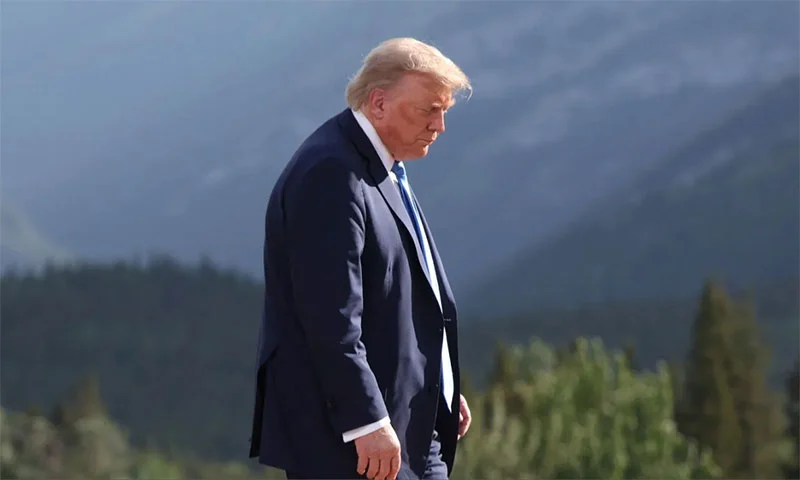
Poll Shows Trump Losing Support on Economy and Foreign Policy
More than half of American voters disapprove of Donald Trump’s handling of inflation and the economy, according to a new poll that highlights growing concerns over tariffs, rising fuel prices and the ongoing conflict involving Iran ahead of the US midterm elections. The nationwide survey, conducted by research firm Focaldata for the Financial Times, found that inflation and the rising cost of living remain the biggest concerns for voters before November’s congressional elections. According to the poll, nearly 58% of registered voters either “strongly” or “somewhat” disapproved of Trump’s management of inflation and living costs. Read More: New Passport Design in US to Include Trump Picture In addition, more than half of respondents expressed dissatisfaction with his handling of jobs and the broader economy. Around 55% of voters said Trump’s tariffs negatively affected the US economy. However, only about one-quarter believed his trade policies improved economic conditions. The findings arrive at a politically sensitive moment for the White House, with six months remaining before control of both chambers of Congress is contested. Trump returned to office in 2025 after winning the presidential election on promises to lower inflation, revive domestic manufacturing and prioritise American economic interests. Iran war and fuel prices create pressure The poll also reflected growing voter unease over the conflict involving Iran and its economic consequences. According to the survey, nearly 54% of voters disapproved of Trump’s handling of the Iran war, while fewer than one-third approved. Even among Republican voters, roughly one in five respondents expressed dissatisfaction with his management of the conflict. The war escalated after the United States and Israel launched air strikes on Iran in late February. As a result, tensions disrupted shipping through the Strait of Hormuz and tightened global oil supplies. Read More: From 2016 to 2026 US President DonalTrump Faces Growing List of Assassination Threats Although a fragile ceasefire remains in place, the conflict has continued to push fuel and consumer prices higher across the United States. Trump recently claimed petrol prices were “way down.” However, average gasoline prices reportedly climbed to about $4.60 per gallon last week. That figure stands nearly 50% higher than before the conflict began. Meanwhile, the administration has attempted to negotiate an agreement with Tehran to avoid further escalation and reduce inflationary pressure before the elections. Democrats gain advantage before midterms Overall, more than 54% of voters said they disapproved of Trump’s performance as president. By comparison, just over 39% approved of his leadership. Independent voters appeared especially critical. More than 58% of independents held an unfavourable opinion of Trump, according to the poll. The survey also showed Democrats holding an eight-point advantage over Republicans among registered voters heading into the midterms. Currently, Republicans control both the United States House of Representatives and the United States Senate. Nevertheless, Democrats hope to regain control of Congress in November. Read More: “You’d Be Speaking French”: Charles Teases Trump in Viral Moment Kush Desai defended the administration’s economic policies, saying Trump’s tax cuts, deregulation agenda and energy measures would keep the economy on a “solid economic trajectory.” He added that Americans would eventually see lower inflation and falling fuel prices once disruptions linked to the Iran conflict eased. The online poll was conducted between May 1 and May 5 among 3,167 registered voters. It carried a margin of error of plus or minus 2.1 percentage points.

TikTok Escapes US Ban After ByteDance Seals American-Led Ownership Deal
TikTok’s Chinese parent company, ByteDance, announced on Thursday that it has finalized a landmark agreement to create a new joint venture that will place TikTok’s US operations under majority American ownership, a move aimed at preventing a nationwide ban on the app used by more than 200 million Americans. The agreement marks a major turning point in TikTok’s long-running standoff with Washington, which began in August 2020 when then-President Donald Trump first attempted to block the platform over national security concerns tied to data privacy and Chinese ownership. Although US lawmakers passed legislation in April 2024 requiring ByteDance to divest TikTok’s US assets by January 2025 or face a ban — a law later upheld by the Supreme Court — Trump ultimately chose not to enforce the measure after negotiations over a restructuring deal gained momentum. Under the finalized arrangement, a new entity named TikTok USDS Joint Venture LLC will oversee the protection of US user data, content moderation systems, and recommendation algorithms through enhanced cybersecurity and privacy safeguards. ByteDance shared limited details about the divestiture but confirmed that American and global investors will collectively own 80.1% of the venture, while ByteDance will retain a 19.9% minority stake. Three managing investors — cloud technology firm Oracle, private equity giant Silver Lake, and Abu Dhabi-based investment company MGX — will each hold a 15% share. Trump welcomed the agreement in a social media post, claiming TikTok “will now be owned by a group of Great American Patriots and Investors, the biggest in the world.” He also publicly thanked Chinese President Xi Jinping for approving the deal, saying cooperation from Beijing was critical to its completion. A White House official confirmed to Reuters that both the US and Chinese governments had signed off on the arrangement. The Chinese Embassy in Washington declined to comment. The new venture will operate TikTok’s US app, according to the White House, while handling backend services related to user data and algorithm security. The recommendation algorithm will be retrained and tested exclusively using US user data and will be stored within Oracle’s US-based cloud infrastructure. TikTok said the venture’s investor group also includes the Dell Family Office — linked to Dell Technologies founder Michael Dell — along with Vastmere Strategic Investments, Alpha Wave Partners, Revolution, Merritt Way, Via Nova, Virgo LI, and NJJ Capital. Former TikTok USDS executive Adam Presser has been appointed chief executive officer of the new venture, while Will Farrell will serve as chief security officer. TikTok CEO Shou Chew will join the board, continuing to oversee the platform’s global strategy. Trump, who has more than 16 million followers on TikTok, has previously credited the app with helping him secure reelection. According to a photo published by the New York Times, TikTok executives presented Trump with internal data highlighting his popularity on the platform in December. The White House itself launched an official TikTok account last August. Earlier reports had indicated that while ByteDance would retain control over revenue-generating businesses such as advertising and e-commerce, operational control over US data, content moderation, and algorithms would shift to the American-led venture. The new entity will earn a share of revenue in exchange for providing technology and data security services.
