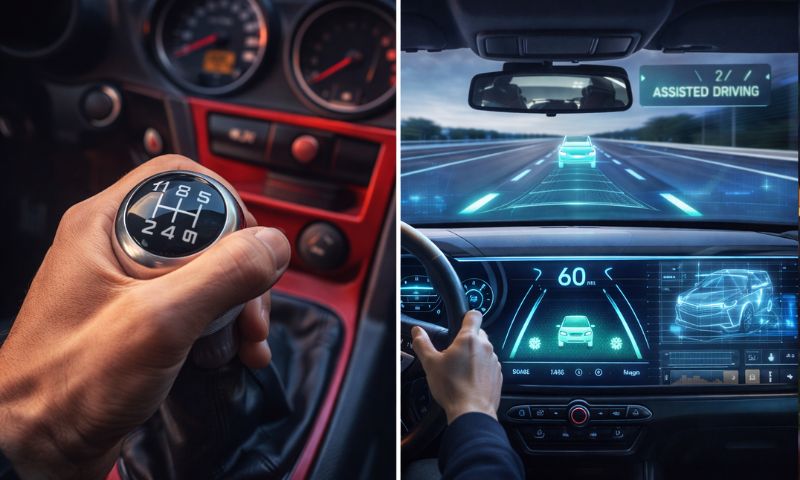
In the 2000s, a manual car made you feel like part of the machine. Your left foot and right hand did real work. You listened to the engine, timed the clutch bite, and judged gaps with your gut. Driving wasn’t just transport. It was a small daily skill test. Fast-forward to today, and the “skill” is getting outsourced. AI-assisted driving (really, driver-assistance) now handles chunks of the job: it warns you, brakes for you, and sometimes nudges the steering wheel back into lane. Automakers sell it as confidence. Many drivers buy it as relief. The market shift is huge. Data widely cited in industry coverage shows manual transmissions dominated Europe around 2000, but by 2022 they had fallen to roughly a third of new-car sales, and they keep dropping. Manuals didn’t lose because they stopped working. They lost because convenience, emissions targets, and traffic made automatics—and now electrification—an easier default. Safety is where AI assistance has a real argument. The Insurance Institute for Highway Safety reports that forward collision warning plus automatic emergency braking can cut rear-end crashes by about 50%. That’s not a “nice to have.” That’s thousands of avoided bumps, injuries, and insurance claims. But here’s the catch: today’s systems still have moods. IIHS testing has found that adaptive cruise control and lane-keeping can perform inconsistently in everyday situations like curves, hills, and approaching stopped vehicles. And regulators keep repeating the same message: these features help, but you remain responsible. NHTSA’s driver-assistance guidance stresses that some systems only warn, while others act, and drivers must understand limits through the owner’s manual. There’s also the “annoyance factor.” J.D. Power says a top consumer complaint about ADAS is that the alerts feel bothersome. When the car beeps too much, people disable the tech—and lose the safety benefit. So who wins: manuals of the 2000s or AI-assisted driving today? Manuals win on connection and control. AI assistance wins on crash prevention when drivers treat it like a smart co-pilot, not a chauffeur. The future is likely neither pure nostalgia nor full automation. It’s a blend: human judgment, plus machines that step in when humans slip.

