

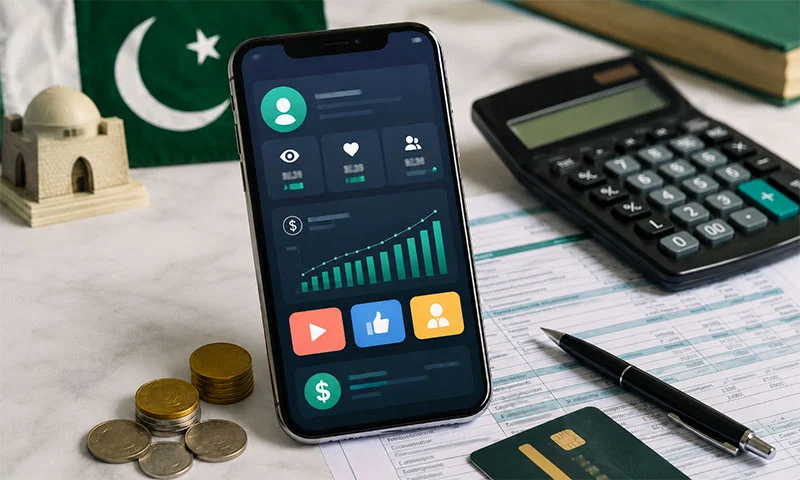
Pakistan’s Federal Board of Revenue (FBR) has introduced a 10% withholding tax on social media earnings received by digital content creators and influencers who do not appear on the Active Taxpayers List. The new rates took effect from July 1, 2026, under changes introduced through the Finance Act 2026. The FBR’s latest Withholding Income Tax Rate Card for Tax Year 2027 confirms two rates under Section 154B. Creators appearing on the ATL face a 5% deduction, while non-ATL creators face a 10% rate. Read More: FBR Targets Social Media Income as New Tax Rules Emerge in Pakistan The new provision is titled “Withholding tax on revenues received from social media platforms.” It covers income earned through platforms such as YouTube, Facebook, Instagram and TikTok, as well as similar digital services. Banks to Deduct Tax When Payments Arrive Under Section 154B, banking and non-banking financial institutions must deduct the tax when social media revenue reaches a creator’s account. The law also covers payments routed through online payment providers and other digital financial platforms. For example, an ATL-listed creator receiving Rs100,000 in qualifying social media revenue would face Rs5,000 in withholding tax. A creator outside the ATL would face Rs10,000 on the same amount. For resident taxpayers, the law treats the deduction as minimum tax. For a non-resident without a permanent establishment in Pakistan, it operates as final tax. The measure expands Pakistan’s tax framework into the fast-growing creator economy. It also creates a financial incentive for influencers, YouTubers and other online earners to remain on the ATL. Read More: NCCIA Takes Notice of Social Media Campaign Against easypaisa FBR says appearing on the ATL already gives taxpayers access to lower withholding rates across several types of transactions. The social media provision now extends that filer advantage to digital creator earnings. The official FBR rate card is updated up to June 30, 2026 under the Finance Act 2026 and applies to Tax Year 2027. This corrects reports suggesting the new card itself remains applicable only through June 30, 2026. Foreign Card Payments Also Get New Rates The Finance Act 2026 has separately changed withholding tax on amounts remitted abroad through credit, debit and prepaid cards. Under Section 236Y, taxpayers appearing on the ATL now face a 0.5% withholding rate on such transactions. The rate doubles to 1% for people outside the ATL. This provision is separate from the tax on creator earnings. Section 154B applies when creators receive social media revenue, while Section 236Y covers money sent abroad through payment cards. Read More: Pakistan EV Tax 2026: Which Electric Vehicles Will Be Taxed and Which Remain Exempt? The Finance Act 2026 came into force on July 1 unless a provision specified otherwise. The new social media withholding regime therefore applies to qualifying payments received from that date. The change means Pakistani creators now face a clear tax deduction at the banking stage. Those outside the ATL will effectively pay twice the withholding rate applied to listed taxpayers.

633 Billion Paid: Salaried Class Dominates Pakistan’s Tax Revenue
Pakistan’s salaried class paid Rs633 billion in income tax during fiscal year 2025-26, making it the largest contributor among major economic segments, according to provisional data from the Federal Board of Revenue (FBR). The figure shows that salaried individuals contributed more than exporters, the real estate sector and retailers combined in terms of income tax contribution. The FBR collected a total of Rs13,010 billion during the fiscal year ending June 30, 2026. Within this, tax deducted directly from salaries played a major role in strengthening the national revenue base. The salaried class contribution also rose compared to the previous year. It stood at Rs585 billion in fiscal year 2024-25, showing steady growth in tax compliance and withholding efficiency. Sector-wise comparison shows mixed trends Exporters contributed Rs174 billion in income tax during 2025-26, slightly lower than Rs176 billion recorded in the previous fiscal year. Officials say this reflects limited change in exporter tax payments over the two years. The real estate sector showed mixed performance. Under Section 236-C, the FBR collected Rs191 billion compared to Rs118 billion in 2024-25. However, under Section 236-K, collections dropped to Rs87 billion from Rs120 billion in the previous year. Retailers also contributed through withholding tax mechanisms. Under Sections 236-G and 236-H, the sector paid around Rs70 billion in 2025-26, compared to Rs62 billion last year. Breakdown shows Rs25 billion collected under Section 236-G and Rs45 billion under 236-H in the current fiscal year. These figures compare with Rs24 billion and Rs38 billion respectively in 2024-25. Overall, the data highlights uneven performance across sectors, with salaried individuals remaining the most consistent source of direct tax revenue. FBR targets reforms and higher revenue growth The FBR has set an ambitious revenue target of Rs15,264 billion for the current fiscal year. Officials believe reforms and digitalisation will help improve collection efficiency. Tax authorities expect relief measures for salaried individuals and exporters. They also plan to rationalise taxes on real estate transactions to support economic activity. FBR officials said technology and artificial intelligence will play a growing role in improving compliance and monitoring. A key reform under consideration is the adoption of a new operating model in the Inland Revenue Service. It aims to reduce direct interaction between taxpayers and tax officials to improve transparency and efficiency. Authorities believe these steps will help expand the tax base while maintaining pressure on high-compliance sectors such as the salaried class. At the same time, policymakers face the challenge of increasing revenue without slowing down economic activity, especially as different sectors respond differently to taxation measures.

Survey Shows Public Support for 5% Tax on Social Media Creators
A majority of Pakistanis support the government’s proposal to impose a 5 percent withholding tax on income earned by social media influencers, according to a new survey by the Press Network of Pakistan (PNP). However, respondents also urged policymakers to protect small creators through exemptions and supportive measures. The online survey was conducted after the government announced the proposal in the Finance Bill 2026. It included responses from 100 participants, comprising 45 men and 55 women. The findings showed broad support for bringing digital creators into Pakistan’s formal tax system. At the same time, respondents stressed that taxation should not discourage young entrepreneurs or people entering the digital content industry. The proposed 5 percent withholding tax forms part of the Finance Bill 2026. The government says the measure aims to document income generated through social media platforms and improve tax collection. Officials from the Federal Board of Revenue (FBR) have noted that earnings from digital platforms have grown rapidly in recent years while much of that income remains outside the country’s tax net. According to government estimates, Pakistan’s social media economy generates between Rs4 billion and Rs10 billion annually. Survey highlights support for fair taxation The PNP survey gave the proposed 5 percent withholding tax an average support score of 3.42 out of 5. Meanwhile, respondents expressed even stronger support for the broader principle that influencers should pay taxes like other professionals and businesses. That statement received an average score of 3.89 out of 5. However, participants also recognised potential challenges. They gave an average score of 3.34 out of 5 to concerns that the tax could discourage young people from pursuing careers in digital content creation. Many respondents supported exempting smaller creators from the proposed tax. The recommendation to exclude influencers earning below a certain income threshold received an average score of 3.88 out of 5. Read More: Why Traditional News Outlets Are Losing Ground to Social Platforms Participants also strongly supported government incentives alongside taxation. That recommendation received the survey’s highest average score of 3.92 out of 5. The report concluded, “As Pakistan’s digital economy continues to expand, balanced policymaking will be essential to ensure that taxation strengthens rather than hinders one of the country’s fastest-growing sectors.” YouTube creators expected to feel the biggest impact The survey also explored which platforms would feel the greatest impact if the proposal becomes law. A total of 53.8 percent of respondents said YouTube creators would face the biggest effect. Another 24.6 percent believed the tax would affect all social media platforms equally. Meanwhile, 9.2 percent selected Instagram, while 6.2 percent identified TikTok. Facebook and blogs or websites each received 3.1 percent of responses. Pakistan’s digital creator economy has expanded rapidly in recent years as thousands of individuals generate income through YouTube, TikTok, Instagram, Facebook and other online platforms. Industry experts say the sector has created new employment opportunities, particularly for young entrepreneurs and freelancers. The survey suggests that most Pakistanis support taxing influencer income. At the same time, they want the government to adopt balanced policies that encourage innovation, protect small creators and promote long term growth in the country’s expanding digital economy.

Pakistan Moves to Bring Online Earnings Into Formal Tax System
The federal government has proposed a 5 percent withholding tax on income earned by social media influencers, YouTubers, TikTok creators and other digital content producers under the Finance Bill 2026. The move aims to bring Pakistan’s fast-growing creator economy into the formal tax system. Officials also want to improve documentation of online earnings. Under the proposal, banks and financial institutions will deduct the tax when digital platforms transfer payments to creators’ accounts. The tax will cover earnings from YouTube, Facebook, Instagram, TikTok and other similar platforms. If parliament approves the proposal, creators will receive payments after banks deduct the tax. The government has included both resident and non-resident creators in the proposed framework. However, authorities may apply different rules based on a person’s tax status. Officials say the measure will help authorities document online earnings more effectively and improve compliance. Online Earnings Come Under Greater Scrutiny Pakistan’s creator economy has expanded rapidly in recent years. Thousands of people now earn money through advertising revenue, sponsorship deals, affiliate marketing and brand partnerships. YouTube remains one of the biggest sources of income for content creators. Meanwhile, TikTok, Instagram and Facebook continue expanding monetisation opportunities. The Federal Board of Revenue has increased its focus on digital transactions as more economic activity moves online. Officials believe the proposal will create a level playing field between digital creators and traditional businesses. They also argue that creators who generate significant income should contribute to the tax system like other professionals and companies. Many countries have introduced similar measures as governments seek to modernise tax systems and capture revenue from digital economies. Banks to Play Central Role The proposed framework places banks at the centre of the collection process. Instead of requiring separate deductions by digital platforms, banks will collect the tax when creators receive payments. Officials expect this approach to simplify compliance and improve transparency. The government also wants to track payments arriving from foreign platforms more effectively. Tax experts note that withholding taxes often function as advance tax payments. Depending on tax laws and filing status, taxpayers can adjust those payments against their final tax liability. The proposal marks one of Pakistan’s most significant efforts to regulate digital income. Officials believe the measure will strengthen revenue collection while creating a clearer regulatory framework for online creators. If lawmakers approve the proposal, Pakistan will formally integrate social media earnings into its mainstream taxation system and expand oversight of the country’s growing digital economy.

New Budget Makes Non-Filer Car Ownership More Expensive Than Ever
Pakistan’s proposed Budget 2026-27 is set to increase the cost of buying and owning a vehicle, especially for people who are not on the Federal Board of Revenue’s Active Taxpayers List (ATL). The government plans to introduce new taxes that will raise vehicle prices, increase fuel costs and widen the financial gap between filers and non-filers from July 1. One major change is the increase in the Climate Support Levy on locally assembled and imported petrol vehicles with engine capacities up to 1300cc. The levy will rise from 1% to 3% of the ex-factory price. The measure will directly affect popular models such as the Suzuki Alto, Suzuki Cultus and Suzuki Swift. For a vehicle priced at Rs3 million, the higher levy will add around Rs60,000 to the ex-factory cost before registration and other taxes. Motorists will also pay more at fuel stations. The Climate Support Levy on petrol will increase from Rs2.50 per litre to Rs5 per litre under Pakistan’s IMF-linked fiscal commitments. For a car with a 35-litre fuel tank, the increase will add about Rs87.50 to each refill. Non-Filers Face Higher Registration Charges The biggest impact will come at the vehicle registration stage. The government wants to expand the tax net and encourage more people to file returns. Officials aim to make non-compliance more expensive through higher withholding taxes. Under Section 231B of the Income Tax Ordinance, non-filers already pay double the withholding tax charged to ATL members when registering a new vehicle. Read More: Budget 2026-27: Pakistan Likely to Impose Up to 25pc Sales Tax on Imported EVs For vehicles up to 850cc, filers pay Rs10,000 while non-filers pay Rs20,000. For vehicles between 1301cc and 1600cc, filers pay Rs5,000 while non-filers pay Rs10,000. Owners of vehicles above 2500cc pay Rs15,000 if they are filers and Rs30,000 if they are non-filers. These charges apply before provincial token taxes, transfer fees and other registration costs. Provincial governments also offer benefits to tax-compliant citizens. In Khyber Pakhtunkhwa, an 1800cc vehicle owner pays Rs6,000 in annual token tax as a filer and Rs12,000 as a non-filer. Punjab has adopted a value-based taxation system that also rewards registered taxpayers. Filing Returns Could Save Buyers Money Tax experts say ATL membership has become increasingly important for major financial transactions. The FBR allows salaried individuals to use their CNIC as their National Tax Number. Taxpayers can file returns online through the IRIS portal. Even individuals with no tax liability can submit a zero-tax return and qualify for ATL status. The deadline for Tax Year 2025 returns is September 30, 2026. Late filers can restore their status by paying a surcharge, but they still face higher rates than active taxpayers. The latest budget measures show that tax status now plays a larger role in vehicle purchases. Higher car prices, rising fuel costs and increased registration charges will add pressure on buyers. Non-filers will face the biggest burden. For many Pakistanis, filing a tax return before buying a vehicle could save thousands of rupees and reduce costs throughout the year.

Budget 2026-27: FBR Preparing New Tax Scheme for Shopkeepers and Small Traders
The Federal Board of Revenue (FBR) has prepared a new tax scheme for small traders and shopkeepers. The government is likely to announce it in the federal budget for fiscal year 2026-27. The FBR is consulting stakeholders before the launch. Officials say the scheme aims to simplify tax compliance and encourage more businesses to join the tax net. The proposed framework targets small businesses with annual turnover of up to Rs20 million. It offers easier registration, simplified taxation and lower compliance requirements. Salient Features of Small Taxpayers Guidance System 1. The scheme targets small traders and shopkeepers with annual turnover of up to approximately Rs20 million. 2. Individuals who have operated a business for at least three years, maintain a shop or business premises, and belong to professions other than specialised services may qualify. 3. Small taxpayers who filed tax returns before 2025 may also join the scheme if they meet the required conditions. 4. Applicants can register through the FBR IRIS web portal, mobile application, or authorised tax practitioners and facilitators. 5. Participation remains voluntary. However, traders who join must maintain accurate and transparent financial records. 6. A lower tax rate may apply to eligible taxpayers. The scheme aims to simplify tax calculations and reduce compliance costs. 7. Tax liability generally applies when annual income exceeds the prescribed minimum threshold. 8. The FBR is less likely to audit participants. However, unusual financial activity or unexplained transactions may trigger scrutiny. 9. Taxpayers should maintain simple and organised records of sales, purchases, expenses and business transactions. 10.Certain withholding tax obligations and standard tax rules may still apply where legally required. 11. Failure to file returns, concealment of income or violation of scheme conditions may result in fines and legal action. 12. Some small businesses may not need POS systems. They may also avoid advanced digital integration requirements. 13. Compliant taxpayers may receive ATL status, lower withholding taxes and improved financial credibility. 14. Under the FBR’s proposed 2026 guidelines, authorities will generally focus audits on unusual or high-risk cases. 15. Bank deposits and withdrawals should reasonably match declared income, business activities and daily expenses. 16. Large unexplained gaps between declared income and banking transactions may trigger an audit. 17. The FBR may compare taxpayer declarations with data from government departments and financial institutions. 18. Property ownership, business scale, assets and lifestyle should remain consistent with declared income. 19. Authorities may review cases where assets, investments or spending appear much higher than declared income. 20. Honest and compliant taxpayers generally do not need to fear audits if they maintain accurate records and declarations. Purpose of the Scheme The FBR says the scheme will help document the economy and expand the tax base. Officials want to encourage voluntary tax compliance among small businesses. They also want to reduce the burden of complicated tax procedures. The proposed framework may help more traders become active taxpayers. It could also improve transparency in business transactions. The tax authority hopes the scheme will attract businesses that currently operate outside the formal tax system. Small traders who maintain proper records and file returns regularly may benefit from simplified procedures and reduced compliance costs.
