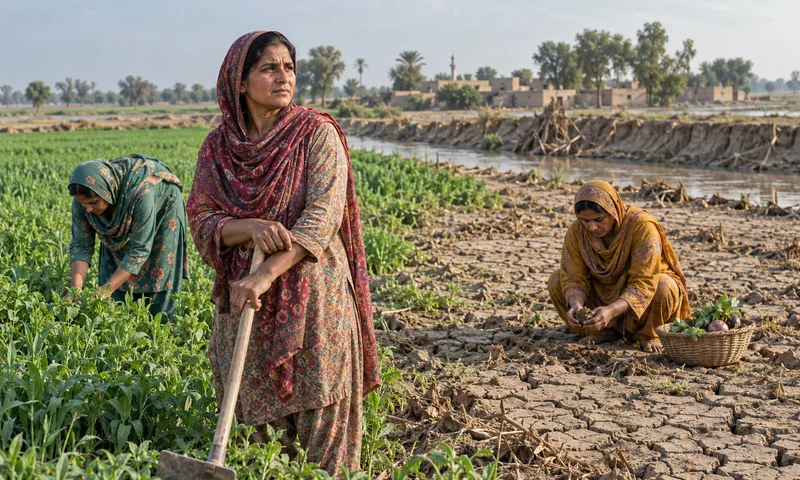
A new study has exposed a deep divide in agricultural ownership and financial power across Pakistan. Only about 2 per cent of ever-married women aged 15 to 49 own land alone or jointly. SDPI and Mobilink Bank presented the research at an Islamabad policy dialogue attended by regulators, banks and development partners. Women power agriculture but rarely own land The study found that 67pc of employed Pakistani women work in agriculture. However, official records classify only 1.5pc of agricultural households as female-headed. About 97.2pc of ever-married women in the surveyed age group had not inherited land or a house. The disparity proved even wider in Sindh, where 99.1pc did not own land individually or jointly. Read More: Pakistan Beats 16 Countries With Insurance Policy for Women Women also face limited access to financial and digital services. Around 56pc of men hold full-service financial accounts, compared with 14pc of women. Mobile-wallet ownership reaches 48pc among men but only 11pc among women. Researchers said the exclusion remains structural because conventional financial products depend on land ownership, personal mobility and digital access. Those requirements rarely reflect the circumstances of women farmers. Climate shocks push women towards debt More than nine in 10 surveyed women farmers experienced an extreme climate event during the previous five years. They reported heatwaves, floods, heavy rainfall and drought-like conditions. More than 80pc suffered crop losses or other negative effects on farming. Borrowing ranked among the two most common coping strategies in every surveyed district. Read More: Airblue Offers Cabin Crew Careers to Multan and Sialkot Women In Khushab, every woman who reported using a coping method had borrowed money. More than half had also sold livestock, potentially weakening future household income. Engr Ubaid Zia, head of SDPI’s Energy Unit, said “women are doing the agricultural work, absorbing the climate shocks, and already borrowing to survive, yet the formal financial system does not treat them accordingly.” The risks have intensified since Pakistan’s 2022 floods. A World Bank-led assessment calculated more than $30 billion in combined damage and economic losses. It estimated that resilient rehabilitation and reconstruction would require at least $16.3bn. Study proposes climate-responsive finance SDPI said half of Pakistan’s population remains largely unrecognised as active agricultural workers. Strengthening agriculture and livestock would therefore support both the rural and national economies. Researchers proposed three financial products. These include input-market loans ranging from Rs50,000 to Rs500,000 over two years, backed by a 3pc insurance premium for recurring climate shocks. They also recommended solar asset-backed financing to reduce women’s reliance on selling gold for household systems. A third proposal covers saffron entrepreneurship through a gender-transformative loan. The study advised lenders to link applications directly to women instead of male household heads. It also proposed female relationship officers to build awareness and encourage participation. SDPI said collaboration with institutions such as Mobilink Bank could sustain research through access to large customer datasets. The framework offers guidance to banks, regulators, development finance institutions and partners designing inclusive climate finance.


