
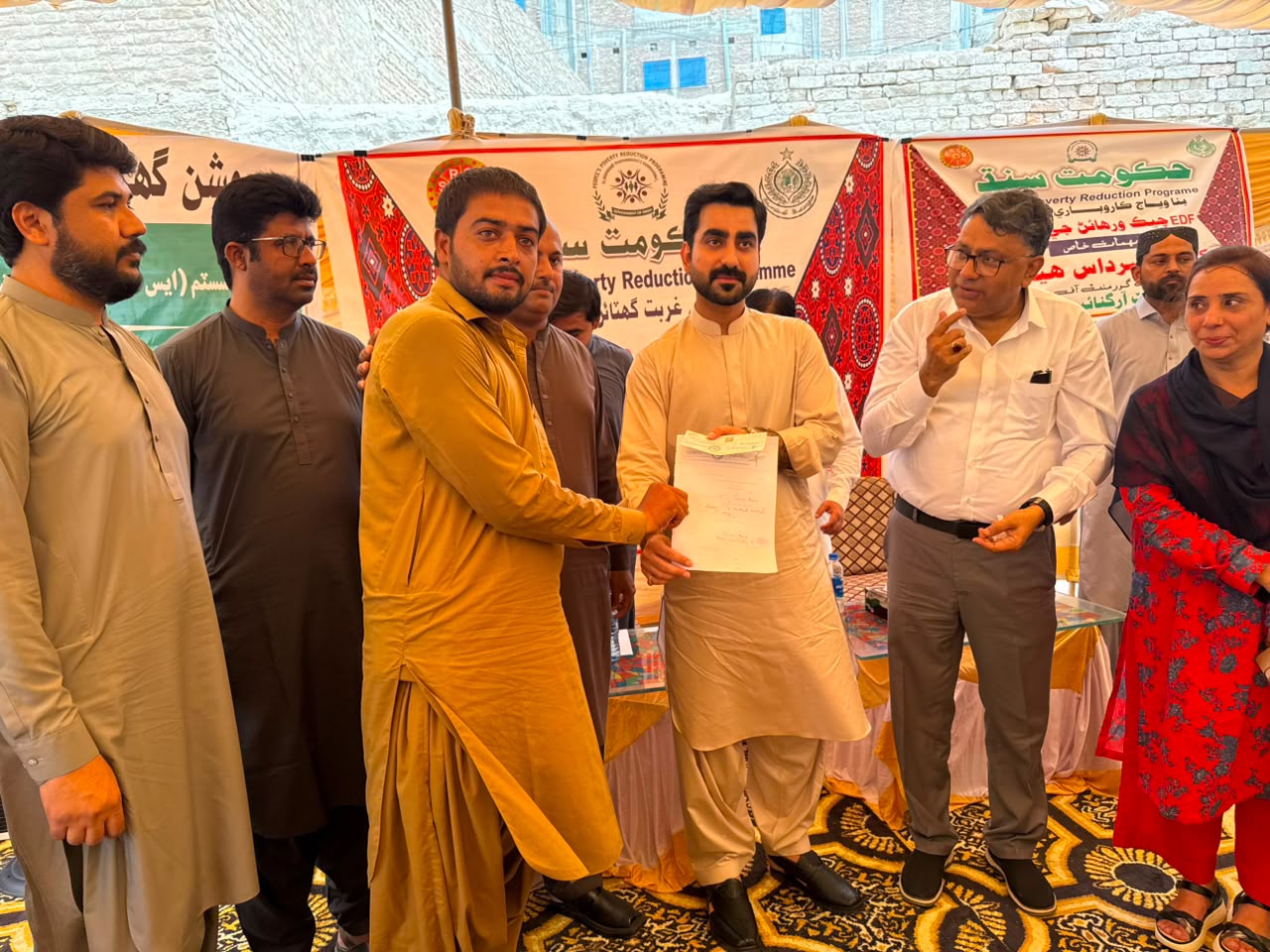
Sindh government spokesperson Sukhdev Hemnani distributed interest-free loan cheques worth Rs10 million among more than 50 deserving people in Ghotki on Tuesday, August 25. The beneficiaries included women seeking funds to start businesses or strengthen existing sources of income. Hemnani also distributed solar kits and plants during the ceremony held under the Peoples Poverty Reduction Programme, or PPRP. Sindh government pushes economic independence Hemnani attended the event as chief guest and handed over loan cheques to the selected beneficiaries. The financing will support businesses, livestock farming, small enterprises and other livelihood activities. One beneficiary received Rs2.5 million to expand a scrap business. Other recipients secured different amounts based on their business plans and economic needs. Read More: Sindh School Crisis: 6,220 Buildings Found Unsafe for Students “We do not want to make people dependent on aid,” Hemnani said. “Our objective is to give them opportunities to stand on their own feet, pursue dignified livelihoods and achieve sustainable economic independence.” The Sindh government funds PPRP, while the Sindh Rural Support Organization implements it in participating districts. SRSO says the programme combines interest-free financing with community organization, vocational training and income-generating support. Focus on women and community-led growth “PPRP is a practical example of PPP Chairman Bilawal Bhutto Zardari’s people-friendly and human-centred development vision,” Hemnani said. “It also reflects the PPP philosophy of roti, kapra aur makaan.” “The PPP believes in empowering people, particularly women, so they can stand on their own feet and play an effective role in improving their families’ economic wellbeing,” he said. “When people receive resources to earn, start businesses and expand their livelihoods, they become able to decide their own future. This is the foundation of sustainable development.” Hemnani said PPRP has benefited more than 1.5 million families across Sindh. The programme supports communities through local participation, employment opportunities, economic activity and interest-free loans. Women remain a central focus of the initiative. Publicly available programme material shows that PPRP uses community institutions and financial inclusion to help rural women enter economic decision-making. The programme expanded to Ghotki in 2021. Earlier PPRP-supported enterprises in the district have used interest-free financing for garments, solar equipment manufacturing and plant nurseries, according to the Associated Press of Pakistan. Solar kits, plants and housing rights Hemnani said the same empowerment approach also guides Sindh Peoples Housing for Flood Affectees, known as SPHF. Under the housing initiative, women receive ownership rights to reconstructed homes. He said those rights improve women’s economic security and strengthen their position within families and society. World Bank project documents also identify women’s ownership and secure housing rights as important parts of resilient reconstruction in Sindh. Read More: Sindh to Cancel Vehicle Registrations Over Unpaid Tax Hemnani reaffirmed that the provincial government would continue expanding sustainable livelihoods and women’s economic participation. He also pledged more opportunities for deprived and disadvantaged communities across Sindh.
“I’m Not a Size Zero”: Kubra Khan Responds to Body-Shamers
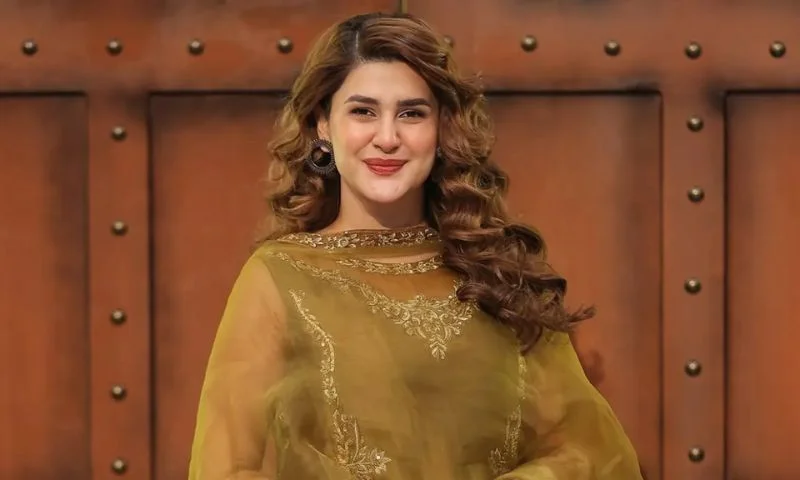
Pakistani actor Kubra Khan has spoken about the body-shaming she faced after appearing opposite Shuja Asad in the drama Doctor Bahu. During a recent interview, Kubra said Pakistan’s entertainment industry often values appearance more than acting ability. She argued that rigid beauty standards prevent many talented performers from receiving fair recognition. Kubra Khan Challenges Industry Beauty Standards “The problem in our industry and culture is that there is a mould, which is so small that everyone can’t fit into it, and unfortunately, I am one of those people who can’t,” she said. According to Kubra, society often expects actresses to remain fair, thin and tall. These expectations create an unrealistic image that many women cannot or do not want to follow. “I’m not a size zero. There is this perception that, in order to be seen as beautiful, a girl has to be thin, tall, and have nice hair. If you do not fit into that mould, you are not good enough,” she said. Criticism intensified after viewers saw her pairing with Shuja Asad. Some social media users claimed that she looked older and bigger than her co-star. Kubra eventually stopped defending herself against such comments. “I’ve been through that for a while, and I stopped justifying it. At the end of the day, it is your opinion,” she said. Although the criticism hurt her, she chose not to argue with online users. “Naturally, I’ve been affected by it quite a lot, but I decided not to respond because that would be like talking to a wall.” She also criticised people who joined online trends built around mocking her appearance. “I would see pictures and videos of people not just being rude but hopping on the trend of others belittling or bullying,” she said. Health Matters More Than Size Zero Instead of chasing unrealistic standards, Kubra now focuses on health and personal well-being. “I need to know that I am healthy. I am not saying that I do not want to be fit or look after myself. Of course, I do. I would want to be a size eight, but not a size zero. I do not want to fit into that mould. I just want to be the best version of myself,” she said. Her message, she added, centres on self-improvement rather than forced conformity. Read More: Mohammed Ahmed Exposes Rise of AI-Written Pakistani Dramas “I want to advocate that being healthy is important, but being the best version of yourself is just as important.” Kubra said her body naturally changed as she grew older. “Earlier in my career, I would fit into that mould. At the end of the day, I am human, and I will grow. I will change. There will be different seasons in my life, and that’s okay,” she said. Doctor Bahu Highlights Women’s Career Struggles Kubra also compared entertainment standards in Pakistan with those in Western industries. “The problem in the East is that the way you look can hinder your talent. However, if your talent is your voice, your appearance should not matter,” she said. “When you look at the West, your appearance is irrelevant. If you are acting well and serving the purpose of the character, that’s great.” Male performers also face visual expectations, she said, while referring to her husband, actor Gohar Rasheed. “If you do not have that same face, beard, or filmy look, then you do not fit the image of a hero,” she said. Turning to Doctor Bahu, Kubra said the drama explores pressure on women to leave their professions after marriage. “Being a doctor is not a joke. Your training starts from childhood. If, at one stage in your life, someone tells you that all of your life’s work is gone because you are to become a daughter-in-law, how would that feel?” she said. Expressing sympathy for women facing such pressure, she added, “Honestly, my heart goes out to everyone who goes through that, and a lot of people do.”
No Signal, No School: Internet Crisis Hits Girls’ Education in KP
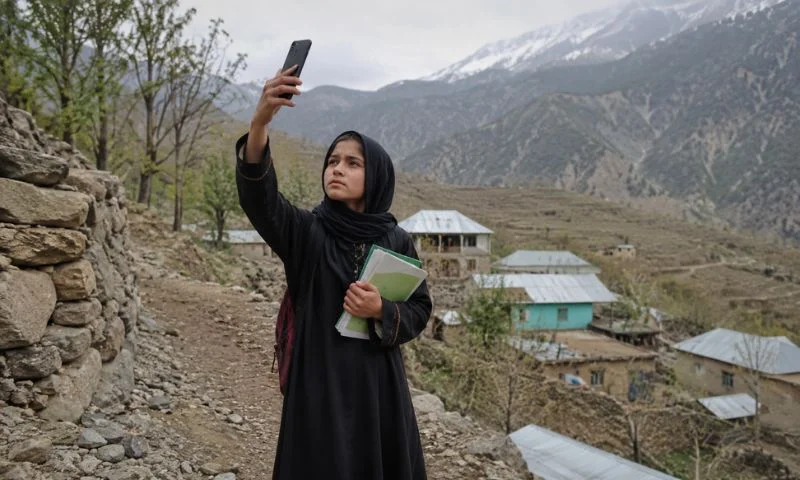
Every morning, 16-year-old Khadija Bibi leaves her Kurram home and climbs a hill. She holds up her phone, searching for enough signal to download notes, submit assignments and attend online classes. “We live in an area where there is still no reliable internet signal,” Khadija told The Express Tribune. “We frequently miss online classes and cannot submit assignments on time.” Khadija studies BS Computer Science at Benazir Women University Peshawar. She described poor connectivity as an obstacle to her education. Read More: Millions Need Help but Funding Is Vanishing, UN Women Warns “The world is talking about 5G technology, but we are still deprived of even basic internet services. This is affecting our education and limiting our future opportunities,” she said. Her experience mirrors the challenges facing girls across Khyber-Pakhtunkhwa’s merged districts. Poverty, insecurity and inadequate schools already restrict education. Unreliable internet has created another barrier despite efforts to expand digital learning. Education and Internet Access Remain Critically Low Residents and education advocates say many schools lack computer labs. Some have designated labs but no computers or internet access. BISP data puts the out-of-school rate at 66 per cent in North Waziristan. It stands at 63 per cent in Bajaur and 61 per cent in South Waziristan. The rate is 51 per cent in Mohmand and Khyber, and 47 per cent in Kurram and Orakzai. The Khyber-Pakhtunkhwa Women Empowerment Policy 2026-2030 says only 11 per cent of women in the merged districts can access the internet. Female literacy stands at just 17 per cent. The province launched it in March 2026 with the KP Commission on the Status of Women and UN Women. Qamar Naseem, programme manager at Blue Veins and Malala Fund Education Champion for Pakistan, said remote communities remained excluded. “Even where network coverage exists, girls often do not own smartphones, cannot afford internet packages and have to rely on borrowed devices,” he said. “In many parts of Khyber-Pakhtunkhwa, particularly the merged districts, girls’ use of mobile phones and the internet is often viewed with suspicion. Families impose restrictions because of concerns over online safety, social pressure, and cultural norms,” he added. Naseem said 35 per cent of women using mobile internet borrow an enabled phone. Only 6 per cent of male users do the same. Experts Demand Connectivity and Better Transport World Bank digital inclusion consultant Karishma Zakiullah said signals alone would not solve the problem. Women also need improved mobility. “Extending Bus Rapid Transit (BRT) services to the merged districts would improve access to education, training centres and employment.” Read More: Pakistan Ends Taxes on Sanitary Pads and Contraceptives, Netizens React “Even today, girls in the merged districts continue to face inadequate digital infrastructure and limited educational opportunities. The government and telecommunications authorities must prioritise these districts and ensure they receive the same quality of internet services available in settled areas,” she said. The Express Tribune said KPITB and PTA did not answer repeated requests for comment.
Mohammed Ahmed Exposes Rise of AI-Written Pakistani Dramas
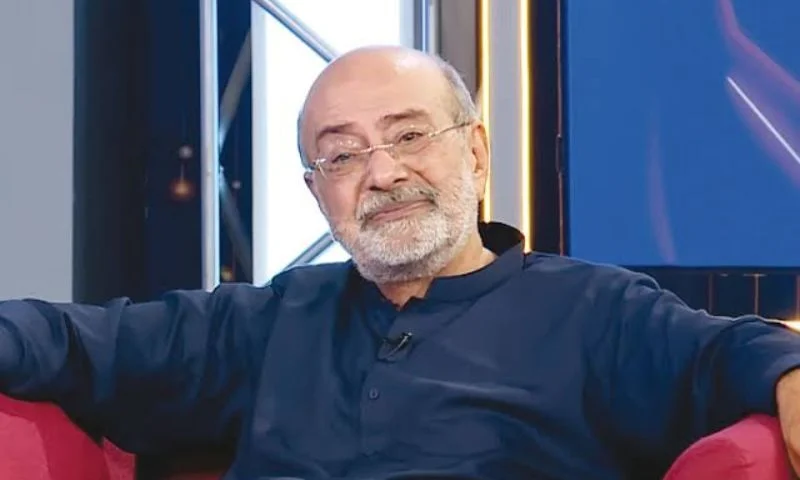
Veteran actor and screenwriter Syed Mohammed Ahmed has criticised AI use in Pakistan’s television industry. He says some writers now use AI to produce complete 26-episode drama scripts. Speaking to Sheeba Khan on the Dareecha podcast, Ahmed said writers often lose control after producers take over. He named writer Sarah Majeed as an example. “Sarah Majeed is a good writer. She’s young, she has a knack for fun writing, but who are the ones getting this writing done, what do they do? They twist [writers’] arms.” Ahmed said producers had also ordered him to remove material from one of his serials. “My own serial, that I’d written 17 episodes of, did they not ask me to delete everything past episode 11?” Ahmed now lets producers alter his scripts when rewrites fail. “I gave them permission because my thoughts are my own. I can’t write as Sheeba, now can I?” he said. “So then I say, ‘Sheeba, this is what I’ve written, now you can tear it apart, do whatever you want to it.’” AI Dialogue Does Not Fit Pakistani Culture Ahmed said some writers have stopped making a serious effort because production teams will rewrite their work. “A lot of writers are now writing 26-episode scripts with the help of AI,” he said. “And you can tell it’s with AI, because these writers don’t even try to change the dialogue to fit our culture.” “It’s not in the language that we speak because AI just wrote it and gave it to you,” he added. Ahmed said he needs 10 to 11 months to write one serial. “Then how are they churning out four serials a day? It’s not humanly possible,” he exclaimed. He also raised concerns about uncredited labour. Ahmed said recognised writers use students, while content teams edit AI-generated drafts without credit. “Names sell. [Production houses] want so and so to write because their name sells,” he said. Why Ahmed Stopped Writing Dramas Ahmed said financial pressure leaves many writers unable to challenge studios. However, he chose to stop writing. “They’re desperate, everyone needs to earn money and run their household, I do too, I just decided not to write anymore,” he said. “I can’t write toxic mothers and daughters-in-law, I just can’t.” He recalled writing a drama about an issue that could empower women and girls. Producers responded with what he called “such a deafening silence.” “It would have exposed men,” Ahmed said. “This is a secret we’ve suppressed for so long because we need our daughters-in-law as punching bags.” He believed the drama would have made “men,” “mothers-in-law” and television channels cry. Yet, he said, “All these educated producers, or so-called educated producers, they went silent on it.” Ahmed warned that someone could later take his idea and ask another writer to develop it. He asked Khan to remember him if that happened.

Pakistan Launches Rs15 Lakh Loan Scheme for Women
Pakistan has taken a significant step toward expanding women’s financial inclusion after the Securities and Exchange Commission of Pakistan (SECP) approved the country’s first fully digital financing facility designed exclusively for women-led micro, small and medium enterprises (MSMEs). The new financing product, called “Khudmukhtar Khatoon”, will provide Shariah-compliant asset financing ranging from Rs100,000 to Rs1.5 million through a digital platform operated by Walee Financial Services. The initiative aims to address one of the biggest challenges facing women entrepreneurs in Pakistan: access to formal credit. The SECP said women entrepreneurs will be able to complete the entire financing process digitally through a mobile application. The platform will cover application submission, approval, disbursement and repayment. Borrowers will also gain access to an integrated marketplace where they can purchase machinery, equipment and other productive assets needed to grow their businesses. The financing facility will allow repayments in monthly installments over a period of up to one year. Addressing Pakistan’s Gender Financing Gap The launch comes at a time when policymakers and regulators are focusing on increasing women’s participation in the formal economy. Although women-owned businesses continue to grow across Pakistan, many entrepreneurs still struggle to secure financing from traditional banks. Women-led enterprises often operate informally and lack the collateral required by conventional lenders. Many business owners also face difficulties navigating complex banking procedures, forcing them to rely on personal savings or support from family members to expand operations. Industry experts believe easier access to financing could unlock substantial economic potential. “The initiative comes at a time when policymakers are increasingly focused on expanding financial access for women, who remain underrepresented in Pakistan’s formal economy despite their growing participation in entrepreneurship. Industry observers note that limited access to credit has long constrained the ability of women-owned enterprises to scale up operations, create jobs and contribute more meaningfully to economic growth,” said Ahmed Ali Siddiqui, Founding Director of the IBA Centre for Excellence in Islamic Finance (IBA CEIF). He added that women-led startups and enterprises can play a major role in Pakistan’s economic development but continue to face financing challenges. Digital Finance Push Gains Momentum The approval also reflects the regulator’s broader efforts to promote digital finance and strengthen alternative financing channels. According to Siddiqui, Pakistan has made notable progress in financial inclusion. More than 17 million new women-owned bank accounts have been opened since 2021. “Expanding access to Shariah-compliant SME financing, credit guarantees and cash-flow based lending solutions can unlock a significant untapped segment and contribute meaningfully to economic growth, job creation and women’s economic empowerment,” he said. SECP data shows that lending non-banking finance companies (NBFCs) disbursed around Rs7.5 billion to approximately 1.7 million micro and small businesses during the six months ending December 2025. Analysts say the success of Khudmukhtar Khatoon will depend on how effectively it reaches women entrepreneurs outside major urban centres. If widely adopted, the model could help narrow Pakistan’s gender financing gap and create new opportunities for women-led businesses across the country. The initiative also supports broader national goals of increasing financial inclusion, encouraging entrepreneurship and promoting sustainable economic growth through greater participation of women in the formal economy.
Experts Warn AI Could Deepen Gender Inequality in Pakistan
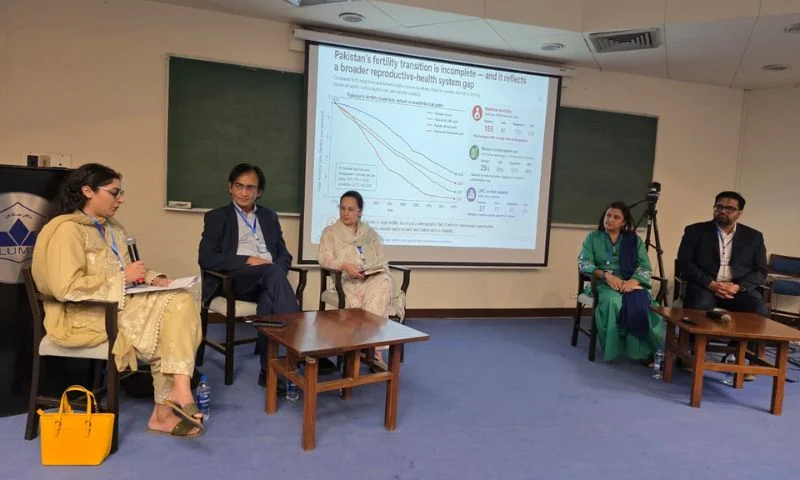
Experts at a gender and economy conference in Lahore warned that artificial intelligence could either unlock major economic opportunities for women or deepen existing inequalities if Pakistan fails to expand digital education and skills training. The discussion took place during a panel on “Health & Gender” moderated by Warda Riaz at LUMS. Panelists included Fyeza Jehan, Usman Ali, Adnan Khan and M. Farhan Majid. Speakers stressed that women’s economic empowerment depends heavily on education, access to information and bargaining power within society. One panelist said affordable learning opportunities and digital skills programmes could help women overcome structural barriers that continue to limit workforce participation and entrepreneurship. “There is a risk that communities with lower skills will be unable to benefit from new technologies,” the panel noted during the discussion. The experts warned that countries failing to invest in digital capacity-building may fall further behind in productivity and global competitiveness. AI Could Transform Women-Led Businesses The panel highlighted how digital tools and AI systems are rapidly reshaping business operations around the world. Referring to survey findings conducted with the Asher Blair Foundation, speakers said women entrepreneurs from nearly 80 countries showed strong interest in adopting generative AI tools. According to the findings, many women business owners wanted to use AI for accounting, payroll management and routine administrative work. Experts said AI could help women-led enterprises reduce time-consuming manual tasks while improving efficiency and productivity. The panel also referenced estimates suggesting Pakistan’s women-focused digital economy could represent a market worth nearly $500 million. That estimate is linked to Pakistan’s female population of around 73 million, highlighting the scale of untapped economic potential. Pakistan has one of the lowest female labor force participation rates in South Asia. The World Bank estimates female participation remains below 25 percent, despite rising smartphone and internet usage. Digital access for women also remains uneven, particularly in rural areas where internet access, digital literacy and educational opportunities remain limited. Digital Divide Could Hurt Long-Term Growth Experts warned that Pakistan’s weak education indicators and low literacy rates could limit the country’s ability to benefit from AI-driven economic transformation. They argued that unequal access to technology may create broader macroeconomic problems in the future. According to the discussion, economies with lower digital adoption could face slower productivity growth and greater dependence on imports. Meanwhile, digitally advanced economies may continue scaling faster through automation and AI integration. The panelists urged policymakers, educational institutions and private companies to invest urgently in women’s digital education and technology-focused training. They said inclusive access to AI skills would play a critical role in ensuring equitable economic growth across Pakistan. Analysts worldwide have increasingly warned that AI may widen social and economic inequality if governments fail to invest in education and workforce adaptation. For Pakistan, experts said the challenge now lies in ensuring women are not excluded from the next phase of technological and economic change.
