


Pakistan has taken a significant step toward expanding women’s financial inclusion after the Securities and Exchange Commission of Pakistan (SECP) approved the country’s first fully digital financing facility designed exclusively for women-led micro, small and medium enterprises (MSMEs). The new financing product, called “Khudmukhtar Khatoon”, will provide Shariah-compliant asset financing ranging from Rs100,000 to Rs1.5 million through a digital platform operated by Walee Financial Services. The initiative aims to address one of the biggest challenges facing women entrepreneurs in Pakistan: access to formal credit. The SECP said women entrepreneurs will be able to complete the entire financing process digitally through a mobile application. The platform will cover application submission, approval, disbursement and repayment. Borrowers will also gain access to an integrated marketplace where they can purchase machinery, equipment and other productive assets needed to grow their businesses. The financing facility will allow repayments in monthly installments over a period of up to one year. Addressing Pakistan’s Gender Financing Gap The launch comes at a time when policymakers and regulators are focusing on increasing women’s participation in the formal economy. Although women-owned businesses continue to grow across Pakistan, many entrepreneurs still struggle to secure financing from traditional banks. Women-led enterprises often operate informally and lack the collateral required by conventional lenders. Many business owners also face difficulties navigating complex banking procedures, forcing them to rely on personal savings or support from family members to expand operations. Industry experts believe easier access to financing could unlock substantial economic potential. “The initiative comes at a time when policymakers are increasingly focused on expanding financial access for women, who remain underrepresented in Pakistan’s formal economy despite their growing participation in entrepreneurship. Industry observers note that limited access to credit has long constrained the ability of women-owned enterprises to scale up operations, create jobs and contribute more meaningfully to economic growth,” said Ahmed Ali Siddiqui, Founding Director of the IBA Centre for Excellence in Islamic Finance (IBA CEIF). He added that women-led startups and enterprises can play a major role in Pakistan’s economic development but continue to face financing challenges. Digital Finance Push Gains Momentum The approval also reflects the regulator’s broader efforts to promote digital finance and strengthen alternative financing channels. According to Siddiqui, Pakistan has made notable progress in financial inclusion. More than 17 million new women-owned bank accounts have been opened since 2021. “Expanding access to Shariah-compliant SME financing, credit guarantees and cash-flow based lending solutions can unlock a significant untapped segment and contribute meaningfully to economic growth, job creation and women’s economic empowerment,” he said. SECP data shows that lending non-banking finance companies (NBFCs) disbursed around Rs7.5 billion to approximately 1.7 million micro and small businesses during the six months ending December 2025. Analysts say the success of Khudmukhtar Khatoon will depend on how effectively it reaches women entrepreneurs outside major urban centres. If widely adopted, the model could help narrow Pakistan’s gender financing gap and create new opportunities for women-led businesses across the country. The initiative also supports broader national goals of increasing financial inclusion, encouraging entrepreneurship and promoting sustainable economic growth through greater participation of women in the formal economy.
Experts Warn AI Could Deepen Gender Inequality in Pakistan
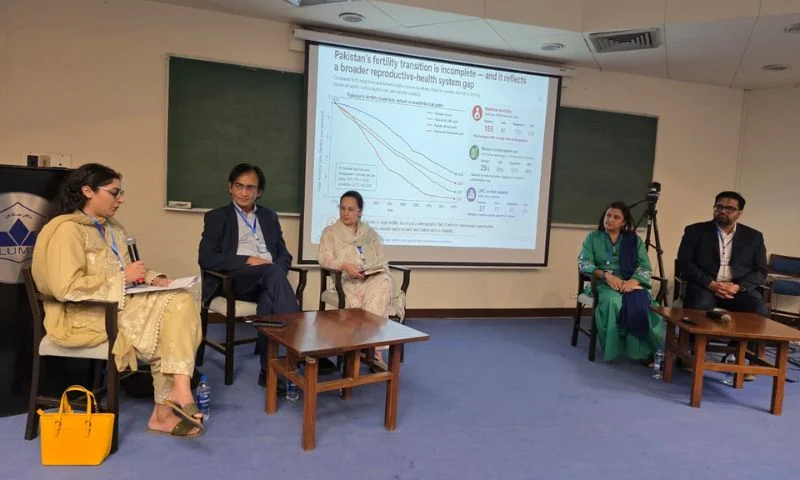
Experts at a gender and economy conference in Lahore warned that artificial intelligence could either unlock major economic opportunities for women or deepen existing inequalities if Pakistan fails to expand digital education and skills training. The discussion took place during a panel on “Health & Gender” moderated by Warda Riaz at LUMS. Panelists included Fyeza Jehan, Usman Ali, Adnan Khan and M. Farhan Majid. Speakers stressed that women’s economic empowerment depends heavily on education, access to information and bargaining power within society. One panelist said affordable learning opportunities and digital skills programmes could help women overcome structural barriers that continue to limit workforce participation and entrepreneurship. “There is a risk that communities with lower skills will be unable to benefit from new technologies,” the panel noted during the discussion. The experts warned that countries failing to invest in digital capacity-building may fall further behind in productivity and global competitiveness. AI Could Transform Women-Led Businesses The panel highlighted how digital tools and AI systems are rapidly reshaping business operations around the world. Referring to survey findings conducted with the Asher Blair Foundation, speakers said women entrepreneurs from nearly 80 countries showed strong interest in adopting generative AI tools. According to the findings, many women business owners wanted to use AI for accounting, payroll management and routine administrative work. Experts said AI could help women-led enterprises reduce time-consuming manual tasks while improving efficiency and productivity. The panel also referenced estimates suggesting Pakistan’s women-focused digital economy could represent a market worth nearly $500 million. That estimate is linked to Pakistan’s female population of around 73 million, highlighting the scale of untapped economic potential. Pakistan has one of the lowest female labor force participation rates in South Asia. The World Bank estimates female participation remains below 25 percent, despite rising smartphone and internet usage. Digital access for women also remains uneven, particularly in rural areas where internet access, digital literacy and educational opportunities remain limited. Digital Divide Could Hurt Long-Term Growth Experts warned that Pakistan’s weak education indicators and low literacy rates could limit the country’s ability to benefit from AI-driven economic transformation. They argued that unequal access to technology may create broader macroeconomic problems in the future. According to the discussion, economies with lower digital adoption could face slower productivity growth and greater dependence on imports. Meanwhile, digitally advanced economies may continue scaling faster through automation and AI integration. The panelists urged policymakers, educational institutions and private companies to invest urgently in women’s digital education and technology-focused training. They said inclusive access to AI skills would play a critical role in ensuring equitable economic growth across Pakistan. Analysts worldwide have increasingly warned that AI may widen social and economic inequality if governments fail to invest in education and workforce adaptation. For Pakistan, experts said the challenge now lies in ensuring women are not excluded from the next phase of technological and economic change.
