

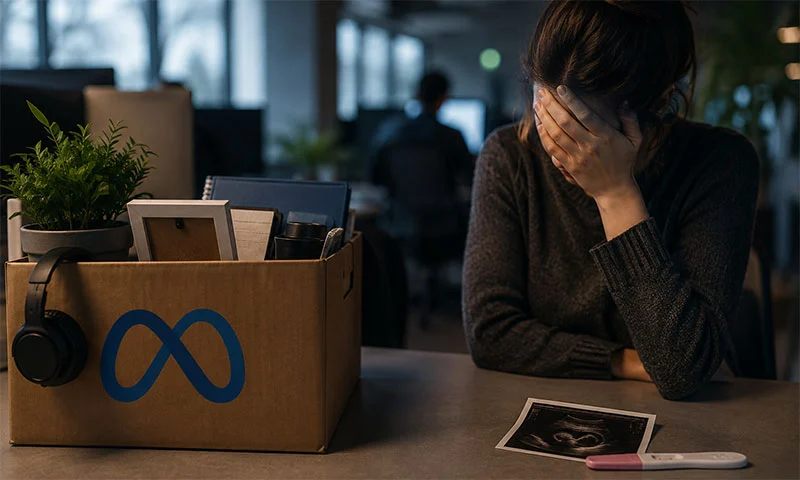
A Meta employee has sparked debate over job security and work-life balance after saying repeated layoffs and restructuring have made her afraid to start a family. Writing anonymously on Blind, a workplace platform that verifies users through corporate email addresses while keeping identities hidden, she said: “I gave up on having kids while I’m at Meta.” Read More: Want to Travel More? This 9-to-5 Employee Shares Her Formula She said the decision followed a conversation with her husband and fears that she could lose her job during pregnancy or maternity leave. “There is absolutely zero guarantee I’ll still be employed here by next year, let alone by the time I’d actually return from mat leave,” she wrote. The account cannot be independently verified. However, it comes amid broader reports of employee anxiety at Meta following major job cuts and a rapid shift toward artificial intelligence. Layoffs and AI Restructuring Fuel Anxiety Meta cut about 10% of its workforce, close to 8,000 jobs, in May 2026. Reuters reported that the company also reassigned around 7,000 employees to AI-focused projects. That followed a February 2025 performance-based round targeting about 3,600 jobs. Some affected workers later disputed Meta’s description of those cuts as focused on low performers. Meta Chief Technology Officer Andrew Bosworth later acknowledged the strain. He said morale was “probably one of the worst it’s ever been,” according to a report on an internal June meeting. Read More: Meta’s New Plan Could Transform 1,000 Pakistani Businesses Blind told Fast Company that 83% of Meta posts discussing AI had turned negative since late 2025. Meta’s culture rating on the platform had also fallen to 2.23 out of five. Employee Says Job Insecurity Changed Family Plans “It’s insane that I’m even writing this, but after a talk with my husband, the realization finally hit me… I have to give up on having a kid while I’m at Meta,” the woman wrote. She blamed “the company’s dynamics, entirely unstable TC, and complete lack of job security” for making family planning feel impossible. “My biological clock is ticking and it’s ticking fast. What if because of this stupid job I’m never able to have kids?” she added. Blind later shared the post on X, where it triggered discussion about work-life balance and delayed family planning. “This has been happening for a long time. It’s why birth rates are low,” one user wrote. Others advised the employee not to put major personal decisions on hold because of professional uncertainty. Meta Says No More Company-Wide Cuts Expected Chief Executive Mark Zuckerberg told employees in May that he did not expect further company-wide layoffs during the rest of 2026. Reuters later reported that he acknowledged mistakes during Meta’s AI workforce transition. Read More: Microsoft Announces 4,800 Layoffs. Here’s What Employees Get The workplace concerns have also reached the courts. In July, 26 Meta employees sued the company, alleging that AI-assisted performance systems unfairly disadvantaged workers who had taken medical, parental or family leave. Meta rejected the allegations and said organisational and workforce decisions were made by people, not AI. The Blind post represents one employee’s experience rather than the views of Meta’s entire workforce. Still, it adds to wider evidence of declining confidence and morale as the technology giant restructures its workforce around AI.

Man Fired Minutes Into Hawaii Vacation as Wife’s Video Goes Viral
A man allegedly fired during a Hawaii vacation has become the centre of a viral debate about workplace loyalty and employee treatment. An X account reposted the clip on July 16, and it attracted more than 1.7 million views by the following day. The woman says her husband’s employer dismissed him through Microsoft Teams on their first full vacation day. Read More: Woman’s Netflix-Style Leave Request for Bali Vacation Goes Viral The couple had reportedly saved for months for the trip. Neither the family nor the company has identified itself. Independent reporting has not verified the circumstances. Family Holiday Interrupted by Unexpected Work Call Dressed in a swimsuit, the woman filmed herself while walking through the Hawaii resort. “So my husband and I both work full-time corporate jobs, and we saved up. We’re in Hawaii. We’re on a beautiful family vacation at a beautiful resort,” the woman said. Her husband is fired in the middle of a vacation. pic.twitter.com/iXuz5uaYOa — Dr.L (@DrAlmarielao) July 16, 2026 She said her husband received a call from his manager at around 9 am local time. “This morning at about 9:00 am Hawaii time, he gets a call from his boss, and says, ‘We need to get you on Teams,’” she said. According to the woman, the company already knew he had taken leave for the week. “Now they know he’s on vacation. He’s supposed to be on vacation the rest of the week. This is our first full day in Hawaii.” Teams Meeting Ends With Sudden Termination The woman said her husband joined the meeting after his manager instructed him to do so. However, the conversation ended his employment within minutes. “He gets on Teams, and within minutes he’s terminated,” she said. She then questioned why the employer contacted him during the holiday instead of waiting for his return. “We’re supposed to just enjoy our vacation like nothing happened?” she asked. Read More: Want to Travel More? This 9-to-5 Employee Shares Her Formula She said her husband also challenged the timing. “He’s like, ‘It couldn’t have waited till Monday? They couldn’t have waited till Monday?’” The woman said they had worked hard and saved specifically for the family trip. She ended the video with a blunt criticism. “There’s just no heart.” Viral Clip Sparks Debate Over Work and Loyalty Many social media users sympathised with the couple. Several argued that workers should avoid answering company calls or emails during approved leave. “That is why I don’t answer any work calls or emails on vacation. The office can burn down to the ground for all I care, I will find out when I am back. No work is ruining my vacation with its existence,” one person wrote. Another commenter warned employees against assuming that loyalty guarantees job security. Read More: Rising Hotel Prices Push Indian Traveler to Book Sri Lanka Instead “This is why you should never ever feel guilty for entertaining other offers of employment even if you are happy at your current job. A company will let you go and act like you never existed,” another said. “This is why I don’t get why people mill themselves for their jobs. Take that time off and go relax somewhere,” a user added. The video has renewed debate about employer conduct during leave and the emotional impact of sudden layoffs. However, the employer remains unnamed, and the company had not issued a public response.

Want to Travel More? This 9-to-5 Employee Shares Her Formula
Lifestyle and travel creator Annie Sharma has sparked discussion online after explaining how she travels regularly while keeping a full-time 9-to-5 job. In an Instagram video, Sharma said people do not always need to leave stable careers to follow their passion for travel. She said better planning, remote work and smart budgeting can make regular trips possible. The video has resonated with users at a time when social media often celebrates quitting corporate jobs for full-time travel. Sharma offered a more practical alternative. “You don’t have to quit your job to follow your passion,” she said in the clip. Planning makes travel possible Sharma said the biggest factor behind her travel routine is advance planning. She usually starts preparing around two months before each trip. “I usually don’t take spontaneous trips because this helps me calculate how much money I need to save, how much the expenditure will be and how many leaves I will take,” she says. She also prefers longer trips instead of short breaks. Most of her trips last around 10 days. “What this helps me do is sandwich two weekends during my trip. I can explore the place on weekends and on weekdays I can also work remotely,” she explains. Sharma said remote work has played a major role in making this lifestyle easier. It allows her to continue working during weekdays while using weekends for sightseeing. She also supports her travel expenses through social media content, sponsored activities and occasional sponsored trips. Message resonates online Sharma ended the video by challenging the popular idea that people must quit their jobs to live more freely. “So the point is, you don’t have to leave your job to follow your passion because everyone on social media is saying you do that. Sometimes all it needs is better planning,” she says. Her message has gained attention because many young professionals struggle to balance career stability with personal goals. Travel experts often advise workers to plan trips around weekends, public holidays and remote work flexibility. Sharma’s approach follows that pattern while keeping financial security intact. Her video also reflects a wider shift in work culture. Since the pandemic, remote and hybrid jobs have made it easier for some employees to travel without fully disconnecting from work. Still, Sharma’s advice depends heavily on job flexibility, employer policy and personal finances. Not every worker can travel while working remotely. Many roles still require physical presence. The report is based on user-generated social media content. Hindustan Times noted that it had not independently verified the claims and did not endorse them.

840,000 Deaths a Year Linked to Work Stress and Long Hours
Workplace stress, excessive working hours and toxic environments are contributing to more than 840,000 deaths globally each year, according to a new international study that highlights the growing health risks tied to modern work culture. The findings point to what experts describe as a silent crisis, where pressures at work are increasingly linked to serious physical and mental health conditions. “More than 840,000 people die each year from health conditions linked to risks such as long working hours, job insecurity, workplace harassment and bullying,” the study said. Read More: Doctors Say Heart Attacks Give Silent Warnings We Often Ignore Growing toll on mental and physical health The research examined how job design, management practices and workplace policies influence employee health. It found that long hours, unstable employment and hostile work environments are major contributors to conditions such as heart disease, depression and anxiety. In some cases, prolonged stress and workplace pressures have also been associated with increased suicide risk. Experts warn that these risks are rising as work patterns shift globally. The expansion of gig work, remote employment and performance-driven corporate cultures has intensified pressure on workers while weakening traditional support systems. The report notes that many workplaces still focus primarily on physical safety, often overlooking psychological well-being despite mounting evidence of its impact. Read More: Anxiety Isn’t Just Overthinking: The Symptoms People Miss and What Helps Calls for urgent action The findings have prompted calls for governments and employers to rethink how work is structured and managed. Specialists say improving working conditions requires a broader approach that includes mental health protections, fair workloads and stronger safeguards against harassment. “Addressing psychosocial risks is not optional. It is essential for protecting both workers and economies,” the study emphasised. Analysts also highlight the economic consequences of inaction, including lost productivity, rising healthcare costs and increased absenteeism. As more people face burnout and chronic stress, businesses and policymakers are being urged to adopt sustainable work models. The study underscores that healthier workplaces are not only a social priority but also a critical factor in long-term economic stability. Read More: Two-Week Digital Detox Shows Major Brain and Mood Benefits

No More Hustle: The Rise of the Reset Weekend Explained
The modern weekend is quietly undergoing a transformation. Once seen as a simple break from work, it is increasingly being treated as a deliberate “reset” period, shaped by rising burnout, digital fatigue and shifting work cultures. Across industries and regions, workers are rethinking how they spend their two days off, prioritising recovery, mental health and personal growth over passive leisure. From downtime to deliberate recovery A growing body of research suggests that how people use their weekends directly affects both mental health and productivity. Studies show that regular relaxation during weekends is “consistently associated with better mental health,” reinforcing the idea that rest is not optional but essential. At the same time, the cost of not switching off is becoming clearer. Research indicates that working on weekends has a significantly stronger negative impact on mental health than weekday overtime, with the effect estimated to be up to twice as severe. This has prompted many professionals to treat weekends more intentionally. Instead of catching up on unfinished work, people are now carving out time for sleep recovery, social connection and activities that provide a psychological break from routine. The shift is also visible in how companies are rethinking work structures. Trials of reduced working weeks have shown that fewer working days can lead to lower burnout and improved wellbeing, without harming productivity. The rise of the “reset weekend” The idea of a “reset weekend” reflects a broader cultural shift away from hustle-driven routines. Surveys show that many workers remain unable to fully disconnect, with one in five spending nearly six hours working over weekends. But that pattern is gradually changing. Experts say people are now focusing on quality over quantity when it comes to rest. Activities such as digital detoxing, outdoor exercise, mindfulness practices and spending time with family are becoming central to weekend routines. Psychologists note that recovery is not just about stopping work, but about engaging in experiences that restore energy and reduce stress. Research has found that positive weekend experiences can improve mood, reduce burnout and even enhance job performance in the following week. “There is a growing awareness that rest fuels performance,” one workplace productivity expert noted, adding that well-rested individuals tend to make better decisions and communicate more effectively. A response to burnout and digital overload The trend is also closely tied to rising levels of workplace stress. Global surveys have shown that a majority of workers report negative work-related stress, driven in part by always-on digital environments. As a result, weekends are becoming a key tool for managing that pressure. Higher-quality sleep during weekends has been linked to reduced exhaustion during the workweek, highlighting the importance of genuine recovery time. For many, the reset now includes setting boundaries such as no emails, limited screen time and structured personal routines. These practices are increasingly viewed not as indulgence, but as necessary for long-term productivity and well-being. The shift reflects a deeper realisation that productivity is no longer defined by constant activity. Instead, it is shaped by balance. As work continues to evolve in the post-pandemic era, the weekend is emerging not just as a pause, but as a strategy. A carefully used reset that determines how the week ahead will unfold.
