

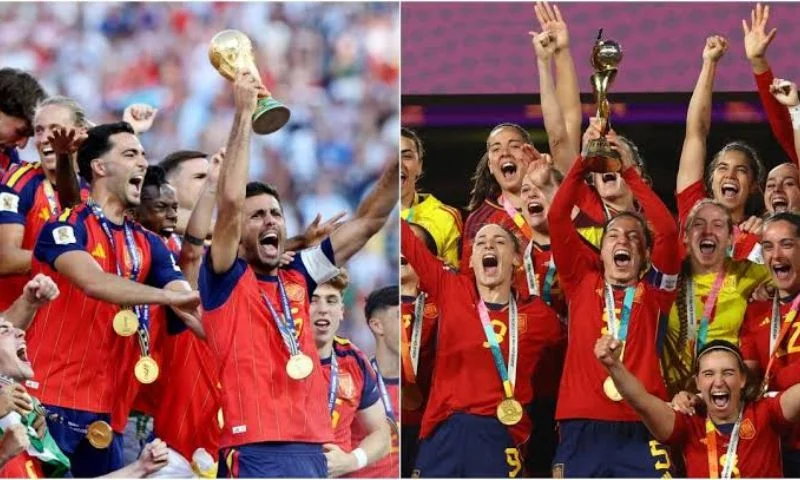
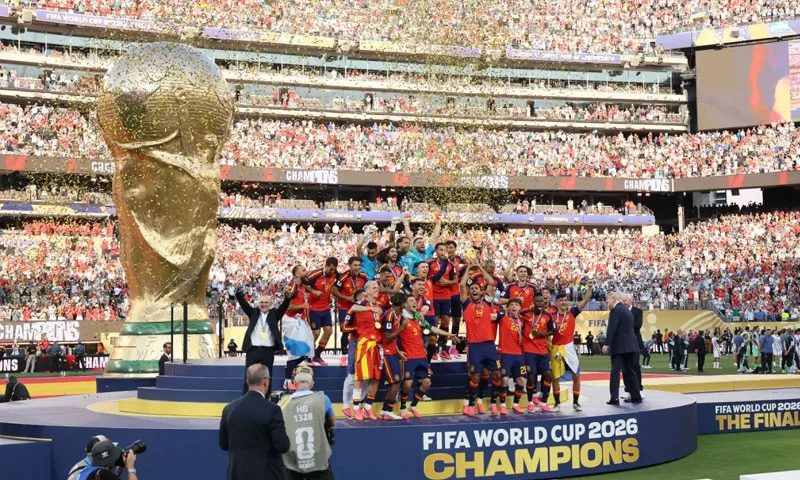
Spain has achieved a historic milestone in international football after winning the 2026 FIFA World Cup and becoming the first nation to hold both the men’s and women’s World Cup titles simultaneously. La Roja defeated defending champions Argentina 1-0 after extra time in the World Cup final at MetLife Stadium in East Rutherford, New Jersey, on Sunday. Substitute Ferran Torres scored the decisive goal in the 106th minute, securing Spain’s second men’s World Cup title and its first since lifting the trophy in South Africa in 2010. The victory completed an unprecedented double for Spanish football. Spain’s women’s national team claimed its maiden FIFA Women’s World Cup title in 2023 after defeating England 1-0 in Sydney, Australia. No country had previously held both the men’s and women’s World Cup crowns at the same time, making Spain the first to accomplish the feat in FIFA history. Spain Rewrites Football History Spain’s triumph capped an extraordinary period for the country’s football program, which has consistently produced elite talent across both the men’s and women’s games. The 2026 final was decided by Ferran Torres after a tense contest in which Argentina struggled to threaten Spain’s defense. Reuters reported that Argentina failed to register a shot on target and finished the match with 10 players after Enzo Fernandez received a second yellow card in stoppage time. Spain’s disciplined performance extended its remarkable unbeaten run under coach Luis de la Fuente and reinforced its status as one of world football’s dominant forces. According to USA TODAY, Spain also earned $50 million in prize money and a championship ring for winning the tournament. However, FIFA’s official prize structure awards $51 million to the winning national federation as part of a record tournament prize pool worth $871 million. The funds are paid to the federation, which decides how they are distributed among players and staff. Spain Joins Football’s Greatest Nations Spain’s latest World Cup success adds another chapter to one of football’s most successful eras. The men’s team previously won the FIFA World Cup in 2010 and the UEFA European Championship in 2008, 2012 and 2024. The women’s side has also emerged as a global powerhouse after winning the 2023 Women’s World Cup and continuing to challenge for major international honors. Read More: Spain Breaks Messi’s Heart to Win the 2026 FIFA World Cup The 2026 FIFA World Cup was the largest in history, featuring 48 teams across the United States, Canada and Mexico. The tournament concluded at a packed MetLife Stadium before more than 80,000 spectators and global television audiences. Spain lifted the trophy after captain Rodri received it from FIFA officials during the closing ceremony. Spain’s achievement now stands alone in football history. While several nations have dominated either the men’s or women’s game for extended periods, none had previously managed to reign as world champions in both competitions at the same time. The remarkable double further strengthens Spain’s reputation as the current benchmark in international football and marks one of the sport’s most significant milestones.
Spain Breaks Messi’s Heart to Win the 2026 FIFA World Cup
Spain won the 2026 FIFA World Cup on Sunday after Ferran Torres scored a dramatic extra-time winner to secure a 1-0 victory over defending champions Argentina, denying Lionel Messi a dream farewell on football’s biggest stage. Torres struck in the 106th minute at MetLife Stadium in East Rutherford, New Jersey, capping a dominant Spanish performance in front of a crowd of 80,663 that included US President Donald Trump. The victory handed Spain only its second World Cup title, 16 years after lifting the trophy for the first time in South Africa in 2010. Read More: Messi Effect? FIFA World Cup Final Tickets Break US Record For Argentina captain Messi, almost certainly appearing in his final World Cup match at the age of 39, the defeat ended hopes of adding a second World Cup title to his glittering career. Spain’s disciplined defence ensured Argentina failed to register a single shot on target across 120 minutes. Torres Delivers the Decisive Moment Spain controlled possession and created the better chances throughout the contest, but Emiliano Martinez repeatedly frustrated Luis de la Fuente’s side with a string of crucial saves. 🇪🇸 The moment Ferran Torres unleashes a thunderbolt in extra time to send Spain into World Cup final ecstasy! 🏆 The winner that crowned La Roja champions — pure magic in the 106th! pic.twitter.com/CjflwT13aY — FIFA World Cup Stats (@alimo_philip) July 20, 2026 The breakthrough finally arrived after Nico Williams nodded Pedro Porro’s lofted cross into the path of Torres, who hammered an unstoppable finish into the roof of the net. “Ultimately, the goal belongs to 47 million people, not just me or the 26 players,” Torres said after the victory, referring to Spain’s population. “At the end of the day, all finals are tough; when you’re up against Messi, there’s a certain nervousness, but we always believed in our football and in ourselves.” Read More: Pakistan Sets Sights on 4 Lac Overseas Jobs Ahead of FIFA 2034 Earlier in extra time, Williams thought he had opened the scoring, but Slovenian referee Slavko Vincic ruled out his effort for a marginal foul on Nicolas Otamendi. Frustration Boils Over as Argentina Finish With 10 Men The final developed into a fiercely contested encounter marked by several heavy challenges. Alexis Mac Allister escaped an early booking after catching Dani Olmo with a studs-up tackle, while Spain’s Alex Baena also avoided punishment after catching Messi with an elbow. Argentina continued committing cynical fouls as Spain dictated play. Lisandro Martinez eventually received the first yellow card for bringing down Mikel Oyarzabal before leaving injured and making way for Nicolas Otamendi. President Donald J. Trump presents the World Cup Trophy to Spain, the 2026 @FIFAWorldCup Champions! 🏆 pic.twitter.com/SHsoBhYm1b— The White House (@WhiteHouse) July 19, 2026 Enzo Fernandez’s frustration boiled over late in normal time when he received a booking for dissent before seeing a straight red card in stoppage time for a dangerous challenge on Pau Cubarsi. Argentina entered extra time with only 10 men. Despite the numerical disadvantage, Martinez continued to keep Argentina alive with saves from Lamine Yamal, Pedri and Torres before finally being beaten by the Barcelona striker. Spain Complete a New Era of Success Spain’s triumph capped an outstanding tournament built around a young squad featuring Lamine Yamal, Pedri, Nico Williams and Cubarsi, alongside experienced leaders such as Rodri and Dani Olmo. The victory also reinforced Luis de la Fuente’s remarkable record after guiding Spain to UEFA Nations League and European Championship success before conquering the world. Read More: Why a 64 Team World Cup Could Become Reality in 2030 For Messi, the defeat brought an emotional end to a remarkable World Cup journey that included victory in Qatar in 2022. Although Argentina fell short of retaining their crown, the eight-time Ballon d’Or winner leaves the tournament as one of football’s greatest players. Spain, meanwhile, celebrated a deserved victory after dominating the final from start to finish and proving that their new generation is ready to lead world football.
FIFA Just Made the 2026 World Cup Richer Than Ever Before
FIFA has turned the 2026 World Cup into the richest tournament in football history, with prize money rising by about 50 percent compared to the 2022 edition in Qatar. The expanded tournament, which will be hosted by the United States, Canada and Mexico, will feature 48 teams and 104 matches. It will also distribute a record $727 million among participating nations, according to figures approved by the FIFA Council. Of that amount, $655 million will be paid as performance-based prize money. The biggest reward will go to the eventual champions. FIFA has confirmed that the winning federation will receive $50 million, the largest prize ever awarded to a World Cup winner. The runners-up will earn $33 million, while the third and fourth-placed teams will receive $29 million and $27 million respectively. As a result, the final weekend of the tournament could mean a difference of millions of dollars for the remaining contenders. The increase reflects FIFA’s growing revenues and the commercial strength of the world’s most watched sporting event. FIFA expects the 2023-2026 cycle to generate record income, helping fund larger payments to participating nations and development programs around the world. Every Stage Carries Major Financial Rewards Teams that reach the quarterfinals will each receive $19 million. Meanwhile, nations that advance to the round of 16 will collect $15 million. A place in the newly introduced round of 32 guarantees $11 million. Even countries that fail to progress beyond the group stage will not leave empty-handed. FIFA has allocated $9 million to each group-stage team. In addition, every qualified nation will receive a separate preparation payment of $1.5 million. This means all 48 participants are guaranteed at least $10.5 million simply for reaching the tournament. For smaller football nations, those figures could transform the future of the sport. Football associations often use World Cup earnings to build academies, improve stadiums, expand coaching programs and support women’s football initiatives. Furthermore, the expanded format creates new opportunities for countries that rarely qualify for the tournament. More nations will have access to substantial funding, helping narrow the development gap between football’s traditional powers and emerging teams. Financial Windfall Beyond the Pitch The official prize money represents only part of the financial picture. Successful teams can also benefit from sponsorship agreements, commercial bonuses, broadcasting incentives and player-related endorsement deals. FIFA President Gianni Infantino described the financial package as groundbreaking for global football. “The FIFA World Cup 2026 will also be groundbreaking in terms of its financial contribution to the global football community,” Infantino said when FIFA approved the record funding structure. The tournament will run from June 11 to July 19, 2026, across North America. By the time the final whistle blows, FIFA’s biggest World Cup could also become its most financially significant. For many nations, the rewards may continue long after the trophy has been lifted.
