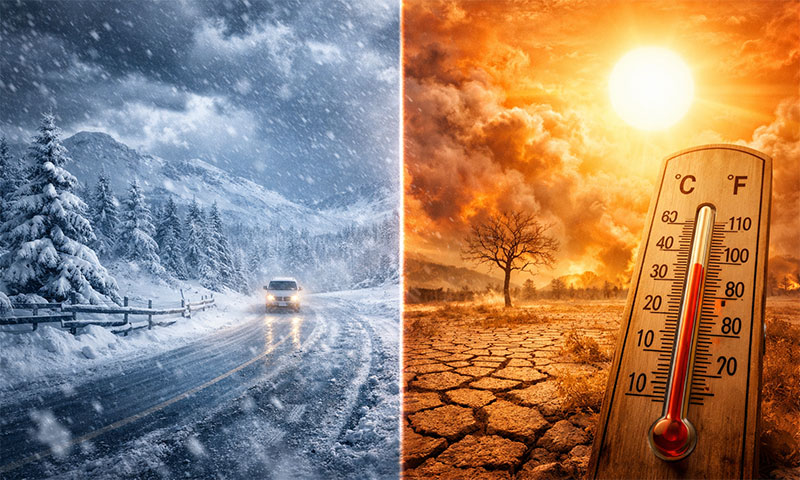
From North America and East Asia to South Asia, this winter has delivered unusually intense snowfall and prolonged cold, setting records and disrupting daily life across multiple regions. Countries including the United States, Japan and Russia have reported historic snow accumulation, while Pakistan’s northern areas and Balochistan have also experienced some of the heaviest snowfall in years — prompting renewed discussion among scientists about how climate change is reshaping weather extremes. In Pakistan, the impact has been particularly striking. Gilgit-Baltistan, upper Khyber Pakhtunkhwa and northern Balochistan have faced persistent snowstorms, road closures and freezing temperatures. Notably, Quetta and Abbottabad recorded widespread snowfall after many years, an event residents and local authorities described as rare فfor urban centres that have seen diminishing snow frequency over the past decade. The Pakistan Meteorological Department (PMD) said the snowfall was linked to strong westerly weather systems interacting with unusually cold air, warning that such intense winter episodes could occur even as long-term temperature trends continue upward. Heavy snowfall has affected Chitral, with over one foot of snow recorded in the town. Roads including the Lawari Tunne remain closed and power supply is disrupted. ❄️#Snowfall #Chitral #Pakistan pic.twitter.com/dKuANHmhRC— Chitral (@ChitralPK) January 23, 2026 A warming world — with sharper cold extremes Climate scientists stress that severe winters do not contradict global warming. According to the World Meteorological Organization (WMO), recent years remain among the warmest on record globally, despite episodes of extreme cold in some regions. WMO Secretary-General Celeste Saulo has said that rising global temperatures are increasing atmospheric moisture and energy, which can intensify weather systems of all kinds — including winter storms. “High land and ocean temperatures are contributing to more extreme weather events across the world,” the WMO noted in its latest global climate update. The Intergovernmental Panel on Climate Change (IPCC) explains that while cold extremes are decreasing overall, climate change is also linked to greater variability and volatility in weather patterns. This means regions can still experience short-lived but severe cold spells, especially when Arctic air masses are displaced southward. Why heavy snow can increase in some regions Scientists note that a warmer atmosphere can hold more moisture, which can lead to heavier precipitation. When temperatures remain below freezing, that moisture falls as snow rather than rain — producing intense snowfall events, even in a generally warming climate. This mechanism has been observed globally this winter — from record snowfalls in parts of Japan to widespread disruption across the United States — and was also evident in Pakistan’s recent snowstorms, particularly in Quetta, Ziarat, Abbottabad and the upper valleys of KP and Gilgit-Baltistan. What lies ahead: colder shocks, hotter summers While winters may still deliver sudden cold extremes, scientists warn that the bigger long-term shift is toward hotter and more dangerous summers. The IPCC projects that as global temperatures rise: Heatwaves will become more frequent and intense Cold spells will be less common but potentially more disruptive Energy demand, health risks and water stress will increase Climate researcher Samantha Burgess of the European Centre for Medium-Range Weather Forecasts (ECMWF), cited in WMO-linked assessments, has warned: “Every fraction of a degree matters. Even small increases in global temperature significantly raise the risk of extreme weather.” For Pakistan, experts say this means greater seasonal contrasts — harsher heatwaves in summer alongside sporadic but powerful winter systems. Urban centres not adapted to snow or extreme cold, such as Quetta and Abbottabad, may face growing infrastructure and public safety challenges. Japan: Today, Sapporo had the heaviest snowfall ever recorded for the month of January.pic.twitter.com/CD9amYLhDE— Volcaholic 🌋 (@volcaholic1) January 25, 2026 Human impact and adaptation Across Pakistan, recent snowfall has already affected transport, water supply and tourism, while freezing temperatures damaged pipelines and left remote communities temporarily cut off. Authorities and climate analysts agree that adapting infrastructure and disaster preparedness to both heat and cold extremes is becoming increasingly urgent. The WMO has repeatedly warned that climate change is no longer a future risk but a present reality, urging governments to strengthen early-warning systems and resilience planning.


