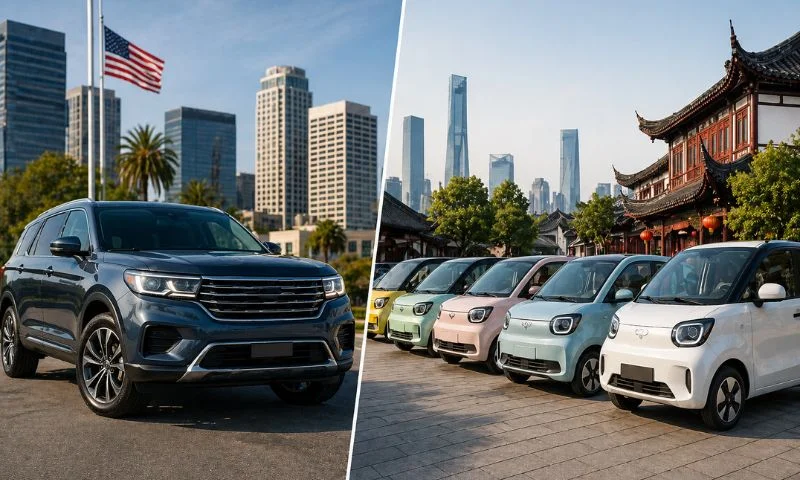
The idea that the price of one American car could buy five Chinese electric vehicles is not far from reality. The average new car in the United States now costs close to $48,000, according to data from Cox Automotive. In contrast, several entry-level EVs in China sell for under $10,000. Models like the BYD Seagull and the Wuling Hongguang Mini EV have become symbols of China’s aggressive push into low-cost electric mobility. Analysts say this pricing gap reflects structural differences in manufacturing, policy, and consumer demand. “The cost advantage Chinese manufacturers have is not marginal, it is structural,” said Tu Le, managing director at Sino Auto Insights. “They have optimized supply chains, local battery production, and scale in a way Western automakers are still catching up to.” Why Chinese EVs Are So Cheap China’s EV boom has been driven by years of state support and industrial strategy. Companies like BYD and SAIC Motor benefit from domestic battery supply chains, lower labor costs, and intense competition among dozens of local brands. Battery prices, which account for a large share of EV costs, have also fallen sharply in China. According to the International Energy Agency, China produces more than 70 percent of the world’s EV batteries, giving its manufacturers a decisive edge. Chinese EVs also tend to focus on urban mobility. Many offer smaller battery packs, shorter driving ranges, and fewer premium features compared to U.S. vehicles. That design philosophy helps cut costs while meeting local demand. “Chinese EV makers design for affordability first, not luxury,” said an analyst at BloombergNEF. “That changes everything from materials to performance expectations.” Read More: Electric Rides & Hybrid Power: Pakistan’s 2026 Car Lineup Preview Barriers in Western Markets Despite the price advantage, most ultra-cheap Chinese EVs are not available in the United States. Trade tariffs, safety regulations, and political tensions limit their entry. The U.S. has also imposed steep tariffs on Chinese EV imports, citing concerns over unfair subsidies. American automakers like Tesla and General Motors focus on higher-margin vehicles. Their models often include longer range, advanced software, and premium features, which push prices higher. Still, the price gap has sparked concern among policymakers and industry leaders. Some warn that Western markets risk falling behind in the race for mass-market EV adoption. “The affordability challenge is real,” said Fatih Birol, executive director of the International Energy Agency. “If electric cars are to scale globally, they must become accessible to a much wider population.” As competition intensifies, analysts expect global automakers to rethink their strategies. Lower-cost EV platforms, localized supply chains, and policy incentives could reshape pricing dynamics in the coming years. Read More: “Not a Fair Fight”: Ford CEO Warns Chinese EVs Could Crush US Auto Industry


