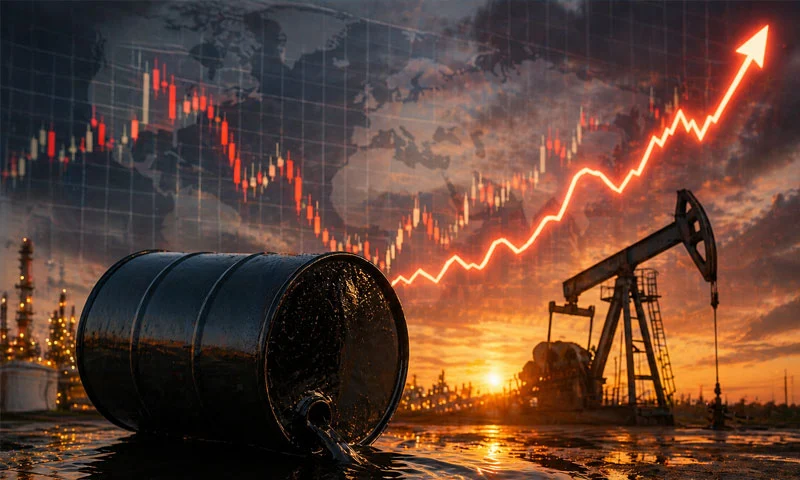
Global markets jolted as the oil price surge global markets intensified following fears that Donald Trump could tighten or prolong measures affecting Iranian oil flows, pushing crude prices sharply higher and fuelling inflation concerns. Oil Prices Spike on Geopolitical Fears Brent crude jumped about 6 percent overnight to a four-year high of $122.53 a barrel. Traders reacted to concerns that the Strait of Hormuz could remain constrained, a critical route for global energy supplies. The sharp rise in oil prices amplified volatility across financial markets. Higher energy costs raised expectations that inflation pressures will persist, especially in major economies. Read More: Oil, Weapons and Gold: The Industries Profiting From the Iran-US Tensions The surge weighed on global bonds, where yields climbed as investors reassessed interest rate outlooks. Markets now expect fewer chances of rate cuts by the Federal Reserve this year. Pricing suggests an almost even chance of a rate hike by next spring. The shift follows one of the most divided Federal Reserve decisions since 1992. Three policymakers opposed an easing bias, while another supported a rate cut. The central bank also warned that rising energy prices were feeding inflation risks. Investors are now closely watching signals from the European Central Bank and the Bank of England, both expected to adopt a more hawkish stance. Markets React as Dollar Strengthens Equity markets in Asia showed resilience despite the broader uncertainty. Technology and artificial intelligence-linked stocks gained support from strong earnings. Futures tracking US tech shares also advanced, reinforcing optimism around AI-driven growth. However, caution persisted as geopolitical tensions continued to shape investor sentiment. “Macroeconomic risks are significant at this juncture, but stock market bulls hope a rosy path for artificial intelligence can continue to offset cyclical weakness,” said Jose Torres, senior economist at Interactive Brokers. Read More: Pakistan Holds Four Weeks of Fuel as Global Oil Routes Face Disruption He added: “If earnings, capital expenditures and outlooks are buoyant, investors could remain sanguine even as the threat of a slowdown in overall activity, loftier borrowing costs and widening credit spreads raise eyebrows.” Currency markets reflected diverging policy expectations. The US dollar strengthened alongside rising yields, while the Japanese yen weakened. Iran Pushes Back on US Measures Iran’s parliament speaker Mohammad Bagher Ghalibaf rejected claims that US actions had disrupted Iran’s oil sector. He said production remained intact despite the measures. Read More: Major Oil & Gas Discovery in Khyber Pakhtunkhwa: What It Means for Pakistan’s Energy Supply “Three days in, no well exploded,” Ghalibaf said. “We could extend to 30 and livestream the well here.” 3 days in, no well exploded.We could extend to 30 and livestream the well here. That was the kind of junk advice the US admin gets from people like Bessent who also push the blockade theory and cranked oil up to $120+. Next stop:140. The issue isn't the theory, it's the mindset.— محمدباقر قالیباف | MB Ghalibaf (@mb_ghalibaf) April 29, 2026 He criticised US officials, including Treasury Secretary Scott Bessent, accusing them of relying on flawed assessments. “They push the blockade theory and cranked oil up to $120+. Next stop: 140. The issue isn’t the theory, it’s the mindset,” he said. The comments highlight escalating rhetoric between Tehran and Washington over sanctions and oil market stability. Analysts say tensions in the region continue to influence global energy prices and investor behaviour.


