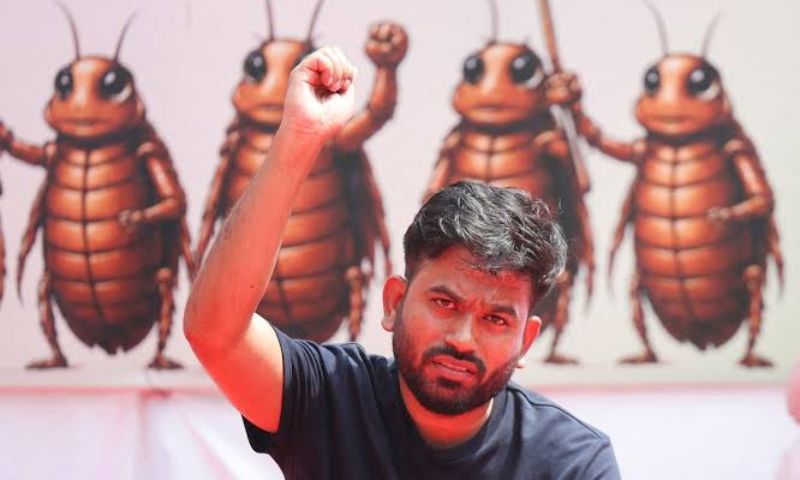
India’s Cockroach Janta Party turned an internet joke into one of the country’s most powerful youth protest movements. Its campaign forced Union Education Minister Dharmendra Pradhan to resign after weeks of demonstrations over alleged examination leaks and failures in the education system. Pradhan announced his resignation on July 25, 2026. Protesters had made his removal their central demand. The decision marked a rare concession by Prime Minister Narendra Modi’s government during a nationwide agitation led largely by students and young professionals. The immediate crisis began after allegations of a paper leak in the May 3 NEET undergraduate medical entrance examination. About two million students took the test before authorities cancelled the results and arranged a retest. Investigators later handed the case to the Central Bureau of Investigation. Officials also discussed computer-based testing for future examinations. The controversy deepened anger over competitive tests, student distress, unemployment and limited opportunities for young Indians. From a Courtroom Remark to a National Movement The movement’s unusual name came from comments by Chief Justice of India Surya Kant during a Supreme Court hearing in May. Reports said he compared some unemployed young people entering media, social activism and other fields to “cockroaches.” He later said media outlets had misrepresented him. He explained that his criticism targeted people who entered professions with fake qualifications. Political communications strategist Abhijeet Dipke responded on May 16 with six words: “What if all cockroaches come together?” The post went viral and inspired the Cockroach Janta Party, or CJP. The group used humour as a political weapon and adopted the cockroach as a symbol of resilience. It described itself as the “voice of the lazy and unemployed.” The phrase turned an insult into a shared identity for frustrated young people. Dipke, 30, had worked with the Aam Aadmi Party’s social media team. He later moved to Boston to study public relations. As the campaign gathered pace, he returned to India and became its most recognisable organiser at Delhi’s Jantar Mantar. Reuters reported that the CJP’s Instagram following reached 25 million. Organisers used memes, AI-generated images, short videos, livestreams and satire to mobilise supporters. Their strategy transformed digital anger into major gatherings across Delhi, Mumbai, Kolkata and other cities. Memes, Hunger Strikes and Street Pressure The CJP held its first major physical demonstration at Jantar Mantar on June 6. Protesters wore cockroach masks and demanded exam reforms, accountability for alleged paper leaks and Pradhan’s resignation. Education reformer Sonam Wangchuk joined the campaign on June 28 and began an indefinite hunger strike. Wangchuk founded the Students’ Educational and Cultural Movement of Ladakh and received the Ramon Magsaysay Award in 2018. Many people also know him as an inspiration for the character Rancho in the Bollywood film 3 Idiots. His fast lasted 26 days and brought wider attention to the movement. He survived on salt and water before his health deteriorated. Doctors admitted him to hospital on July 18. Wangchuk ended the strike on July 23 after government representatives offered assurances on education accountability and relief for affected families. Read More: Viral Video Reveals Disgusting Indian Hotel Practices The demonstrations intensified during a July 20 march towards Parliament. Police used tear gas and batons to disperse protesters, leaving several students injured. The crackdown increased public anger and strengthened demands for action against officers accused of excessive force. CJP continued nationwide demonstrations on July 24. Talks remained stuck because its leaders called Pradhan’s resignation “non-negotiable.” The movement also demanded ₹1 crore for each family of students who allegedly died after examination-related distress. It sought the withdrawal of cases against protesters and action over police violence. Resignation Ends Protest After Government Accepts Demands Pradhan resigned before the next decisive round of negotiations. In his statement, he said: “Considering the situation that has arisen at Jantar Mantar and across the country, so that anti-national forces do not take advantage of this situation … I have sent my resignation letter to the Prime Minister.” Celebrations erupted at Jantar Mantar after the announcement. CJP supporters danced, distributed sweets and raised patriotic slogans. The movement called the resignation a “victory of democracy.” Before the final agreement, Dipke told protesters: “This is democracy. He has resigned. We have two more demands. We won’t go like this.” Later talks changed the situation. Health Minister J.P. Nadda said the government had accepted all demands. These included examination reforms, compensation for affected families and withdrawal of police cases against protesters. Authorities also restored mobile internet around the protest area and reopened nearby metro stations. “The Cockroach Janta Party declares that we withdraw the agitation in good faith,” CJP spokesperson Saurav Das said. Another spokesperson, Ashutosh Ranka, asked supporters to leave peacefully after the agreement. The CJP episode showed how quickly online humour can become organised political pressure. A sarcastic post created a decentralised youth movement, brought thousands onto the streets and delivered a major political setback to the Modi government.


