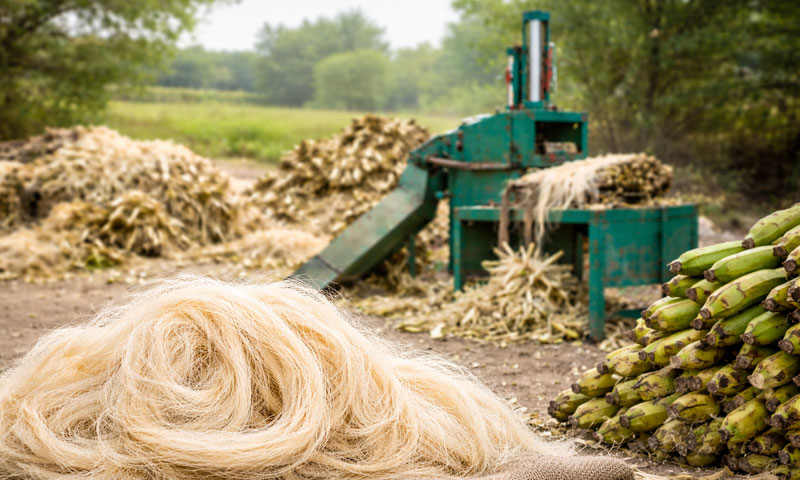
research project by Mohammad Sarfraz, a student from Balochistan University of Information Technology, Engineering and Management Sciences (BUITEMS), has earned international acclaim after winning the Discover Natural Fibre Initiative (DNFI) Award for producing eco-friendly fibre from banana stems. The award was presented during a global research competition held alongside Heimtextil, the world’s leading home textiles exhibition, in Frankfurt. The competition attracted more than 100 research institutions, companies and academic organisations from across the world. Sarfraz’s achievement has been widely praised as a milestone for Pakistan’s emerging presence in sustainable textile research, highlighting the innovation potential of young researchers from underserved regions. Four years of research Speaking after receiving the award, Sarfraz dedicated the recognition to his teachers and to the youth of Balochistan. He told that the project was the result of four years of continuous research, focused on developing a reliable and high-quality method for extracting fibre from banana plant waste. He said the international response to his work was particularly encouraging, especially as it competed directly with projects from European research institutions and developed economies. Academic backing and technical process Dr Mohammad Qasim, Head of the Department of Textile Engineering at BUITEMS and Sarfraz’s research supervisor, said the global recognition confirms that Balochistan’s youth possess capabilities equal to any in the world. He explained that the project involves three main stages: Extraction of natural fibre from discarded banana stems Conversion of the fibre into yarn and composite materials Production of fabric and finished textile products “With access to opportunities and industry linkages, Pakistan’s name can be projected globally through innovation,” he said. Industry interest and European collaboration Industrial support for the project was provided by the Natural Fibre Company, whose director Mohammad Fawwad Supriya described the award as a moment of pride for Pakistan. He revealed that European companies attending Heimtextil showed strong interest in the banana fibre technology. As a result, a partnership agreement with a German company has already been signed to manufacture and market banana-waste-based products in Germany and other European markets. Economic and social impact According to Fawwad, the project has the potential to reduce poverty and generate employment in marginalised regions of Sindh and Balochistan, where banana farming produces large volumes of agricultural waste. Fibre production has already begun in Sukkur and Lasbela, while the next phase aims to expand operations to 4,000 households. To support this expansion, Sarfraz has designed specialised fibre-extraction machines locally. Each unit, consisting of two machines, is expected to cost between Rs700,000 and Rs800,000 and can produce up to 1,000 kilograms of fibre per acre of banana waste. The fibre will be used by skilled artisans in Sindh, Balochistan and Punjab to produce handmade and traditional textile goods. Billion-dollar potential Fawwad said Pakistan has the capacity to produce up to 500 million kilograms of natural fibre annually from banana waste alone, with an estimated global market value of $1 billion. He added that fibre-based exports could generate substantial foreign exchange earnings for the country. Pakistan is among the world’s major banana-producing countries, generating millions of tonnes of agricultural waste each year. Much of this waste is either burned or dumped into rivers, contributing to air and water pollution. Experts say initiatives like Sarfraz’s not only open new economic pathways but also offer environmentally sustainable solutions, turning waste into value while positioning Pakistan within the global green textile movement.


