

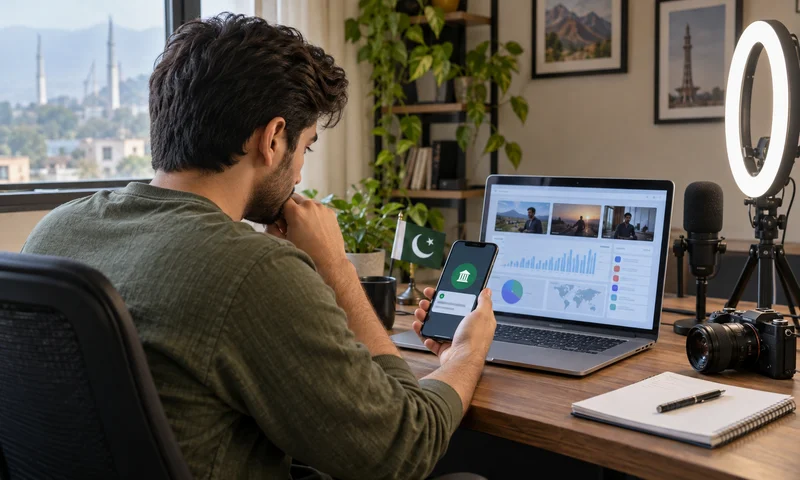
The Federal Board of Revenue (FBR) will ensure a 5% withholding tax deduction from revenues that digital content creators and social media influencers receive through banking channels. The measure took effect on July 1, 2026, and applies to income received from social media platforms. Banks and non-banking financial institutions must deduct the tax when they credit or receive a qualifying payment in a person’s account. An income tax circular issued by the FBR on Tuesday explained the measure, which forms part of the changes introduced through the Finance Act, 2026. Banks Responsible for Tax Deduction The Finance Act inserted Section 154B into the Income Tax Ordinance, 2001. It requires every banking and non-banking financial institution to deduct tax when processing revenue received from social media platforms. Division IIIAB of Part III of the First Schedule sets the withholding tax rate at 5%. Read More: FBR Makes Sales Tax Registration Easier for Businesses The law defines a “digital content creator” or “social media influencer” as an individual or entity earning income from creating, publishing or monetising content on digital platforms. The definition specifically covers YouTube, Facebook, Instagram and TikTok. Its wording also allows the FBR to bring similar platforms within the tax regime. The provision has broad implications for Pakistani YouTubers, vloggers, streamers, publishers and other online creators who receive platform-generated revenue through local accounts. Remittances and Digital Payments Covered Section 154B also defines the type of “payment” subject to the deduction. It includes inward remittances, transfers and credits received through banking channels. Payments routed through intermediaries are also covered. These may include online payment service providers and digital financial platforms used to transfer creators’ overseas earnings into Pakistan. Under the mechanism, the financial institution processes the deduction when the money reaches the recipient’s account. Creators will therefore receive the remaining amount after the institution withholds the applicable tax. The provision focuses on revenue that can be identified as coming from social media platforms. The FBR may issue further rules through an official Gazette notification to govern identification, reporting and implementation. The official FBR withholding tax rate card also lists a 5% rate under Section 154B for revenues received by digital content creators and social media influencers. Different Treatment for Residents and Non-Residents The legal status of the deduction depends on whether the recipient is a resident or non-resident taxpayer. For a resident person, the amount deducted constitutes minimum tax. This means the 5% deduction establishes the minimum tax treatment for income covered by the provision. Read More: New FBR Rule Hits Digital Creators With 5% to 10% Tax For a non-resident person without a permanent establishment in Pakistan, the deduction constitutes final tax. Such a recipient generally faces no further Pakistani tax liability on that particular income after the deduction. A consequential amendment to Section 169 supports this final-tax treatment for qualifying non-residents. The separate 5% regime distinguishes social media platform revenue from certain IT and IT-enabled service exports. The Finance Act, 2026 extended the reduced 0.25% rate for eligible Pakistan Software Export Board-registered exporters through tax year 2029.

Survey Shows Public Support for 5% Tax on Social Media Creators
A majority of Pakistanis support the government’s proposal to impose a 5 percent withholding tax on income earned by social media influencers, according to a new survey by the Press Network of Pakistan (PNP). However, respondents also urged policymakers to protect small creators through exemptions and supportive measures. The online survey was conducted after the government announced the proposal in the Finance Bill 2026. It included responses from 100 participants, comprising 45 men and 55 women. The findings showed broad support for bringing digital creators into Pakistan’s formal tax system. At the same time, respondents stressed that taxation should not discourage young entrepreneurs or people entering the digital content industry. The proposed 5 percent withholding tax forms part of the Finance Bill 2026. The government says the measure aims to document income generated through social media platforms and improve tax collection. Officials from the Federal Board of Revenue (FBR) have noted that earnings from digital platforms have grown rapidly in recent years while much of that income remains outside the country’s tax net. According to government estimates, Pakistan’s social media economy generates between Rs4 billion and Rs10 billion annually. Survey highlights support for fair taxation The PNP survey gave the proposed 5 percent withholding tax an average support score of 3.42 out of 5. Meanwhile, respondents expressed even stronger support for the broader principle that influencers should pay taxes like other professionals and businesses. That statement received an average score of 3.89 out of 5. However, participants also recognised potential challenges. They gave an average score of 3.34 out of 5 to concerns that the tax could discourage young people from pursuing careers in digital content creation. Many respondents supported exempting smaller creators from the proposed tax. The recommendation to exclude influencers earning below a certain income threshold received an average score of 3.88 out of 5. Read More: Why Traditional News Outlets Are Losing Ground to Social Platforms Participants also strongly supported government incentives alongside taxation. That recommendation received the survey’s highest average score of 3.92 out of 5. The report concluded, “As Pakistan’s digital economy continues to expand, balanced policymaking will be essential to ensure that taxation strengthens rather than hinders one of the country’s fastest-growing sectors.” YouTube creators expected to feel the biggest impact The survey also explored which platforms would feel the greatest impact if the proposal becomes law. A total of 53.8 percent of respondents said YouTube creators would face the biggest effect. Another 24.6 percent believed the tax would affect all social media platforms equally. Meanwhile, 9.2 percent selected Instagram, while 6.2 percent identified TikTok. Facebook and blogs or websites each received 3.1 percent of responses. Pakistan’s digital creator economy has expanded rapidly in recent years as thousands of individuals generate income through YouTube, TikTok, Instagram, Facebook and other online platforms. Industry experts say the sector has created new employment opportunities, particularly for young entrepreneurs and freelancers. The survey suggests that most Pakistanis support taxing influencer income. At the same time, they want the government to adopt balanced policies that encourage innovation, protect small creators and promote long term growth in the country’s expanding digital economy.
