

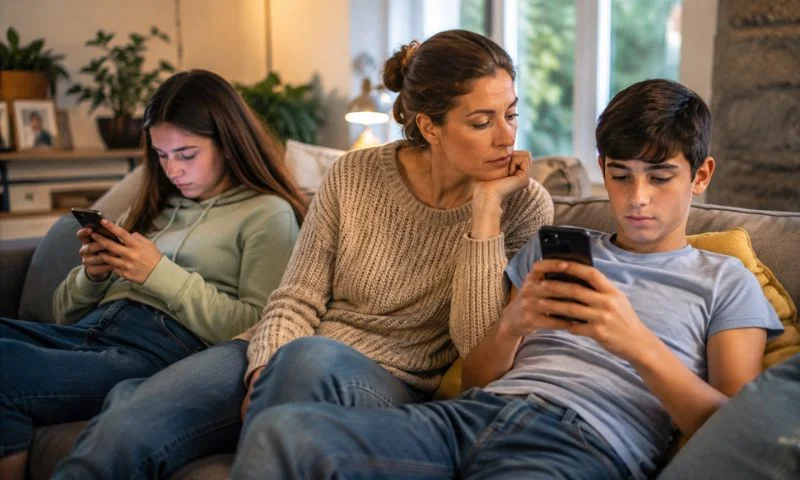
Parents should avoid sudden phone bans and build realistic family habits, experts say. The UK government plans default midnight-to-6am curfews for 16 and 17-year-olds on Instagram, TikTok and YouTube. Teenagers may opt out. Autoplay videos and infinite feeds will also switch off by default to support sleep, focus and family life. Start Small and Work Together Child psychologist Dr Jane Gilmour advises parents to introduce changes during a neutral moment. “Changing a habit is always going to be hard,” she says. “Calm brains communicate best.” A designated charging place can create a routine. “Have one place for chargers… so when the phones go away, they go on the charger and that’s it.” Dr Maryhan Baker says teenagers should help shape screen-time rules. Parents should recognise social pressure rather than dismiss it. “I understand that that’s where you connect with your friends. I understand the social pressure if you’re deemed not to be on this. I really get it. “So let’s have a conversation about how we can begin to create space within our day, and your day where you’re not on that phone all of the time.” Parenting coach Olivia Edwards agrees. “We have to have a strong relationship with our child because that is what’s going to get us towards co-operation [and] teamwork.” Turn Scrolling Into Learning Parents can discuss how platforms hold attention and earn money. Edwards suggests asking: “How do you think social media works? How do you think that app works to keep people looking at it? Did you know they make money off the more time people spend on it?” Gilmour recommends checking online claims together. “There might be content that you can look at together and say, ‘OK, do you think that that is true? How would I figure out if that’s true or not?’” Model Good Habits and Stay Calm Baker urges parents to admit their own struggles. “We’re all guilty of this, I’m not as great on my relationship with [my phone] as I could be.” Gilmour says boredom supports reflection and creativity. “Being on the screen, it keeps us looking at the external world. When we go into our internal world and we sort of stare into space, into the middle distance, it allows us to think about the past, it allows us to visualise the future, it predicts creativity. “So when your kids are protesting [that] there’s nothing to do, they’re just staring into space – that’s OK. And actually that’s a positive thing.” Read More: Doctor Says One Bedtime Habit Could Increase Your Cancer Risk Dr Tony Sampson of the University of Essex warns against panic. “There is a tendency for anxious parents to become caught up in a prevailing media panic and see all adolescent brains as simply hardwired for social media addiction,” he says. “We read a lot about the ways in which social media erodes attention,” Sampson says. “[But] social media does not shorten or erode attention. It captures it and diverts it toward engagement with commercial content.” He adds: “Positive technological use can help boost neuroplasticity for creativity, exploration and learning.”
How Pornographic Content Led to 88,000 Website Bans in Pakistan
The Pakistan Telecommunication Authority (PTA) has blocked more than 88,000 illegal website links during 2024 and 2025, reflecting an intensified regulatory drive to curb unlawful and harmful online content across digital platforms. Official figures show that over 88,000 URLs were restricted as part of the regulator’s ongoing efforts to enforce national laws and maintain digital discipline. The largest share of blocked content involved pornographic and obscene material, underscoring the authority’s continued focus on morality-related violations. Obscene and immoral content leads violations During the reporting period, the PTA blocked 38,214 URLs for hosting obscene or immoral material. Officials said such content was targeted to prevent the spread of material considered damaging to public decency and social norms. Another major category involved content related to national security and defence, with 31,313 URLs blocked for material deemed harmful to Pakistan’s security interests. The authority also restricted 7,608 website links for content found to be offensive to the dignity of Islam, while 6,269 URLs were taken down for promoting sectarianism or hate speech, highlighting ongoing concerns over online extremism and incitement. Defamation and court-related violations The report further revealed that 2,498 URLs were blocked for defamation and forgery-related content. An additional 353 links were restricted for hosting material considered contempt of court. Smaller numbers of websites were also blocked for other violations, including 15 URLs linked to proxy services and 1,765 URLs restricted under miscellaneous categories. Social media platforms under scrutiny Social media platforms accounted for a significant portion of the blocked content. TikTok topped the list, with 35,000 URLs restricted. This was followed by Facebook with 25,482 URLs, Instagram with 13,242, and YouTube with 8,586 URLs blocked. Other platforms included X with 2,103 URLs, Likee with 991, and Snack Video with 345 URLs restricted. Only three URLs were blocked on Dailymotion, indicating comparatively lower violations. Strengthening digital oversight PTA officials say the enforcement actions align with the authority’s mandate to promote a safer and more responsible digital environment. The regulator continues to monitor online platforms closely and coordinate with service providers to ensure compliance with Pakistan’s legal and regulatory framework. The scale of blocked content highlights the growing complexity of digital governance, as well as the government’s determination to tackle unlawful online activity amid rapidly expanding internet use.
