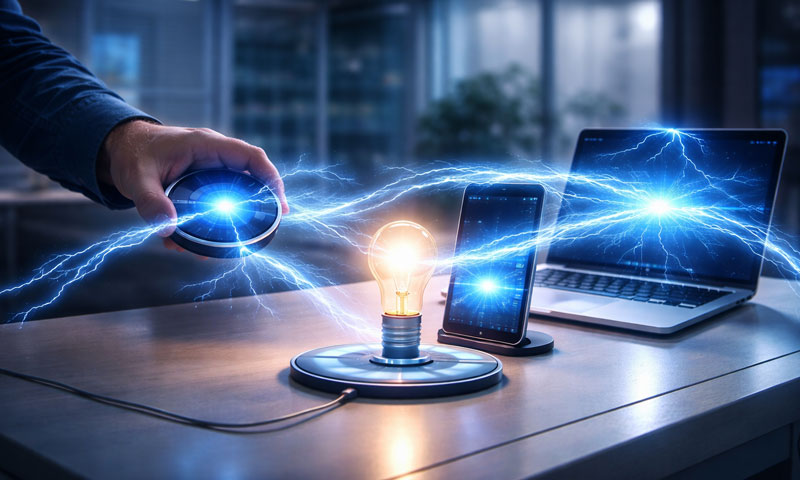
In a breakthrough that could redefine how electricity is delivered, scientists in Finland have successfully transmitted electrical energy through the air without using wires, combining sound waves, lasers, and radio-frequency technology in a controlled laboratory experiment.
The research demonstrates that electricity can be guided across space without physical cables — a development that challenges the long-standing assumption that power must travel through metal conductors. While the technology is still experimental, researchers say it opens the door to a future where plugs, wires, and charging cables could become optional.
How the experiment worked
The Finnish scientists used a carefully engineered mix of high-intensity ultrasonic sound waves, laser beams, and radio-frequency (RF) energy harvesting. Together, these tools allowed them to create invisible pathways in the air along which small amounts of electrical energy could safely travel.
At the heart of the experiment is a concept known as the “acoustic wire.” Ultrasonic waves were used to shape the density of air, forming a narrow, controlled channel. Along this channel, tiny electrical discharges were guided precisely, mimicking the role of a physical wire — but without any solid material.
Lasers played a complementary role by transmitting energy as light, which could then be converted into electrical power at a receiving point. Meanwhile, RF harvesting captured ambient electromagnetic energy already present in the environment to power low-energy devices such as sensors.
Who led the research
The work was carried out by research teams from University of Helsinki and University of Oulu, in collaboration with private-sector partners developing next-generation power-by-light and wireless energy systems.
Researchers described the project as a fusion of physics, electrical engineering, and applied innovation, aimed not at science fiction, but at real-world applications.
Is this “wireless electricity” as people imagine?
Not quite. Scientists caution that this is not unlimited, free-floating electricity moving across cities or continents. Instead, the breakthrough lies in field-guided energy transmission — meaning the energy is carefully controlled and directed, not randomly dispersed.
The system currently delivers small, precise amounts of power, suitable for electronics, sensors, and smart devices rather than heavy machinery. However, researchers say improving efficiency and range is the next major challenge.
Why this matters
The experiment challenges the century-old dominance of wired electrical systems. If scaled successfully, it could lead to:
Cable-free industrial sensors
Safer power delivery in hazardous environments
Reduced wear and tear from physical connectors
New designs for smart homes, factories, and medical devices
Because no physical contact is required, the technology could also improve safety and durability in places where wires are prone to damage.
Is Finland leading the way?
Wireless charging already exists globally for phones and wearables, but Finland is among the first countries to combine sound, light, and radio waves to transmit electricity in a coordinated, practical demonstration.
While similar ideas have been explored elsewhere, researchers say this experiment stands out for its precision, stability, and potential for real-world use.
What comes next
Scientists stress that the technology is still in its early stages. Scaling it for higher power levels, longer distances, and everyday consumer use will require years of further research. Still, the findings suggest that the future of electricity may not be tied to wires alone.