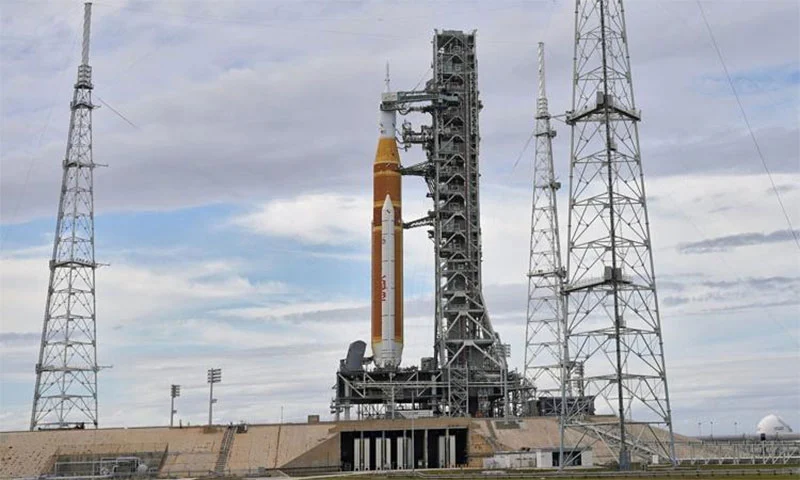
The National Aeronautics and Space Administration (NASA) has entered a decisive phase in preparations for its Artemis II mission, the first crewed lunar mission in more than 50 years, with a full-scale practice countdown taking place this week at Kennedy Space Center.
This comprehensive rehearsal — known as a wet dress rehearsal — tests launch systems and procedures in real time and ensures NASA is ready to send astronauts beyond Earth orbit again.
The practice countdown involves loading the giant Space Launch System (SLS) rocket and the Orion spacecraft with hundreds of thousands of gallons of super-cold rocket propellant, moving through launch configurations, timing the countdown, and rehearsing abort scenarios and system checks. The process stops just before ignition.
“This rehearsal is critical,” said Jim Free, NASA’s Associate Administrator for Exploration Systems Development. “We’re taking the time to know that every system we ask our crew to rely on is proven, tested, and ready for this mission.”
He added that the countdown primarily focuses on “fueling operations, communication networks, and crew safety checks that might be impossible to test any other way.”
Why the Practice Countdown Matters
Practice countdowns are not simple technical dry runs. They serve as the final chance to spot issues in hardware, software, or launch procedures before a mission carrying astronauts leaves Earth. NASA engineers watch how components behave under real-world loading conditions and how teams coordinate in a live, timed environment.
According to NASA Flight Director Mellisa Thompson, the practice countdown is as close as you can get to an actual launch without flying. “We verify all critical connections, life support interfaces, rocket performance, and contingency plans,” she said. “Doing this now keeps our astronauts safe and prevents surprises once we commit to the real countdown.”
Because Artemis II will be NASA’s first crewed lunar mission since Apollo 17 in 1972, the practice countdown carries extra scrutiny. Any failure during this rehearsal could delay the launch window and require repairs that might push the date back further.
Broader Implications for NASA’s Moon Goals
Artemis II is scheduled no earlier than February 8, 2026 and will send four astronauts on a 10-day lunar flyby mission before returning to Earth. The mission will test life support, navigation, deep space communication, and reentry systems with humans onboard — before NASA attempts a crewed lunar landing on Artemis III.
NASA Administrator Bill Nelson explained the long view: “The Artemis program isn’t just about one mission. It’s about sustaining human presence on and around the Moon, and ultimately using it as a stepping stone to Mars.”
He pointed out that every test and rehearsal now builds confidence for future, more ambitious missions.
In addition to technical checks, Artemis II’s rehearsal has highlighted NASA’s hard-earned expertise in integrating complex spaceflight systems across dozens of contractors and international partners. It also marks an opportunity for young engineers and mission controllers to demonstrate their readiness to operate in deep space for years to come.
“Today’s countdown safeguards tomorrow’s explorers,” Free said. “Success here means NASA can send humans to the Moon safely, confidently, and sustainably.”
As NASA completes this rehearsal, global space enthusiasts will be watching — not just for a launch date, but for the successful start of a new chapter in human space exploration.