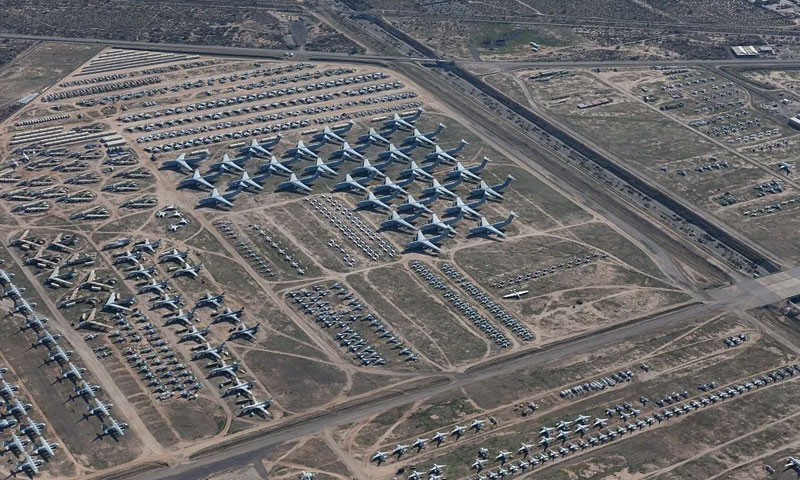
In the vast deserts of Tucson, Arizona, lies a place that is far more than a graveyard for old aircraft. Known as the world’s largest military aircraft boneyard, this facility is unique not simply because of its size, but because of what it represents, how it operates, and why it still matters today.
At first glance, the boneyard at Davis-Monthan Air Force Base appears to be a resting place for thousands of retired military aircraft. In reality, it functions as a strategic reserve, a parts warehouse, a maintenance hub, and a living archive of military aviation history. According to the World Record Academy, the site holds more than 4,000 aircraft, making it the largest of its kind anywhere in the world.
Why Tucson? The Climate Advantage
What makes this location especially valuable is its desert climate. Tucson’s dry air, minimal rainfall, and hard alkaline soil dramatically slow corrosion. This allows aircraft to be stored outdoors for decades with far less structural damage than would occur in humid regions. Experts note that aircraft preserved here can remain in recoverable condition for years, sometimes even decades, with minimal maintenance.
Not Just Storage — Strategic Preservation
Unlike typical scrap yards, aircraft at this facility are not immediately dismantled. Managed by the 309th Aerospace Maintenance and Regeneration Group (AMARG), the boneyard categorizes aircraft into different preservation levels. Some are kept in near-flyable condition, others are used as spare-parts donors, and a select few are regenerated and returned to service when military needs arise.
This makes the boneyard a strategic asset for the US military. Engines, landing gear, avionics, and structural components reclaimed here save billions of dollars by extending the life of active fleets.
This is what the world’s largest airplane graveyard looks like today. Located in Tucson, it holds over 3,200 retired aircraft. pic.twitter.com/p5AY9fRzXg
— Historic Vids (@historyinmemes) February 2, 2026
A Timeline of Military Aviation
Another defining feature is the breadth of aviation history on display. Aircraft from World War II, the Cold War, and modern conflicts sit side by side. Fighters, bombers, cargo planes, refuelling tankers, helicopters, and even NASA aircraft are preserved here, offering a rare chronological view of how military aviation evolved over nearly a century.
Security, Scale and Precision
Every aircraft that arrives undergoes a carefully controlled process. Weapons systems, classified electronics, and fuel are removed, after which the aircraft is cleaned, sealed, and coated with protective materials. Rows are mapped with military precision, allowing engineers to locate specific parts quickly across thousands of aircraft.
Why It Still Matters
The Tucson boneyard is special because it turns retirement into readiness. It ensures that past technology continues to support present and future missions. At the same time, it stands as a reminder of the scale of modern warfare and the cost of maintaining air dominance.
In essence, what makes this aircraft boneyard extraordinary is not the silence of grounded planes — but the fact that many of them are not truly retired at all.