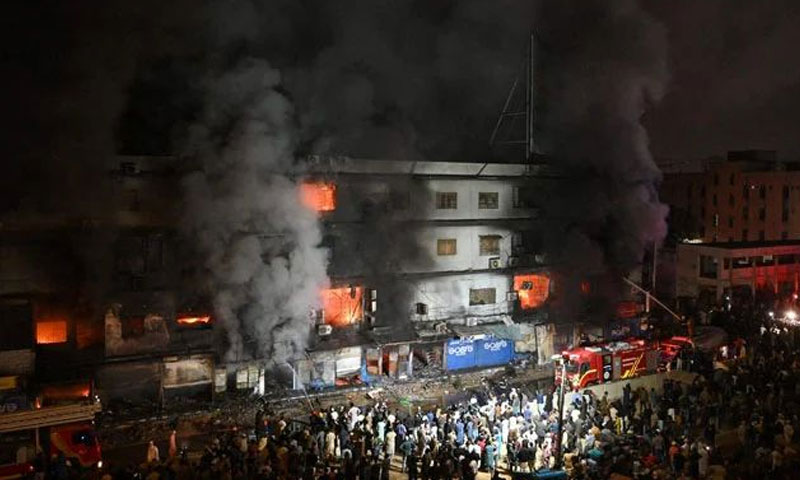
When Karachi’s Gul Plaza caught fire late on January 17, 2026, the first shock was the scale. The second was the timeline. Even after parts of the structure gave way, the blaze didn’t simply “end”. It lingered in heat pockets, smoke, and smoldering rubble. That detail matters, because fires that burn beyond 24 hours usually signal something bigger than bad luck. They reveal a mix of fuel load, building design, and response capacity that can turn a single spark into a multi-day disaster.
Right now, the most important question is: why do some fires refuse to die, even after a building fails?
Why long-running fires are different
In many routine building fires, crews aim to starve the flames by cooling, cutting oxygen, and preventing spread. But in dense commercial structures, three factors can stretch a fire into a long event:
Fuel-rich interiors
Textiles, plastics, chemicals, foam, and packed inventory can keep feeding combustion. Flammable materials inside Gul Plaza as a major factor in how intense it became.
Compartmentalization failures
Modern codes rely on fire-rated walls/doors and protected shafts to slow spread. When these are missing or bypassed fire migrates through stairwells, ducts, and voids.
The “rubble pile” problem
Collapse doesn’t guarantee extinction. It often creates a maze of debris where embers survive in insulated pockets. Firefighters may have to cool and break open layers for days to reach burning cores.
Global parallels: when flames outlive the structure
Ground Zero, New York (2001): the most famous “fire after collapse”
The World Trade Center is a stark reminder that a collapsed site can keep burning long after the headlines move on. A U.S. EPA report noted that fires at the site “were not officially declared extinguished until December 19, 2001,” and debris continued to smolder and flare up. In other words, the problem wasn’t a lack of will. It was physics: huge debris volume, buried heat, and difficult access.
Beirut Port (2020): industrial fuel loads and toxic smoke
Port fires are a different category, but the lesson is transferable: when the “fuel” includes stored commercial goods and industrial materials, duration and toxicity both rise. The response becomes as much about safety distance and hazardous fumes as it is about water.
Collapses that keep burning: when safety systems are absent
Across multiple incidents worldwide, one pattern repeats: buildings without functioning suppression systems burn longer, spread faster, and become more dangerous to enter. That’s why sprinklers are considered non-negotiable in many jurisdictions for large commercial spaces.
A key data point here: the National Fire Protection Association (NFPA) reports that the death rate per 1,000 reported fires was about 90% lower in properties with sprinklers compared with those with no automatic extinguishing system. That doesn’t mean sprinklers “solve everything,” but it shows how strongly early suppression changes outcomes before a fire becomes a citywide emergency.
Karachi’s “time factor”: when response turns into endurance
Local frustration has centered on whether the emergency response was equipped for a fire of this scale. In an interview, Gul Plaza traders’ body chief Tanveer Qasim alleged repeated operational failures during the response: “Every ten minutes, the fire brigade’s water supply would run out, or there would be some technical issue,” he said.
Even allowing for emotion and chaos, the quote captures what prolonged fires often expose: the endurance gap. Big commercial fires aren’t won in the first hour alone; they demand sustained water supply, equipment reliability, safe access, and incident coordination especially when structural collapse becomes likely.
The invisible disaster: smoke, health, and what nearby residents breathe
Long-running urban fires don’t just threaten the site. They push pollution into surrounding neighborhoods for hours or days. Smoke from burning modern goods can contain fine particulate matter and a cocktail of chemicals. Health experts consistently warn that PM2.5 (tiny particles) can penetrate deep into the lungs and even enter the bloodstream raising respiratory and cardiovascular risks.
Stanford’s Woods Institute quoted physician-scientist Kari Nadeau on wildfire smoke exposure, emphasizing its broad harm: “There is no safe distance from smoke.”
Public-health agencies give practical advice that applies in any heavy-smoke situation: stay indoors when possible, reduce outdoor exertion, and use properly fitted respirators when exposure is unavoidable. The U.S. EPA notes that smoke can make both outdoor and indoor air unhealthy because some pollution infiltrates buildings.
For Karachi, a high-value service angle is: what residents and shopkeepers near MA Jinnah Road should do during extended smoke especially children, older adults, pregnant women, and people with asthma or heart disease.
What strong fire-safety systems do differently
Gul Plaza’s story also fits a broader regulatory theme: many cities prevent multi-day fires not through heroics, but through boring, strict systems before anything ignites.
Pakistan already has formal frameworks. The Building Code of Pakistan – Fire Safety Provisions 2016 outlines minimum requirements such as alarms/detection, extinguishers, and emergency response planning. The gap is implementation, audits, and enforcement—especially for older commercial buildings, basements, and high-occupancy markets.
Globally, the standard playbook includes:
Mandatory automatic sprinklers in large commercial buildings
Clear, unlocked, and marked escape routes (multiple exits, protected stairwells)
Fire-rated separation to stop rapid spread
Regular inspections and penalties for blocked exits, illegal wiring, and overloaded circuits
On-site drills and staff training so evacuation isn’t improvised during smoke
The Karachi takeaway: the next fire is being built right now
The lesson of Gul Plaza isn’t only about one building. It’s about how quickly a city can slide from “a fire broke out” to “a disaster that won’t end.”
If more than 1,200 shops can sit inside one complex with such a catastrophic outcome, what does that say about inspections, emergency planning, and the everyday fire risks hidden in Karachi’s commercial zones?
Because fires that last more than 24 hours usually aren’t just fires. They’re system failures under heat and they leave behind not only ash and losses, but a blueprint of what must change.