

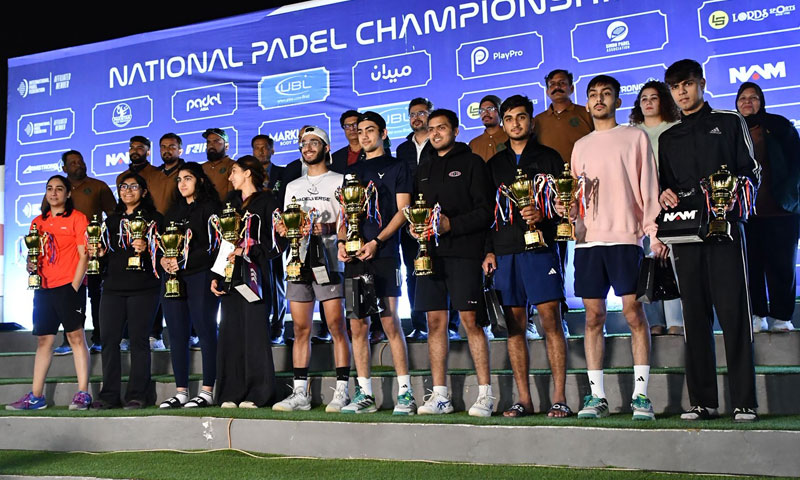
The National Padel Championship 2026 concluded on a celebratory note at Neo Maidan, with Team Sindh delivering a commanding performance by clinching both the men’s and women’s national titles, underlining the province’s growing strength in the sport. The championship was organised by the Pakistan Padel Federation (PPF) under the auspices of the International Padel Federation (FIP), in collaboration with the Sindh Padel Association and Neo Maidan, Karachi Metropolitan Corporation. Sindh claims women’s crown The women’s final saw Sindh (MUV) face off against the Punjab team, with the Sindh pair securing a straight-sets 2–0 victory to lift the national title. Champions: Sindh (MUV) — Natalia Zaman & Mehak Tehrani Runners-up: Punjab — Saimra Umer & Hasnat Third place: Sindh (M&A) — Alisha Elhai & Musfira Zahid All-Sindh showdown in men’s final The men’s final featured an all-Sindh contest between Sindh Team and Sindh Padel-X, highlighting the province’s depth in the sport. The Sindh Team emerged victorious with a 2–0 win, claiming the men’s national championship. Champions: Sindh Team — Rehan Abdullah & Nafees Yaqoob Runners-up: Sindh Padel-X — Sheroz & Rahim Saeed Third place: Team Sindh King — Rayyan Younas & Saad Noman Strong national participation The championship featured 26 women players and 66 men players representing different regions of Pakistan. Over the course of the tournament, players displayed high technical skill, competitive spirit, and strong sportsmanship, reflecting the rapid growth and rising standard of padel in the country. Awards and closing ceremony The closing ceremony was attended by officials and dignitaries from the padel community. Muhammad Mateen, President of the Pakistan Padel Federation, attended as chief guest and distributed trophies, certificates, and cash prizes worth PKR 500,000 among the winning and participating players. Other officials present included Danish Ahmed, Syed Rehanuddin, Syed Nadeem Uddin, and Karima Khan, along with several guests and tournament officials. In a statement, the Pakistan Padel Federation congratulated all teams, players, officials, and partners, describing the National Padel Championship 2026 as a major step forward in promoting padel at the national level and strengthening Pakistan’s presence in the international padel community.

nPerf Mobile Connections Barometer 2025: Jazz Ranks No.1 in Pakistan
Jazz has been named Pakistan’s best-performing mobile network for overall mobile Internet experience in the 2025 Mobile Connections Barometer released by nPerf, an independent global network testing and analytics firm. The ranking is based on millions of real-world user tests conducted across Pakistan between January 1 and December 31, 2025. The nPerf Barometer evaluates mobile Internet quality using experience-based indicators, including download and upload speeds, latency, web browsing performance, and video streaming quality. According to the report, Jazz secured the highest overall nPerf score among all mobile network operators in the country, reinforcing its position as a leader in mobile broadband performance. Strong performance across key metrics Jazz recorded an overall score of 33,369 nPoints, outperforming competing operators across multiple categories. Users on the Jazz network experienced average download speeds of 14.99 Mbps and upload speeds of 6.55 Mbps, while also benefiting from the lowest latency in the market at 89.61 milliseconds. Lower latency and improved speeds translated into smoother video calls, faster browsing, and better responsiveness for real-time applications such as online gaming, video conferencing, and cloud-based services. Lead in browsing and video experience The report highlighted Jazz’s top ranking in web browsing performance, where it achieved the highest success rate among operators. This reflects faster page load times and a more consistent Internet experience for users across the country. Jazz also ranked among the top performers in video streaming quality, demonstrating its ability to handle data-heavy services as video consumption, streaming platforms, and social media usage continue to rise in Pakistan. Year-on-year improvement Beyond leading overall performance, Jazz recorded the strongest year-on-year improvement among all operators. Its overall nPerf score increased by 11.2 percent compared to the previous year, pointing to sustained investment in network upgrades, capacity expansion, and service quality enhancements. Independent, real-world benchmarking The nPerf Mobile Connections Barometer is an independent benchmark built on anonymised, user-initiated tests rather than controlled laboratory measurements. Its composite scoring system reflects actual customer experience across both urban and rural areas, covering network speed, latency, browsing efficiency, and streaming performance. The 2025 Pakistan report aggregates results from tests conducted throughout the year via the nPerf platform, offering a comprehensive snapshot of real-world mobile Internet usage. Strengthening Pakistan’s digital backbone Jazz’s top position in the 2025 nPerf rankings underscores the company’s focus on network resilience, quality, and customer experience. The results also highlight its role in supporting Pakistan’s expanding digital ecosystem, including streaming, online work, e-commerce, digital payments, and emerging technologies that rely on dependable mobile connectivity.
From Balochistan to Frankfurt: Pakistani Student Wins Global Award for Banana Fibre Innovation
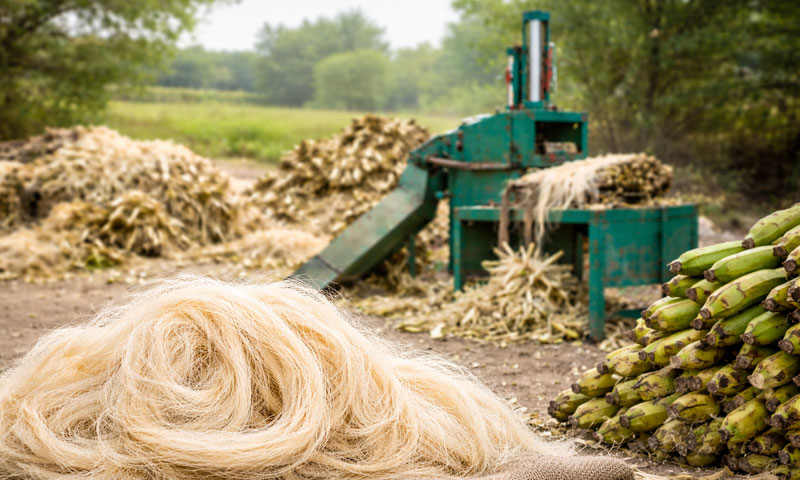
research project by Mohammad Sarfraz, a student from Balochistan University of Information Technology, Engineering and Management Sciences (BUITEMS), has earned international acclaim after winning the Discover Natural Fibre Initiative (DNFI) Award for producing eco-friendly fibre from banana stems. The award was presented during a global research competition held alongside Heimtextil, the world’s leading home textiles exhibition, in Frankfurt. The competition attracted more than 100 research institutions, companies and academic organisations from across the world. Sarfraz’s achievement has been widely praised as a milestone for Pakistan’s emerging presence in sustainable textile research, highlighting the innovation potential of young researchers from underserved regions. Four years of research Speaking after receiving the award, Sarfraz dedicated the recognition to his teachers and to the youth of Balochistan. He told that the project was the result of four years of continuous research, focused on developing a reliable and high-quality method for extracting fibre from banana plant waste. He said the international response to his work was particularly encouraging, especially as it competed directly with projects from European research institutions and developed economies. Academic backing and technical process Dr Mohammad Qasim, Head of the Department of Textile Engineering at BUITEMS and Sarfraz’s research supervisor, said the global recognition confirms that Balochistan’s youth possess capabilities equal to any in the world. He explained that the project involves three main stages: Extraction of natural fibre from discarded banana stems Conversion of the fibre into yarn and composite materials Production of fabric and finished textile products “With access to opportunities and industry linkages, Pakistan’s name can be projected globally through innovation,” he said. Industry interest and European collaboration Industrial support for the project was provided by the Natural Fibre Company, whose director Mohammad Fawwad Supriya described the award as a moment of pride for Pakistan. He revealed that European companies attending Heimtextil showed strong interest in the banana fibre technology. As a result, a partnership agreement with a German company has already been signed to manufacture and market banana-waste-based products in Germany and other European markets. Economic and social impact According to Fawwad, the project has the potential to reduce poverty and generate employment in marginalised regions of Sindh and Balochistan, where banana farming produces large volumes of agricultural waste. Fibre production has already begun in Sukkur and Lasbela, while the next phase aims to expand operations to 4,000 households. To support this expansion, Sarfraz has designed specialised fibre-extraction machines locally. Each unit, consisting of two machines, is expected to cost between Rs700,000 and Rs800,000 and can produce up to 1,000 kilograms of fibre per acre of banana waste. The fibre will be used by skilled artisans in Sindh, Balochistan and Punjab to produce handmade and traditional textile goods. Billion-dollar potential Fawwad said Pakistan has the capacity to produce up to 500 million kilograms of natural fibre annually from banana waste alone, with an estimated global market value of $1 billion. He added that fibre-based exports could generate substantial foreign exchange earnings for the country. Pakistan is among the world’s major banana-producing countries, generating millions of tonnes of agricultural waste each year. Much of this waste is either burned or dumped into rivers, contributing to air and water pollution. Experts say initiatives like Sarfraz’s not only open new economic pathways but also offer environmentally sustainable solutions, turning waste into value while positioning Pakistan within the global green textile movement.
Inside Karachi’s Gul Plaza Fire: Deaths, Damage, and Unanswered Questions
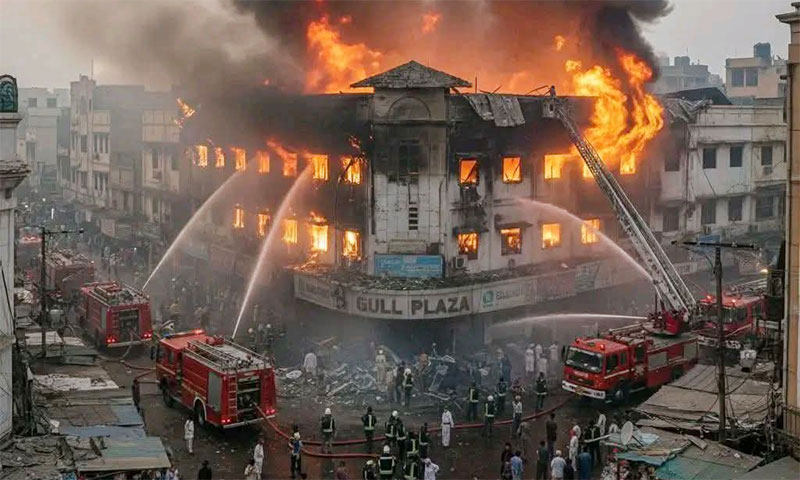
A massive fire at Gul Plaza, one of Karachi’s busiest commercial complexes on M. A. Jinnah Road, has left at least six people dead, dozens injured, and caused billions of rupees in losses, while triggering widespread criticism of the city’s emergency and fire-fighting infrastructure. The blaze erupted at around 10:15 pm on Saturday night, initially on the mezzanine floor, before rapidly spreading to the ground and first floors, according to fire brigade officials. The fire was later declared a third-degree emergency, prompting authorities to summon firefighting units from across the city. Rescue efforts stretched for hours Fire officials said 20 fire tenders, four snorkels, and a water bowser were deployed, with additional assistance from Pakistan Navy fire units. Despite the scale of the response, extreme heat, thick smoke, and structural damage severely hampered rescue operations. The Chief Fire Officer confirmed that a pillar inside the building collapsed during the operation, while all shops on the ground floor were completely destroyed. Gul Plaza houses approximately 1,200 shops, many of them packed with flammable commercial goods. #سانحہ_گل_پلازہ#KarachiFire إِنَّا لِلّهِ وَإِنَّـا إِلَيْهِ رَاجِعونَ کراچی جل رہا ہے کراچی میں آج تک کسی بھی آگ پر قابو نہیں پایا جاسکا جب تک سب کچھ جل کر راکھ نہ ہوجائے۔ pic.twitter.com/UyYPzkIGQb — naeem shabana (@naeemshabana70) January 18, 2026 Rescue authorities said several people were trapped inside the building as smoke filled stairwells and exits. Many victims suffered severe smoke inhalation, while others sustained burn injuries and were rushed to nearby hospitals, including Civil Hospital Karachi. Casualties and injuries Police and rescue officials confirmed that six people have died, most due to suffocation. Four victims were identified as Faraz, Kashif, Aamir, and Shahroz, while two others died during later stages of the operation, including a firefighter injured when a ladder collapsed. At least two firefighters were injured after a fire brigade ladder broke during the rescue effort. Their condition was reported to be stable after medical treatment. Explosion and possible cause According to the Chief Fire Officer, a loud explosion occurred during the blaze, causing the fire to intensify. Preliminary information suggests a gas leak may have triggered the blast, though officials stressed that the final cause will be determined after a formal investigation. The President of the Gul Plaza Traders Association, Tanveer Qasim, said the fire reportedly began at a shop selling artificial flowers, before spreading rapidly due to the presence of combustible materials. Rescue officials warned that several structural pillars have weakened, raising fears of further collapse. Traders accuse authorities of failure Anger mounted among traders and families of victims as the operation dragged on, Tanveer Qasim told media that 80 to 100 people remained trapped for hours, accusing rescue agencies of lacking basic equipment. “Fire brigade vehicles were running out of water every 10 minutes. There were no proper ladders, no modern tools, and no continuous water supply,” he said, adding that despite multiple exits in the building, rescuers failed to reach those trapped inside. One of my friend is stuck with his family inside Gul Plaza, where a fire has broken out. Please pray for their safety and protection, and for the safe evacuation of everyone present. May Allah keep them safe and free from harm… Ameen pic.twitter.com/Fxk8YnSsmm — Muhammad Farhan Khan (@mfarhank90) January 18, 2026 Market representatives said hundreds of people were initially evacuated, but rescue efforts slowed significantly afterward due to logistical failures and water shortages. Roads closed, traffic chaos The fire severely disrupted traffic across central Karachi. Authorities closed M. A. Jinnah Road from Tibet Chowk to Garden Chowk, and Maston Road from Uncle Saria Chowk to Central Plaza, diverting traffic to alternate routes and causing severe congestion in surrounding areas. The Karachi Water and Sewerage Corporation said water tankers were delayed due to traffic jams, though supply was later restored through three hydrants. Government response Sindh Home Minister Zia-ul-Hassan Lanjar ordered the SSP City to investigate the cause of the fire and ensure traffic corridors remain clear for emergency vehicles. Kamran Tessori, the Governor of Sindh, visited the site, reviewed rescue efforts, and assured traders and victims’ families of full government support. Karachi Mayor Murtaza Wahab expressed condolences and pledged immediate assistance for the affected families. Prime Minister Shehbaz Sharif directed authorities to provide the best possible medical care to the injured and ordered all agencies to accelerate rescue and relief operations. Meanwhile, Sindh Chief Minister Murad Ali Shah ordered an immediate inquiry, instructing the Karachi commissioner to submit a detailed report and conduct fire safety audits of commercial buildings across the city. Wider criticism and safety concerns The tragedy reignited debate over Karachi’s fire safety standards. Jamaat-e-Islami Karachi chief Muneem Zafar said more than 2,500 fire incidents have occurred in the city over the past 18 months, warning that commercial buildings lack effective safety mechanisms. Market sources estimate that the fire caused financial losses running into billions of rupees, with traders left devastated as flames destroyed inventories accumulated over years. As firefighting operations continued into Sunday, officials said the fire was about 60 percent contained, but warned that conditions inside the building remained dangerous. A broader failure The Gul Plaza fire has once again exposed systemic weaknesses in Karachi’s emergency response system, from outdated firefighting equipment and water shortages to poor enforcement of building safety regulations. As rescue operations continue and investigations begin, families of the victims and affected traders are demanding accountability — warning that without structural reforms, the city remains dangerously vulnerable to the next disaster.
PSL Enters New Era as League Expands and Auction Model Gains Support
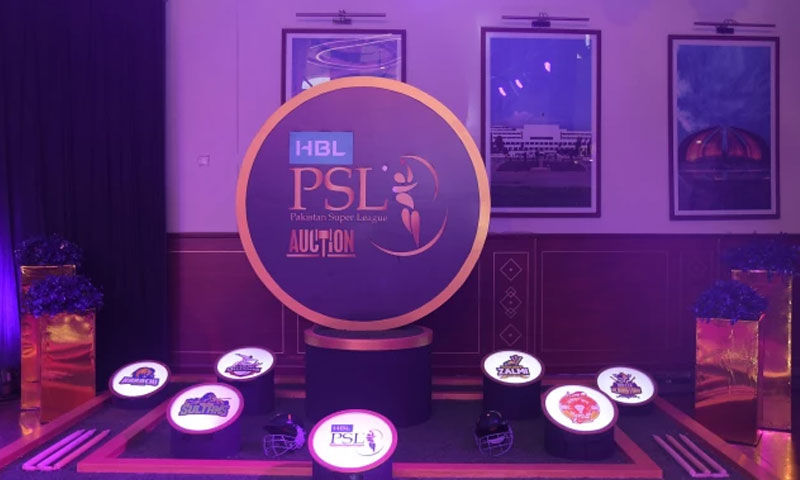
The Pakistan Super League is poised for a major structural shift in its 11th season, with the league’s governing council moving closer to adopting a player auction system and reshaping long-standing retention rules. Deliberations took place during an extended late-night session of the PSL governing council’s working committee, where officials reviewed several operational and commercial aspects of the upcoming season. The discussions focused on modernising the player recruitment process, adjusting retention mechanisms, and reassessing the league’s salary framework as the tournament prepares for expansion. Franchises rally behind auction format A broad consensus emerged in favour of replacing the traditional draft with an auction-based system. According to Geo News, most franchises supported the move, viewing it as a more flexible and market-driven approach to squad building. Defending champions Lahore Qalandars were among the teams backing the proposal, joined by Quetta Gladiators, Islamabad United, Karachi Kings, and the newly introduced Hyderabad franchise. Support for the auction model also came from Peshawar Zalmi and the Sialkot franchise, which endorsed the hybrid “drauction” concept currently under consideration. Revised retention structure Under the proposed system, existing franchises would be allowed to retain up to four players each, limited to one player per category. Officials have also discussed permitting one retained player to be moved into a lower category and assigned a brand ambassador role, offering teams greater financial and branding flexibility. Newly added franchises, meanwhile, are expected to assemble their squads primarily through the auction. Two of the new teams reportedly argued for zero retentions, favouring a clean slate approach that would allow them to compete on equal footing with established sides. Players not retained by franchises will be entered into a central auction pool, from which teams will complete their rosters. Final approval awaited The working committee’s recommendations will now be forwarded to Mohsin Naqvi, chairman of the Pakistan Cricket Board, for formal approval. Should further discussion be required, a full meeting of the PSL governing council may be convened. An official announcement detailing the final auction and retention framework is expected within the next few days. Reports have also indicated that the long-standing requirement to include an Emerging category player in the playing XI may be dropped under the revised regulations. Auction timeline and commercial push Preparations are underway for the PSL 11 player auction, which is likely to be held in the first week of February. Earlier, Mohsin Naqvi urged franchise owners to consider increasing the player salary cap, citing the league’s growing commercial appeal and rising franchise valuations. He encouraged teams to embrace the auction model, arguing that it would allow franchises greater autonomy in securing players aligned with their strategies. Expansion signals new chapter PSL 11 is scheduled to begin on March 26 and will mark the league’s expansion from six to eight teams, following the inclusion of franchises from Sialkot and Hyderabad. The expansion was finalised earlier this year when FKS Group and OZ Developers acquired the new teams for Rs 1.75 billion and Rs 1.85 billion, respectively, at the PSL auction held on January 8 at the Jinnah Convention Centre. With structural reforms, new teams, and a possible auction-based future, PSL 11 is shaping up to be one of the most transformative seasons in the league’s history.
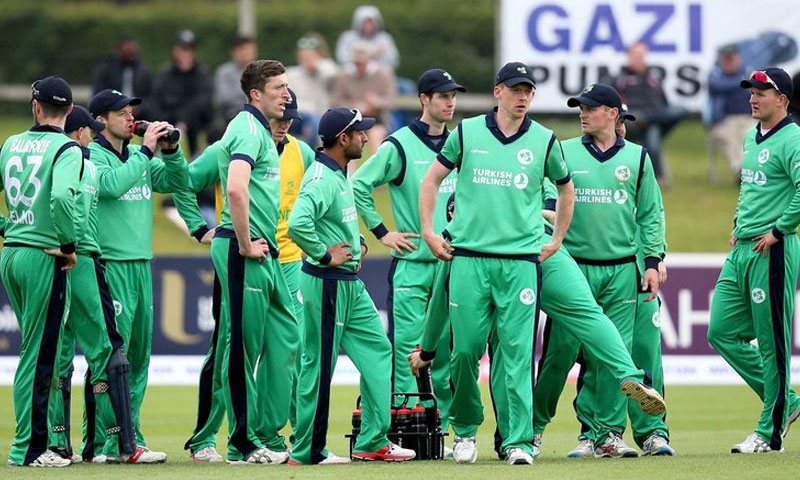
T20 World Cup Uncertainty Continues as Ireland Confirms It Will Not Play in India
Cricket Ireland has firmly stated that Ireland will not play its ICC Men’s T20 World Cup 2026 group-stage matches in India, dismissing speculation that a group swap with Bangladesh was being considered. The clarification comes after claims from Bangladesh that the Bangladesh Cricket Board (BCB) had approached the International Cricket Council (ICC) to explore exchanging groups with Ireland due to security concerns related to travel and participation in India. A Cricket Ireland official confirmed that the matter has been conclusively settled. “We’ve received definitive assurances that we won’t move from the original schedule. We’re definitely playing the group stage in Sri Lanka,” the official said. Ireland fixed in Sri Lanka-based group Ireland have been drawn in Group C, alongside Sri Lanka, Australia, Zimbabwe and Oman, with all of their group-stage matches scheduled to be played in Sri Lanka, one of the two co-hosts of the tournament. Cricket Ireland’s stance makes clear that the board has no intention of relocating its matches to India, regardless of any discussions involving other teams or groups. Bangladesh seeks venue change Bangladesh, meanwhile, are placed in Group B with West Indies, England, Nepal and Italy. Under the current schedule, Bangladesh are due to play their first three matches in Kolkata — against West Indies on February 7, Italy on February 9 and England on February 14 — before facing Nepal in Mumbai on February 17. The BCB confirmed that it raised the possibility of a group change during a meeting with ICC officials in Dhaka, citing concerns over the safety and security of its players, support staff, fans and media personnel. In a statement, the board said that “among other points, the possibility of moving Bangladesh to a different group as a means of facilitating the matter with minimum logistical adjustments was discussed.” However, Cricket Ireland’s confirmation indicates that any such proposal does not involve Ireland, and that the original group allocations remain intact. ICC discussions yield no change The ICC delegation at the Dhaka meeting included Gaurav Saxena, General Manager for Events and Corporate Communications, and Andrew Ephgrave, General Manager of the ICC Integrity Unit. Saxena joined the discussions virtually after receiving his Bangladesh visa later than expected, while Ephgrave attended in person. The BCB delegation was led by president Md Aminul Islam, along with vice-presidents Md Shakawath Hossain and Faruque Ahmed, Director and Cricket Operations Committee chairman Nazmul Abedeen, and CEO Nizam Uddin Chowdhury. In a separate statement, the BCB reiterated that it had formally requested the ICC to relocate Bangladesh’s matches to Sri Lanka, adding that the request reflected concerns expressed by the Bangladeshi government. Tensions remain The BCB has maintained that it is unwilling to send its team to India under the current circumstances, pointing to heightened tensions following Bangladesh pacer Mustafizur Rahman’s withdrawal from the Indian Premier League, an episode that sparked strong reactions in Dhaka. Despite the disagreement, the BCB said discussions with the ICC were conducted in a “constructive, cordial and professional” manner, and that dialogue on the issue would continue. Tournament overview The ICC Men’s T20 World Cup 2026 is scheduled to be held in India and Sri Lanka from February 7 to March 8. While Bangladesh’s participation venues remain under discussion, Cricket Ireland has made it clear that Ireland’s group-stage fixtures will remain in Sri Lanka and will not be shifted to India.

History, Rules, and Reality: What Past Nobel Medal Gifts Reveal About Trump’s Case
The decision by Venezuelan opposition leader and María Corina Machado, the 2025 Nobel Peace Prize laureate, to present her Nobel Peace Prize medal to Donald Trump during a White House meeting has ignited international debate over the limits of symbolism, the rules governing the Nobel Prize, and the ethical weight of such gestures. Machado handed over the gold medal during a meeting with Trump on January 15, describing it as a personal token of gratitude. Trump accepted the medal and publicly thanked her, calling it a gesture of “mutual respect,” according to international media reports. What the Nobel authorities say The Norwegian Nobel Committee moved quickly to clarify the institutional position. In a statement carried by Reuters, the committee stressed that while a laureate is free to dispose of the physical items associated with the prize — including the medal, diploma, and prize money — the Nobel Peace Prize itself cannot be transferred. “Regardless of what may happen to the medal, the diploma, or the prize money, it is and remains the original laureate who is recorded in history as the recipient of the prize,” the committee said. The Nobel Peace Center echoed that stance, noting that although a medal can change hands, the title of Nobel Peace Prize laureate remains permanently linked to the person selected by the committee. Rare, but not without precedent While the episode is highly unusual, Nobel historians note that it is not the first time a Nobel medal has changed ownership. One of the most controversial examples dates back to 1943, when Swedish writer Knut Hamsun gave his Nobel Prize in Literature medal to Nazi propaganda minister Joseph Goebbels. More recently, Nobel Peace Prize laureate Dmitry Muratov auctioned his medal in 2022 to raise funds for Ukrainian refugee children, while the family of former UN secretary-general Kofi Annan donated his Nobel medal to the United Nations’ Geneva office in 2024. What sets the current case apart, analysts say, is the explicit political symbolism of handing the medal to a sitting U.S. president during an official visit. Ethical criticism in Norway The move drew sharp criticism from Norwegian political figures and academics. Janne Haaland Matlary, a professor at the University of Oslo and former politician, described the act as “completely unheard of” in comments to Norway’s public broadcaster NRK. She argued that while the gesture may be legally permissible, it showed “a lack of respect for the award itself.” Other Norwegian commentators, quoted by international media, called the episode “absurd” and warned that such acts risk politicizing a prize intended to recognize independent efforts for peace. Trump’s response Ahead of the meeting, Trump told reporters that Machado — not himself — was the Nobel Peace Prize winner, pushing back against any suggestion that the gesture made him a laureate. After accepting the medal, he publicly thanked Machado but did not claim the Nobel title. Legal bottom line According to the Nobel Foundation’s statutes and the committee’s clarification, the rules are clear: A Nobel laureate may give away, sell, or donate the physical medal. The Nobel Peace Prize itself cannot be transferred, shared, or reassigned. The official historical record remains unchanged, with Machado listed as the sole laureate. As the controversy continues, the Nobel institutions have sought to draw a firm line between symbolic gestures and formal recognition, underlining that while medals may travel, the Nobel Prize — in law and in history — does not.
