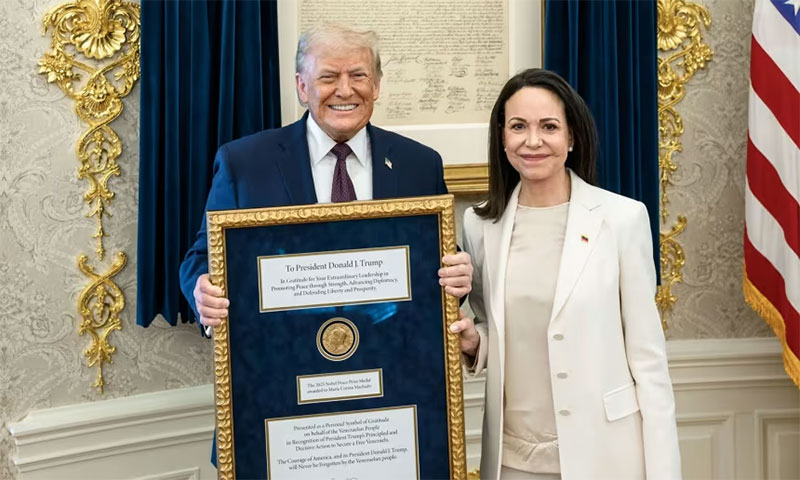
The decision by Venezuelan opposition leader and María Corina Machado, the 2025 Nobel Peace Prize laureate, to present her Nobel Peace Prize medal to Donald Trump during a White House meeting has ignited international debate over the limits of symbolism, the rules governing the Nobel Prize, and the ethical weight of such gestures.
Machado handed over the gold medal during a meeting with Trump on January 15, describing it as a personal token of gratitude. Trump accepted the medal and publicly thanked her, calling it a gesture of “mutual respect,” according to international media reports.
What the Nobel authorities say
The Norwegian Nobel Committee moved quickly to clarify the institutional position. In a statement carried by Reuters, the committee stressed that while a laureate is free to dispose of the physical items associated with the prize — including the medal, diploma, and prize money — the Nobel Peace Prize itself cannot be transferred.
“Regardless of what may happen to the medal, the diploma, or the prize money, it is and remains the original laureate who is recorded in history as the recipient of the prize,” the committee said.
The Nobel Peace Center echoed that stance, noting that although a medal can change hands, the title of Nobel Peace Prize laureate remains permanently linked to the person selected by the committee.
Rare, but not without precedent
While the episode is highly unusual, Nobel historians note that it is not the first time a Nobel medal has changed ownership.
One of the most controversial examples dates back to 1943, when Swedish writer Knut Hamsun gave his Nobel Prize in Literature medal to Nazi propaganda minister Joseph Goebbels. More recently, Nobel Peace Prize laureate Dmitry Muratov auctioned his medal in 2022 to raise funds for Ukrainian refugee children, while the family of former UN secretary-general Kofi Annan donated his Nobel medal to the United Nations’ Geneva office in 2024.
What sets the current case apart, analysts say, is the explicit political symbolism of handing the medal to a sitting U.S. president during an official visit.
Ethical criticism in Norway
The move drew sharp criticism from Norwegian political figures and academics. Janne Haaland Matlary, a professor at the University of Oslo and former politician, described the act as “completely unheard of” in comments to Norway’s public broadcaster NRK. She argued that while the gesture may be legally permissible, it showed “a lack of respect for the award itself.”
Other Norwegian commentators, quoted by international media, called the episode “absurd” and warned that such acts risk politicizing a prize intended to recognize independent efforts for peace.
Trump’s response
Ahead of the meeting, Trump told reporters that Machado — not himself — was the Nobel Peace Prize winner, pushing back against any suggestion that the gesture made him a laureate. After accepting the medal, he publicly thanked Machado but did not claim the Nobel title.
Legal bottom line
According to the Nobel Foundation’s statutes and the committee’s clarification, the rules are clear:
-
A Nobel laureate may give away, sell, or donate the physical medal.
-
The Nobel Peace Prize itself cannot be transferred, shared, or reassigned.
-
The official historical record remains unchanged, with Machado listed as the sole laureate.
As the controversy continues, the Nobel institutions have sought to draw a firm line between symbolic gestures and formal recognition, underlining that while medals may travel, the Nobel Prize — in law and in history — does not.