

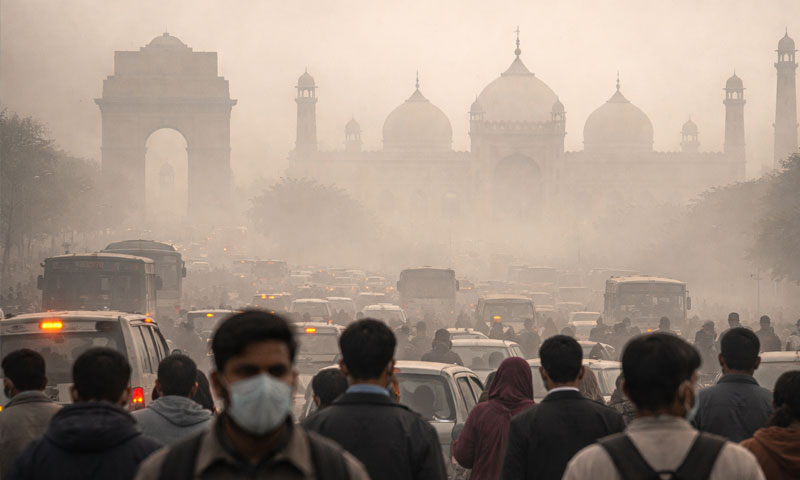
Dhaka has topped the global list of the world’s most polluted cities, recording a “very unhealthy” Air Quality Index (AQI) of 299, just shy of the hazardous threshold, according to the latest industry air-quality data. Close behind, Delhi ranked second with an AQI of 264, while Lahore placed third at 228, underscoring the severe air pollution crisis gripping South Asia’s largest urban centres. Kolkata followed with an AQI of 225, also in the “very unhealthy” category. Other cities appearing near the top of the global pollution rankings include Bishkek (213), Sarajevo (201), Kraków (195), Medan (194), Warsaw (180), and Kabul (175). Most of these cities fall within the unhealthy (red) or very unhealthy (purple) AQI zones. Why pollution levels are surging Experts attribute these alarming readings to a combination of vehicular emissions, industrial pollution, brick kilns, biomass burning, construction dust, and unfavourable seasonal weather patterns. During winter, calm winds and temperature inversions trap pollutants close to the ground, preventing their dispersion and worsening smog conditions. According to global monitoring data, only around 17% of cities worldwide meet the annual PM2.5 air-quality guidelines set by the World Health Organization. In South Asia and parts of Africa, average PM2.5 levels are at least ten times higher than the WHO’s recommended annual limit of 5 micrograms per cubic metre. South Asia’s winter smog crisis Delhi, home to roughly 32 million people, continues to exemplify the region’s winter smog emergency. While air quality fluctuates during the day, winter months routinely push PM2.5-based AQI readings beyond 300, often crossing 400 during severe cold spells. Lahore has repeatedly ranked among the world’s most polluted cities this winter, with thick smog disrupting daily life, closing schools, and increasing hospital admissions. Dhaka, meanwhile, has seen persistent high pollution levels driven by traffic congestion, industrial emissions, and brick kilns operating around the capital. Serious health consequences Health researchers warn that prolonged exposure to AQI levels above 300 can cause severe respiratory and cardiovascular damage. Some studies equate a full day of breathing such air to smoking multiple cigarettes, while heavy outdoor exposure during peak smog episodes has been likened to inhaling the equivalent of dozens of cigarettes per day. These conditions significantly raise the risk of asthma, chronic lung disease, heart attacks, and premature death, particularly among children, the elderly, and those with pre-existing health conditions. How air quality is monitored Global rankings are compiled using real-time and ground-level data from tens of thousands of monitoring stations operated by companies such as IQAir. The system allows hourly tracking of pollution spikes and issues public health alerts when AQI levels reach dangerous thresholds. The bigger picture While modest improvements have been reported in a handful of cities, the majority of urban populations worldwide continue to breathe air that poses serious short- and long-term health risks. The latest rankings highlight the urgent need for stricter emission controls, cleaner energy transitions, and coordinated regional action, particularly in densely populated regions like South Asia.

National Duty Ends Babar Azam’s Big Bash Run as Sixers Face Finals Blow
Pakistan captain Babar Azam has been forced to cut short his Big Bash League stint after being recalled by his national side, ruling him out of Friday’s must-win Challenger final for the Sydney Sixers. The decision means the Sixers will be without their star opener for the remainder of the finals, even if they defeat the Hobart Hurricanes at the Sydney Cricket Ground to book a place in Sunday’s Big Bash final against the Perth Scorchers. Babar has been recalled to join Pakistan’s preparations for a three-match T20 international series against Australia, scheduled to begin next week in Lahore. The series forms part of Pakistan’s build-up to next month’s T20 World Cup, although the squad for the global tournament has yet to be announced. In a farewell message released by the Sixers, Babar thanked the club and its supporters for their backing during his brief stay. “I have very much enjoyed my time here,” he said. “Unfortunately, I now have to leave the team to go for national duty. I’m taking back a lot of positive memories, a lot of fun, and great experiences.” A message from Babar before he heads back to Pakistan to join his national teammates in camp 🩷 pic.twitter.com/0vO0Nuokzw— Sydney Sixers (@SixersBBL) January 22, 2026 He paid special tribute to Sixers fans, saying the atmosphere at the SCG — particularly the vocal support from the so-called “Babaristan” section — made his time in Sydney memorable. Sixers general manager Rachael Haynes said the club fully respected Pakistan’s decision, despite the timing being a blow during finals week. “Babar has made a strong contribution on and off the field,” Haynes said. “The level of fan engagement he generated was exceptional, and the Babaristan stand has been one of the highlights of our home matches this season.” Statistically, Babar’s first Big Bash campaign delivered mixed returns. While he scored 202 runs, including two half-centuries, his strike rate of 103 lagged well behind fellow openers Steve Smith (172) and Daniel Hughes (129). He struck just three sixes across the tournament — the lowest strike rate recorded in BBL history for a player with more than 200 runs in a season. Those numbers had already sparked debate about his role in the Sixers’ finals push. Former Australia batter Mark Waugh suggested earlier this week that the Sixers should consider reshaping their top order. “At the moment, the batting is almost entirely reliant on Steve Smith,” Waugh said on Fox Cricket. “As harsh as it sounds, Babar hasn’t quite done enough at the top this tournament.” Babar’s departure now removes that selection dilemma altogether. Veteran left-hander Daniel Hughes is the most likely replacement at the top of the order, while captain Moises Henriques could also move up, allowing Jordan Silk to return to the middle order. Thank you, Babar 👑Babar Azam has been recalled to join Pakistan’s national camp ahead of upcoming international fixtures.He will be unavailable for the remainder of the BBL|15 Finals Series.More info at https://t.co/XFOTpJiF9I 📲 pic.twitter.com/EOaLKZlLG0— Sydney Sixers (@SixersBBL) January 22, 2026 The Sixers will also continue to back their younger players, with Lachy Shaw, Joel Davies and Jack Edwards all given extended opportunities during this finals run. “We were thrown into the deep end in the Qualifier,” Edwards said on Thursday. “It didn’t go our way, but it’s a learning experience. If we’re in that situation again, we’ll be better prepared.”

Clintons Face Possible Contempt Charges as Republicans Escalate Epstein Investigation
A key US congressional committee is preparing to vote on whether to move toward contempt of Congress proceedings against Bill Clinton and Hillary Clinton, escalating a highly partisan clash tied to the long-running investigation into disgraced financier Jeffrey Epstein. The Republican-controlled House Oversight Committee is set to consider two resolutions accusing the former president and former secretary of state of defying subpoenas by refusing to appear in person before lawmakers. The panel is probing how US authorities handled earlier investigations into Epstein before his arrest and death in federal custody in 2019. If the resolutions pass, the matter will be sent to the full US House of Representatives, where Republicans also hold a majority. The House would then decide whether to formally cite the Clintons for contempt and refer the case to the Justice Department for possible criminal action. The move highlights how the Epstein scandal continues to reverberate through Washington, ensnaring powerful political figures and fueling bitter partisan confrontations. Lawmakers say they are seeking accountability over the handling of Epstein’s past cases, while Democrats argue the inquiry has been turned into a political weapon. Epstein died in jail while awaiting trial on federal sex-trafficking charges, a death that authorities later ruled a suicide. He had spent years moving among elite social and political circles, forging relationships with influential business leaders, academics, and politicians. The Clintons have pushed back forcefully, arguing the investigation is designed to damage political rivals of President Donald Trump, rather than to pursue legitimate oversight. They note that Trump — who had a long-documented social association with Epstein — has not been summoned to testify. Democrats have also accused the Trump administration of dragging its feet on releasing Epstein-related records, alleging that only a limited portion of legally required files has been made public. Neither the Clintons nor Trump has been charged with any crime related to Epstein. Republicans, however, say the Clintons’ past interactions with Epstein warrant direct questioning under oath. They point in particular to Bill Clinton’s use of Epstein’s private jet during international travel in the early 2000s. The contempt effort gained momentum after Oversight Committee Chairman James Comer rejected a late proposal from Bill Clinton’s legal team to provide testimony under more limited conditions in New York. Comer said the offer would have restricted questioning to a single lawmaker, excluded other committee members, and produced no official transcript — conditions he said violated long-standing congressional procedures. “I have rejected the Clintons’ ridiculous offer,” Comer said, accusing the former first couple of seeking special treatment. Representatives for the Clintons dispute that account, saying they never objected to testifying under oath or on the record. In letters declining to comply with the subpoenas, they argue the requests are invalid because they fail to demonstrate a clear legislative purpose, as required under congressional rules.
From Indus to Tankers: How Pakistan Became a Water-Scarce Country
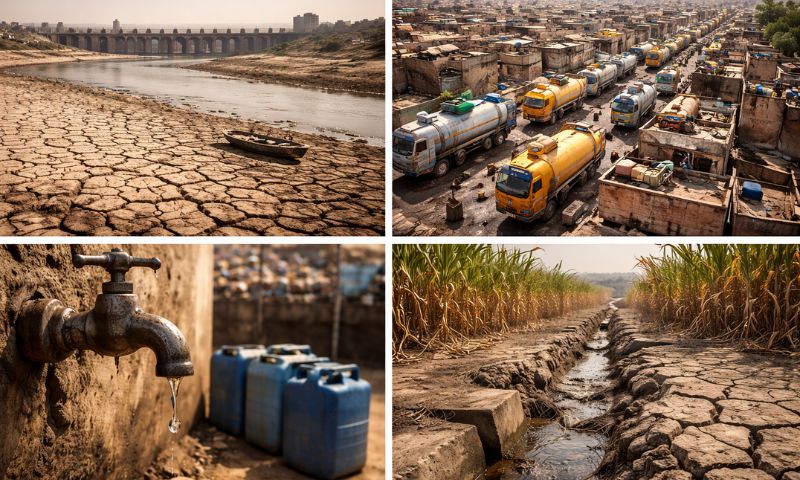
Fresh water scarcity is no longer a distant warning. A new United Nations University report says the world is already entering “water bankruptcy,” with decades of overuse, pollution, and climate change draining rivers, aquifers, and glaciers. Nearly 75% of the global population lives in water-insecure or critically insecure countries, and 4 billion people face severe water scarcity for at least one month each year. UNU lead author Kaveh Madani warns: “Many regions are living beyond their hydrological means, and many critical water systems are already bankrupt.” UNICEF estimates that half of the world’s population could be living in areas facing water scarcity by 2025. At least 700 million people could be forced to move because of intense water scarcity by 2030. Pakistan’s Water Decline: More Than Numbers Pakistan once had abundant water resources. But over generations, that supply has plunged dramatically. In the 1950s, annual per-person water availability was about 5,000 cubic meters. By the early 2000s, it had dropped below 1,500 m³, and today it sits near 930–1,017 m³ per person annually — far below the threshold of 1,700 m³ that defines “water stressed,” and under the 1,000 m³ mark for “water scarce.” Some forecasts suggest Pakistani water availability could fall as low as 660 m³ per person by 2025 and even lower by 2050 if current trends continue. To put that in perspective: an Olympic swimming pool holds roughly 2,500 m³ of water — meaning the annual water available to each Pakistani could soon be less than half that volume. A Nation Running Dry at the Tap and Field Water scarcity in Pakistan affects cities, farms, and everyday routines: 1. Per capita availability has plunged From ~5,000 m³/person/year in the 1950s To under ~1,000 m³ today Forecasts as low as ~660 m³ by 2025 and lower by 2050 2. Agriculture dominates water useAbout 93% of Pakistan’s water goes to farming, with only 5% for households and 2% for industry. Domestic and industrial shares may rise to 15% by 2025, increasing pressure on farmland water. 3. Urban scarcity will growUrban water demand is expected to more than double by 2050, with the number of urban residents facing scarcity rising from about 39.9 million in 2016 to 97.5 million in 2050 if supply does not keep up. 4. Safe drinking water is limitedOnly 47% of Pakistanis have access to safe drinking water, up from 39% in 2022 but still far below the global target. Unsafe water contributes to an estimated 53,000 child deaths every year and chronic health issues like stunting. Why Pakistan’s Water Situation Is Worse Than It Sounds A few facts help explain why numbers matter: Population explosionSince 1947, Pakistan’s population has grown more than fourfold. Higher demand contributes directly to lower per-person water shares. Single river dependenceAbout 95% of renewable water supply comes from the Indus Basin. That makes the country especially vulnerable to seasonal rainfall changes, glacier melt shifts, and upstream variability. Low storage capacityPakistan’s water reservoirs store only about 30 days’ supply, far below the 1,000-day capacity recommended for similar climates, making the country fragile during droughts or dry winters. Groundwater depletionCities and farms increasingly rely on groundwater as surface supplies falter. Over-extraction has lowered water tables hundreds of feet in some areas. The Human Side: Life With Less Water Water scarcity is not just a statistic. In Pakistan, it changes everyday life: Households fetch or pay more for water, increasing living costs. Businesses adjust operations to match supply timing. Families face health risks from contaminated water. Crop failures and irrigation limits push food prices up. An estimated 80% of Pakistan’s population faces acute water shortages at least one month each year. Solutions Pakistan Can Adopt Now Pakistan doesn’t need one big fix. It needs multiple actions: Smarter agricultureWith agriculture consuming most water, improving irrigation efficiency (like drip systems) could free water for other uses. Better storageExpanding reservoirs and rainwater capture helps buffer supply when rains fail. (Construction projects like new dams aim to address this). Fix distributionReducing urban leaks and boosting treatment capacity can protect groundwater and reduce waste. Protect qualityTreating wastewater and preventing industrial pollution ensures water that remains is safe to drink.
