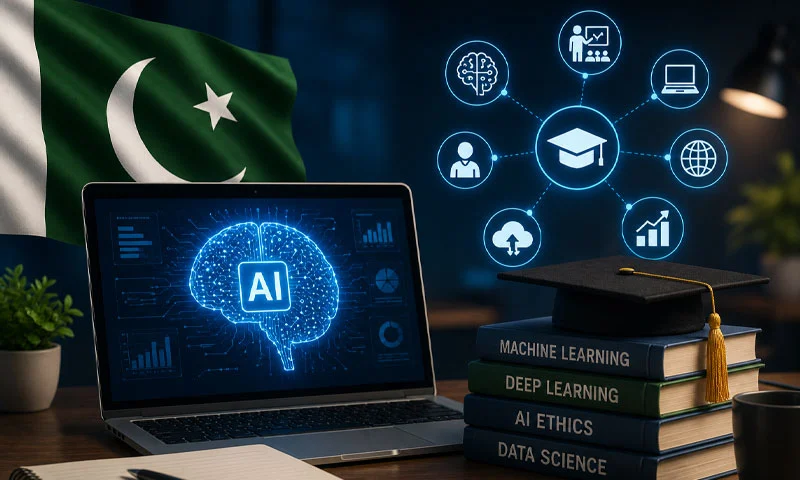
Ministry of Information Technology and Telecommunication plans to launch 20,000 online artificial intelligence training programmes across Pakistan under a major national initiative aimed at preparing the workforce for the rapidly evolving digital economy.
The courses, spanning six to 12 months, will target fresh graduates, government officials, teachers, freelancers and professionals from multiple sectors through an advanced learning management system.
The programmes will operate under the National AI Advancement Initiative, a strategic intervention designed to position Pakistan as a competitive player in the global AI market.
Read More: How To Use AI Without Losing Your Thinking Power
Officials say the initiative seeks to improve workforce capabilities, encourage innovation in the public and private sectors and strengthen AI governance in key industries including healthcare, agriculture, education and manufacturing.
Under the programme, specialised certifications will cover high-demand fields such as machine learning, deep learning and AI ethics. Separate AI literacy programmes will also train civil servants and corporate leaders to support informed policymaking and technology adoption.
The ministry has invited training and capacity-building companies through a request for proposal process to develop an advanced learning management system capable of offering multiple AI courses aligned with domestic and international market needs.
Pakistan’s IT sector has emerged as one of the country’s fastest-growing export industries in recent years, driven by software services, freelancing and overseas demand for digital solutions. Government officials believe artificial intelligence could significantly accelerate that growth.
Experts see opportunity in AI transition
Software and AI expert Asim Tausif Khan described artificial intelligence as a “golden opportunity” for Pakistan to improve its global IT standing.
“Pakistan’s share in the global IT sector currently stands at less than 1%. However, with the rapid transformation driven by AI and related technologies, the country has the potential to secure a significant global position through trained human resources and upgraded infrastructure,” he said.
Khan stressed that Pakistan must rapidly upskill students and professionals, especially those with mathematics and science backgrounds, to meet growing international demand for AI expertise.
Read More: Meet The Robot Hand That Acts Like A Human Brain In Real Time
He said the Gulf Cooperation Council region could become a major destination for Pakistani AI talent if the country develops skilled human resources at scale.
Pakistan’s National AI Policy 2025 aims to upskill one million people by 2030. The policy also targets the creation of 10,000 AI trainers, 20,000 internships annually and 3,000 advanced research scholarships every year.
Dr Noman Said, an IT exporter and AI coach, said artificial intelligence has become essential for professionals seeking long-term relevance in global markets.
“The adoption of AI is no longer a choice but a necessity to remain relevant, productive and part of a high-demand global workforce,” he said.
He urged authorities to introduce AI concepts at the secondary school level to accelerate the development of a future-ready workforce.
“Going forward, a tech-savvy and highly skilled nation will make a significant difference across every sector of life, ranging from IT and e-commerce to healthcare and agriculture, safe cities to strong defence,” he remarked.
Freelancers warned to adapt
Industry experts warn that emerging AI technologies could replace millions of jobs globally each year, increasing pressure on workers to adapt to changing market demands.
Ibrahim Amin, chairman of the Pakistan Freelancers Association, said many freelancers risk losing work opportunities unless they upgrade their skills and learn AI tools.
Read More: Pakistani Founder’s AI Startup Lands $60 Billion SpaceX Deal
He noted that artificial intelligence also offers new opportunities for professionals willing to relearn modern digital skills and invest in training.
Amin welcomed the government’s efforts to improve workforce capabilities through large-scale online training initiatives.
Analysts say Pakistan’s youthful population could become a major advantage if the country successfully implements its AI strategy and creates sustainable pathways for digital employment and innovation.