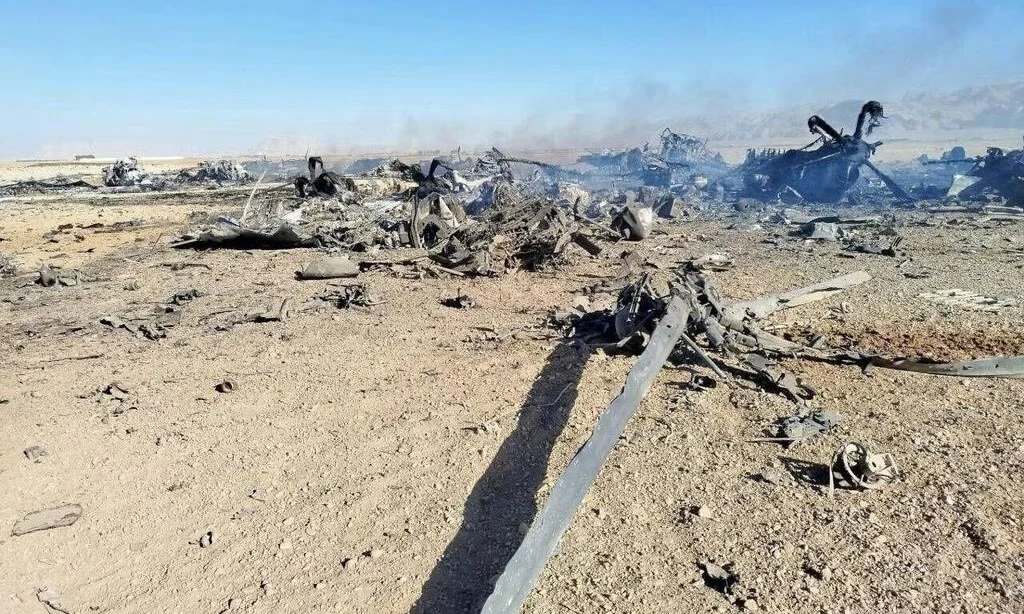
A new report by the Congressional Research Service said the United States lost or damaged 42 military aircraft during Operation Epic Fury, the 40-day military campaign against Iran that began on February 28, 2026.
The report, released last week and circulated by several US media outlets on Friday, offers the most detailed public assessment so far of American aircraft losses during the conflict.
However, the Pentagon has not yet issued a full official breakdown of losses.
CRS researchers said they compiled the figures using Pentagon statements, media reports and announcements from US Central Command.
The report also noted that the Department of Defense has increasingly used the title “Department of War” after an executive order issued in September 2025.
During a congressional hearing on May 12, Acting Pentagon Comptroller Jules W. Hurst III said US military operations against Iran had already cost around $29 billion.
He said much of the increase came from “repair or replacement costs for equipment.”
Fighter jets, helicopters and drones among major losses
The CRS report detailed losses involving fighter aircraft, surveillance planes, tankers, helicopters and drones.
Among the most serious incidents was the loss of four F-15E Strike Eagle fighter jets.
Centcom said three F-15Es were accidentally shot down by friendly fire over Kuwait on March 2. All six crew members survived after ejecting safely. A fourth F-15E later crashed during combat operations over Iran on April 5, although rescuers safely recovered both crew members.
The report also cited damage to an F-35A stealth fighter caused by Iranian ground fire during operations in March.
An A-10 Thunderbolt II attack aircraft was additionally lost on April 3 after enemy fire struck the aircraft.
According to Chairman of the Joint Chiefs of Staff Gen. Dan Caine, the pilot ejected safely before the crash. Support aircraft also suffered major damage during the conflict.
One KC-135 tanker crashed in Iraq on March 12, killing all six crew members onboard. A second tanker made an emergency landing during the same incident.
Iranian missile and drone strikes on Prince Sultan Air Base in Saudi Arabia later damaged five more KC-135 refueling aircraft and an E-3 Sentry AWACS aircraft.
Reports said the E-3 had been parked on an unprotected taxiway.
Drone losses raise concerns over future US military strategy
The report also described heavy losses involving unmanned aircraft systems.
According to CRS researchers, the US military lost 24 MQ-9 Reaper drones during the campaign. Another MQ-4C Triton surveillance drone also crashed in what the US Navy described as a mishap.
Special operations forces faced additional setbacks during rescue operations.
Two MC-130J Commando II aircraft reportedly became stranded during a rescue mission inside Iran.
US forces later destroyed the aircraft on the ground after crews evacuated safely. An HH-60W Jolly Green II rescue helicopter also suffered damage from small-arms fire.
The CRS warned that the scale of losses could raise serious concerns in Congress regarding military readiness and aircraft replacement capabilities.
Researchers said the conflict exposed growing risks for US aircraft operating in heavily contested airspace.
The report also suggested the Pentagon may now reconsider future tactics, aircraft deployment strategies and procurement planning.