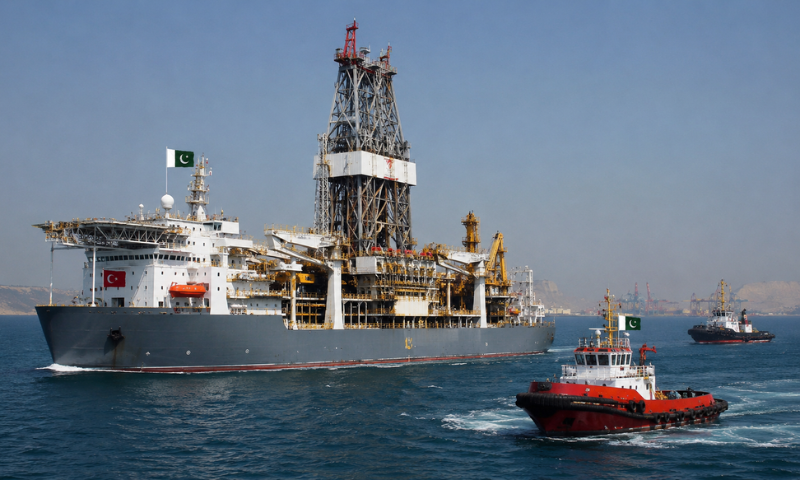
Turkiye’s state-owned Turkish Petroleum will soon begin offshore drilling in Pakistan’s territorial waters, Petroleum Minister Ali Pervaiz Malik said on Sunday. He said the move could attract significant foreign investment and support Pakistan’s effort to cut its dependence on imported energy. Pakistan’s offshore push gathers pace Malik said Pakistan imports around 90% of its energy requirements. Domestic oil production stands at about 70,000 barrels per day, compared with daily demand of roughly 500,000 barrels. He stressed faster exploration of local oil and gas reserves to narrow that gap and strengthen energy security. The planned Turkish activity follows Pakistan’s revival of offshore exploration after a long pause. The Petroleum Division said its 2025 offshore bid round received bids for 23 blocks covering about 53,510 square kilometres. Read More: Pakistan, Saudi Arabia and Turkiye Sign Historic Defence Pact Turkish Petroleum joined the programme as a foreign partner. It also took a 25% stake and operatorship in Offshore Block C. Pakistan Petroleum Limited earlier identified the partnership as involving the Eastern Offshore Indus Block C and Turkish Petroleum Overseas Company, a TPAO subsidiary. The government said initial three-year work commitments represented about $80 million in investment. If exploration moves to drilling, investment across the offshore programme could rise to between $750 million and $1 billion. Turkiye’s Energy Minister Alparslan Bayraktar said in December that operations in Pakistani fields were planned for 2026. “Our goal is to begin operations in these fields in 2026,” he said. Energy roadmap, circular debt and gas connections Malik said Prime Minister Shehbaz Sharif and Chief of Defence Forces (CDF) and Chief of Army Staff (COAS) Field Marshal Syed Asim Munir had assigned a leading international company to prepare a comprehensive energy-sector roadmap. He said the roadmap would go before the national leadership in the coming months. The minister also said the government had stopped the flow of circular debt. Efforts were underway to clear outstanding liabilities inherited from previous administrations. Read More: Why Your Petrol Price Could Change Every Morning in Pakistan He announced that LPG tenders would open on Monday, August 10. He also said the government had arranged new gas connections to facilitate consumers. Malik said difficult economic decisions had helped stabilise the economy. He added that the national focus had now shifted from fears of default to faster economic growth. Makkah pact and global oil pressures Malik described the Makkah defence agreement as a matter of national pride. He said “Pakistan has emerged as a net security provider in the region.” He said the combined strengths of Saudi Arabia’s economy, Turkiye’s technological advancement and Pakistan’s defence capabilities would contribute to regional stability. The minister said Pakistan’s next major destination, after strategic and diplomatic successes, was sustainable economic progress. He also linked recent energy-market pressure to the Iran-US conflict. Malik said the conflict had caused major disruption and unprecedented increases in crude oil and petroleum-product prices. Despite those pressures, he said the government maintained uninterrupted fuel supplies nationwide. It also tried to shield consumers from the full impact of higher international prices. Malik said the government remained committed to providing maximum public relief despite limited financial resources.


