

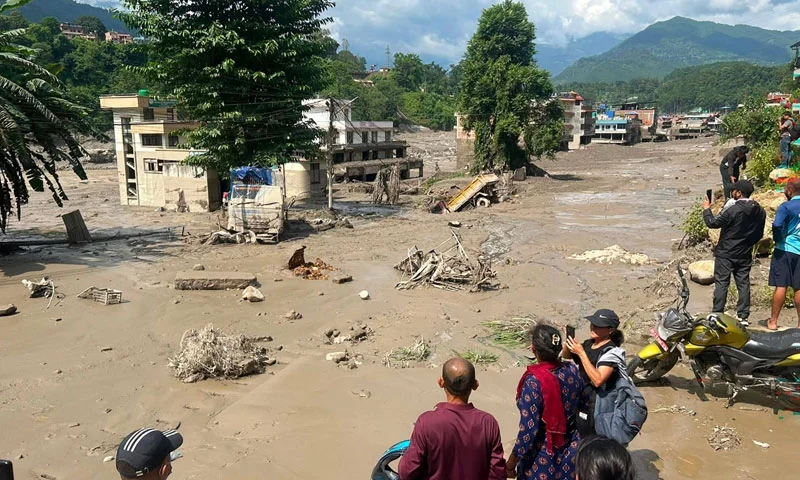
At least 22 people have died and hundreds remain missing after massive flash floods struck northern Nepal near the China border on Wednesday. The Nepal Tourism Board listed 384 tourists and travellers as missing after the disaster. The group includes 291 foreign nationals and 93 Nepalis, according to updated local reports. The missing include people from Nepal, India, the United Kingdom, South Africa, Australia and the Netherlands. Authorities have yet to establish the nationalities of several others. Foreign Minister Sishir Khanal briefed Nepal’s parliament on the disaster. He said government officials and members of the security forces were also missing. Khanal said 29 police officers and 44 Nepal Army soldiers were missing after floodwaters swept away their barracks in Rasuwa district. The Tourism Board said authorities “are working to verify the whereabouts and safety status of the tourists and travelers who were in or traveling through the affected areas.” Officials cautioned that the missing-person figures remain preliminary. Damaged roads, electricity networks and communication systems have made it difficult to contact people in remote areas. Floods Destroy Roads, Bridges and Hydropower Projects The Bhotekoshi River surged through Rasuwa and neighbouring areas on Wednesday morning. The floods caused widespread destruction in Rasuwa, Dhading and Chitwan districts, according to Khanal. Apocalyptic floods and a massive landslide have devastated parts of Tibet and Nepal The scale of destruction is hard to comprehend pic.twitter.com/2hLlg3BiPO — Surajit (@surajit_ghosh2) August 26, 2026 Government estimates showed that 19 bridges had been swept away. Around 40 kilometres of roads also suffered damage. Officials said 13 hydropower projects were affected, while floodwaters swept away around 200 trucks. The Kathmandu Post later reported that an entire 42-kilometre road between Betrawati and the Rasuwagadhi border had suffered damage at several points. Several concrete bridges also disappeared in the flood. “Due to the flood, a large number of hydropower projects, government offices and road facilities were erased,” Khanal said. The floods also left dozens of workers at hydropower facilities out of contact. The Kathmandu Post reported that 60 people linked to the Langtang Khola Hydropower Project remained unreachable. Tourists regularly travel through the Rasuwagadhi area to reach the Langtang region, one of Nepal’s best-known trekking destinations. Other travellers use the route while heading towards Mount Kailash and Lake Mansarovar in China. Many of those listed as missing were travelling towards Kailash. The preliminary list includes more than 100 Indian nationals. South Korea’s Foreign Ministry also said eight South Korean nationals remained unaccounted for. Another 10 were stranded after the floods, according to Yonhap News. Earthquake and Avalanche Examined as Possible Trigger Khanal told parliament that an earthquake struck the border region on Wednesday morning. He said it triggered an avalanche that “eventually caused the collapse of glacial lakes in the Tibet region of China.” China officially refers to Tibet as the Xizang Autonomous Region. The US Geological Survey recorded a magnitude 4.4 earthquake near Kodari, a Nepali village bordering Tibet. The tremor struck at around 8:37am local time, according to the information cited by officials. However, scientists were still investigating the precise sequence that produced the catastrophic flood. An initial assessment suggested an ice avalanche may have blocked the Lhende River. Water then accumulated behind the blockage before bursting downstream. Researchers were also examining whether a glacial lake outburst contributed to the surge. Nepal’s Department of Hydrology and Meteorology noted that the area had not received heavy rainfall before the disaster. The region suffered another destructive glacial flood in 2025, which damaged the Nepal-China border crossing and major infrastructure. Massive Rescue Operation Underway on Both Sides Nepal deployed the army, police and Armed Police Force for a large search and rescue operation. “Equipped with helicopters, drones and rafting boards, rescuers from all state forces – Nepal Police, Armed Police and Nepal Army – were deployed to the flood-hit area,” Khanal said. Rescue teams have struggled with damaged roads, poor communications and difficult weather. The Nepali Army had rescued at least 88 people by Wednesday evening. Twelve helicopters also joined rescue efforts, though poor weather disrupted several flights. Authorities in Kathmandu cleared government hospitals and medical facilities operated by security agencies to receive injured survivors. The disaster also struck the Chinese side of the border. China’s state-run Xinhua News Agency reported that a mudslide hit Gyirong Port, a major land crossing between Nepal and China. “The disaster has cut off roads leading to the port on the Chinese side, as well as communications and power supplies,” Xinhua reported. Chinese authorities sent rescue personnel and emergency supplies to the area. The number of casualties on the Chinese side remained unclear. Chinese President Xi Jinping ordered “all-out efforts” to find and rescue missing people. Xi also called for authorities to “evacuate residents at risk and provide timely medical treatment to the injured to minimize casualties.” “Authorities in Xizang have mobilized forces to carry out search and rescue operations. All relevant operations are underway,” Xinhua reported. Nepal has also sought assistance from India and China. Both countries offered support as rescuers continued searching the devastated Himalayan border region. The death toll rose to at least 22 by Wednesday evening, according to the Kathmandu Post and Associated Press. Authorities warned that the toll could change as teams reach isolated areas.

15 Days on Water Leaves Woman With Serious Brain Disorder
A 31-year-old woman in China developed a serious brain disorder after following an extreme water-only diet for 15 days. The woman, from Henan province, stopped eating food as part of a fasting regimen known as “bigu”. She lost around 20kg within a few weeks. However, the rapid weight loss came with severe health consequences. She developed memory problems and struggled to walk normally. Doctors warned that some of the damage could remain permanent. The woman stood 160cm tall and weighed around 70kg before starting the diet. She reportedly consumed only water for 15 consecutive days. Her weight later dropped by about 20kg. Doctors at The First Affiliated Hospital of Zhengzhou University diagnosed her with Wernicke’s encephalopathy. Extreme Diet Leads to Brain Disorder Neurologist Sun Guifang said the woman’s walking pattern had become similar to that of a “penguin”. He warned that her walking difficulties might never fully disappear. Wernicke’s encephalopathy is a serious neurological condition linked mainly to severe thiamine, or vitamin B1, deficiency. The condition can cause confusion, poor balance and coordination, abnormal eye movements and memory problems. The MSD Manual says Wernicke encephalopathy can develop when the body does not receive or absorb enough thiamine. It requires urgent treatment with thiamine and supportive care. The US National Institute on Alcohol Abuse and Alcoholism also lists confusion, impaired coordination and vision problems among its main symptoms. Some problems can improve with prompt treatment. However, delayed treatment can lead to lasting neurological and memory damage. Sun linked the woman’s illness to her extreme fasting routine. He stressed that the body needs regular nutrition to obtain essential vitamins and other nutrients. He also warned against prolonged fasting and extreme dieting for rapid weight loss. What Is the ‘Bigu’ Fasting Trend? The woman told doctors that she had practised “bigu”, a traditional Taoist fasting practice. The term literally means “grain avoidance”. The practice has roots in traditional beliefs that people can survive through “qi”, or vital energy, instead of ordinary food. Some people now promote bigu online as a weight-loss or “detox” method. The trend has attracted widespread attention on Chinese social media. Reports say bigu-related hashtags have drawn hundreds of millions of views. Some users claim they lost more than 10kg while surviving on water and vitamin supplements for long periods. Others encourage meditation as a way to absorb “qi”. Medical experts, however, warn that extended fasting can deprive the body of nutrients needed for the brain, heart and other organs. Thiamine is particularly important because the human body stores only limited amounts of it. Without adequate intake, those stores can decline quickly during prolonged starvation or severe dietary restriction. Previous Extreme Fasting Cases Raise Concerns The latest case is not the first serious illness linked to extreme fasting in China. According to reports cited by the South China Morning Post, a 26-year-old man from Heilongjiang died in 2020 after consuming only water for 52 days. He reportedly developed dementia-like symptoms shortly before his death. Another woman in Zhejiang followed a water-only regimen for around a week last year. She also consumed an “energy pill”. She lost about 5kg but later suffered severe intestinal damage and a bloodstream infection. Doctors also found dangerously low potassium levels. The Henan woman’s case has again highlighted the potential dangers of crash diets promoted as quick routes to dramatic weight loss. Losing 20kg in a matter of weeks may appear attractive to people seeking rapid results. However, severe food restriction can disrupt essential biological functions. Health experts generally advise people seeking substantial weight loss to use balanced nutrition and medically appropriate plans instead of prolonged starvation. Wernicke’s encephalopathy can become a medical emergency. Early diagnosis and thiamine treatment can improve outcomes, but some neurological damage may persist. For the 31-year-old woman, the effects of her 15-day water-only diet could now last far longer than the weight loss itself.

Suzuki Reveals e SKY Electric Kei Car With 310km Range
Suzuki has revealed the near-production e SKY, its first battery-electric passenger model developed for Japan’s kei-car category. The compact EV is scheduled to debut in Japan in autumn 2026. Suzuki released early details and images of the vehicle on August 24. The e SKY evolved from the Vision e-Sky concept shown at the Japan Mobility Show in 2025. That concept was originally targeted for commercialisation during fiscal 2026. Suzuki developed the production model under the concept “Easy to Switch”. The company wants drivers to move from petrol cars to electric vehicles without changing their everyday driving habits. It designed the e SKY for commuting, shopping, school runs and short trips. Read More: Nishat Group Set to Launch iCAUR V23 and V27 SUVs in Pakistan Suzuki is also focusing on smooth acceleration and a quiet cabin rather than outright performance. Suzuki e SKY Gets 26kWh Battery and 310km Range The e SKY takes a different approach from many new electric cars. Instead of using a large battery, Suzuki has focused on keeping the vehicle small and light. The prototype uses a 26kWh lithium iron phosphate battery. It offers a claimed driving range of up to 310km on a full charge. The car weighs around 1,030kg, making it considerably lighter than many modern EVs. Suzuki has developed a dedicated HEARTECT e electric platform for the model. The battery sits low in the vehicle to improve its centre of gravity and body rigidity. The e SKY measures 3,395mm in length and 1,475mm in width. It stands 1,625mm tall and has a 2,460mm wheelbase. These dimensions place it firmly within Japan’s kei-car category. The e SKY uses front-wheel drive and a compact eAxle. The system combines the motor, inverter and gearing into a lightweight unit. Suzuki has also focused heavily on energy efficiency. Japanese media reported an electricity consumption figure of around 97Wh per kilometre for the prototype. The EV supports up to 50kW DC fast charging. Suzuki’s prototype figures show that charging to 80% takes around 25 minutes. A 6kW AC charger can reach a full charge in about 4.5 hours. A 3kW charger takes around eight hours. The e SKY can also use energy stored in its battery to power external electrical equipment. Suzuki says the function could prove useful during outdoor activities and emergencies. Interior Keeps Physical Controls The production-oriented model retains much of the upright styling seen on the Vision e-Sky concept. Its short body and tall roof aim to maximise usable cabin space. The wheels sit close to the corners of the vehicle. The front features slim lighting and a mostly closed EV-style fascia. Suzuki has also used a contrasting roof on promotional models. Inside, Suzuki has avoided putting every function behind a touchscreen. Read More: Rs1.09 Crore Nevo Hunter Arrives in Pakistan With 900km Range The dashboard combines a digital instrument display with a 10.1-inch infotainment screen. The e SKY is Suzuki’s first kei model to use a display of this size. Physical controls remain available for frequently used functions. The prototype also features a two-level centre console and additional storage on the passenger side. A heated steering wheel and electronic parking brake are also included. Japanese reports have also highlighted heated seats and a heat-pump climate system. Suzuki has kept several controls familiar for existing petrol-car owners. That approach fits the company’s aim of making the transition to electric driving easier. Could Suzuki e SKY Launch in Pakistan? Suzuki has not announced the e SKY for Pakistan. The company has only confirmed a Japanese debut in autumn 2026. Final production specifications and pricing have not yet been announced. However, the small EV could attract interest among Pakistani buyers. Suzuki already has a major presence in Pakistan’s small-car market. Pak Suzuki currently lists the Alto, Every, Cultus, Swift and Fronx among its passenger vehicles. Read More: Inverex GO Launches 8 Electric Bikes and Scooters in Pakistan The e SKY’s compact dimensions could suit congested urban areas. Its relatively small battery could also help reduce one of the biggest costs associated with electric cars. Still, any Pakistan launch remains speculative. Pak Suzuki has not listed the e SKY in its local range or announced plans to introduce the model. In Japan, the e SKY will compete in a kei-EV category that already includes vehicles such as the Nissan Sakura and Mitsubishi eK X EV. Suzuki’s strategy stands out because it does not rely on a huge battery or heavy vehicle platform. Instead, the company has applied its familiar small-car philosophy to electric mobility. Low weight, compact dimensions and practical range remain at the centre of the project. For buyers in cost-sensitive markets, that formula could become significant if Suzuki eventually expands the e SKY beyond Japan. For now, the company is preparing the electric kei car for its Japanese launch this autumn, with pricing expected closer to its market debut.
Up to 200,000 US Visas Could Be Revoked Under New Policy
The United States plans to revoke visas held by some foreigners who entered as tourists or business visitors and later applied for asylum. The State Department confirmed the new policy on Tuesday. It is working with the Department of Homeland Security to identify affected visa holders. The move targets holders of B-1 business and B-2 tourist visas who later sought asylum in the United States. Officials are examining visas issued between 2016 and 2026, according to reports citing government documents. Read More: US Court Blocks Visa Policy Affecting Pakistan and 74 Countries The policy marks another expansion of President Donald Trump’s immigration crackdown since he returned to the White House in January 2025. Up to 200,000 US Visas Could Be Affected State Department spokesman Tommy Pigott said officials were targeting people who presented themselves as temporary visitors but later sought permanent protection. “Obtaining a visa in order to seek asylum is fraud,” Pigott said, calling that “grounds for visa revocation.” He said B-1 and B-2 visas are intended for temporary travel by people who plan to leave the United States after their visit. The White House suggested in a post on X that “up to two hundred thousand visas” could face revocation. It described the planned action as the “largest mass visa revocation in history”. However, the State Department has neither confirmed nor denied the 200,000 figure. Set to revoke up to TWO HUNDRED THOUSAND visas 🔥 pic.twitter.com/K0mnxpXvla— The White House (@WhiteHouse) August 25, 2026 “The number of revocations remains dynamic and will be done on a rolling basis,” Pigott said. Associated Press reported that visa revocation would not necessarily lead to immediate deportation. People with pending asylum cases could lose their visitor status while their asylum proceedings continue. US Citizenship and Immigration Services guidance says people physically present in the country may apply for asylum regardless of immigration status. Applicants generally must file within one year of arrival, although exceptions exist. The administration’s new policy instead focuses on whether a person intended to seek asylum when applying for a temporary visitor visa. Trump Administration Has Already Revoked 175,000 Visas The latest measure follows a sharp rise in visa cancellations during Trump’s second term. Earlier this month, the State Department said it had revoked more than 175,000 visas since January 2025. Officials said most cancellations followed law enforcement encounters involving crimes such as assault, driving under the influence, theft and drug offences. Other cases involved reckless driving, sexual assault, child abuse, fraud and embezzlement. Read More: Visa and Mastercard May Face New Challenge From PayPak The administration has also revoked visas from foreigners accused of calling for violence or abusing US immigration rules. Some people lost visas after comments praising the killing of conservative activist Charlie Kirk, according to the State Department. Washington has also targeted Mexican political figures. Andrés Manuel López Beltrán, the son of former Mexican president Andrés Manuel López Obrador, said this month that the United States had revoked his visa. Mexican President Claudia Sheinbaum criticised the decision and sought evidence supporting the action. Reuters reported that the wider campaign had affected several Mexican political figures. Courts Push Back Against Some Visa Restrictions Trump made tougher immigration enforcement a major part of his 2024 presidential campaign. Since returning to office, his administration has tightened controls on undocumented migration as well as several legal immigration routes. It has strengthened scrutiny of visa holders, introduced tougher application requirements and expanded online vetting. The State Department announced in March that it was expanding online presence reviews to additional categories of visa applicants. Some applicants must make their social media profiles public for vetting purposes. Pigott said on Tuesday that the administration wanted to make clear that a visa is a privilege, “not a right.” However, several Trump administration immigration measures have faced court challenges. Read More: US Judge Blocks Trump’s $100,000 H-1B Visa Fee in Major Legal Defeat Last Friday, US District Judge Jeannette Vargas struck down a policy that suspended immigrant visa processing for citizens of 75 countries. The affected list included Pakistan, Afghanistan, Brazil, Egypt, Iran, Iraq, Nigeria, Somalia, Thailand and Yemen, among many others. The judge found that the State Department had exceeded its legal authority by imposing a broad nationality-based suspension. That case involved immigrant visas and is separate from the new plan targeting B-1 and B-2 visa holders who seek asylum. The latest revocation plan could also face legal challenges as the government begins implementing it. For now, the State Department has not published a final number of affected visa holders or a complete timetable. Officials say the reviews will continue on a rolling basis as the administration expands its scrutiny of temporary visitors and asylum claims.
Pakistan May Soon Say Goodbye to Rs10 Banknote
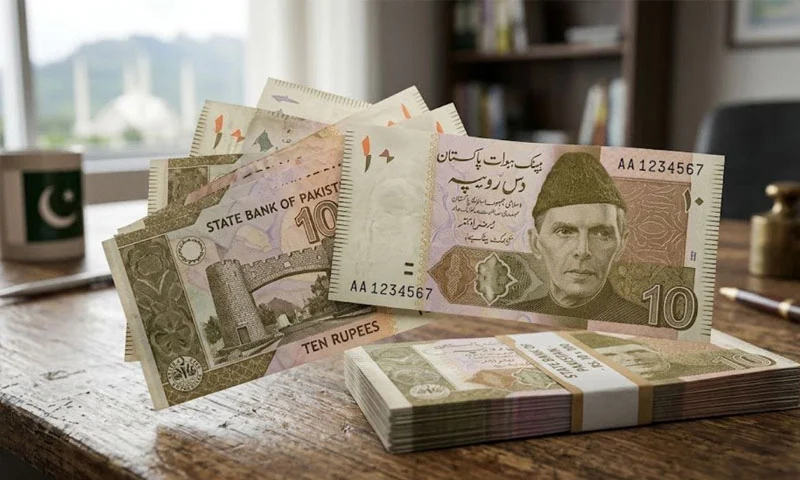
The State Bank of Pakistan has recommended discontinuing the Rs10 banknote as work continues on Pakistan’s new currency series. SBP Deputy Governor Dr Inayat Hussain disclosed the proposal during a Senate Standing Committee on Finance and Revenue meeting on Tuesday. Senator Saleem Mandviwalla chaired the meeting, which also focused on counterfeit currency and the design of new banknotes. The federal cabinet will make the final decision on the denominations of the new currency series. The discussion came amid growing concerns over fake high-value notes reaching consumers through banking channels. New Currency Notes Could Take Another Year The deputy governor told senators that the government had formed a ministerial committee headed by the finance minister. The committee is overseeing the design and issuance of the new currency notes. Read More: 1950s Pakistani Banknote Returns From Bangladesh Rekindling Shared History According to the briefing, the ministerial committee has approved the designs. The SBP is now working to meet required security and production standards. However, the new notes may not reach the public soon. The deputy governor said their introduction could take another year even after federal cabinet approval. The SBP formally started work on a new banknote series in January 2024. At the time, it planned designs for all seven existing denominations. These included Rs10, Rs20, Rs50, Rs100, Rs500, Rs1,000 and Rs5,000 notes. The central bank said new designs would improve security and respond to advances in counterfeiting technology. It later hired international banknote designers through a competitive process. The bank also held an art competition to collect local design ideas. Senator Agha Shahzaib Durrani criticised the slow progress. “Two years have passed, but the State Bank has not been able to complete this work,” he said. Counterfeit Notes From ATMs Raise Alarm Mandviwalla also raised serious concerns about reports of counterfeit notes coming from bank ATMs. He referred to fake Rs5,000 and Rs1,000 notes and questioned how consumers could protect themselves. “The biggest tragedy is that counterfeit notes are being dispensed by bank ATMs,” Mandviwalla said during the discussion. The committee chairman said banks often do not replace counterfeit notes received through ATMs. Read More: SBP Plans New Currency Designs: What Will the Rs 5,000 Note Look Like? “If a counterfeit note comes out of a bank ATM, where are the people supposed to go?” he asked. Mandviwalla also recalled sending three Rs5,000 notes to the SBP for verification. According to him, one of those notes proved counterfeit. He said the committee had still not received a complete response on the matter. Officials told senators that the new currency system would strengthen safeguards against counterfeiting. The SBP’s existing Rs5,000 note already includes several security features. These include a watermark, window security thread and optical variable ink. The planned series will introduce newer security technologies and updated designs. Rs5,000 Note Costs Around Rs14 to Produce Senator Abdul Qadir asked officials about the cost of printing Pakistan’s highest denomination note. The deputy governor said producing one Rs5,000 banknote costs approximately Rs14. The committee also discussed the future of the Rs10 banknote. Officials said the SBP had proposed discontinuing the denomination. Reports linked the proposal to its relatively high production cost compared with its face value. Read More: Moody’s Lifts Pakistan’s Sovereign Credit Rating to B3 from Caa1 For now, the Rs10 note remains legal tender and continues to circulate. The SBP still lists it among Pakistan’s current banknotes. Mandviwalla also questioned the appointment of consultants for the new currency project. “This does not happen anywhere in the world. All details of this tender should be provided,” he said. The SBP had formally sought consulting services in 2024 for the new banknote series. Its tender required professional designers to recommend security features and prepare printable designs. Mandviwalla asked the SBP to provide the committee with full details of the tender process. He also called for a briefing from an international banknote printing company on how modern currency production works. Officials explained that designers initially prepare original banknote artwork before machines process it for production. The committee also asked what safeguards would stop criminals from counterfeiting the new notes. Officials said the entire currency production process would undergo changes. They expect the new system to significantly reduce counterfeit currency. The Senate panel has also sought measures to stop fake notes from entering circulation through banks and ATMs. The SBP has said modernising Pakistan’s banknotes will improve durability and security. Its original plan called for advanced printing techniques and stronger anti-counterfeiting features.
14 Babies Died After Fire Erupts at PIMS Mother and Child Hospital
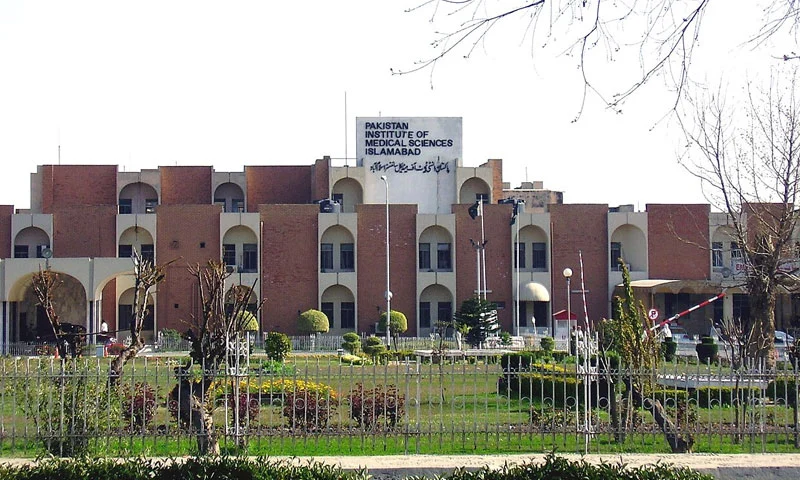
Fourteen infants were killed after a fire tore through a nursery at the Pakistan Institute of Medical Sciences in Islamabad early Wednesday. The blaze erupted on the third floor of the Mother and Child Hospital, according to the Islamabad administration. Emergency crews rushed to the scene shortly after the fire began. Television footage showed rescue workers climbing ladders and entering the affected area through broken windows. Six fire brigade vehicles and four ambulances took part in the operation. Firefighters brought the blaze under control and started cooling operations. “The fire was immediately brought under control and the children were immediately shifted to the intensive care unit,” the Islamabad administration said. Its statement added that 14 children “were completely burnt”. Officials formed an inquiry committee under the additional deputy commissioner general to investigate the tragedy. Conflicting Accounts Emerge Over Cause of PIMS Fire Health Minister Mustafa Kamal said the incident occurred at around 6:45am. Speaking to Geo News, he said the infants were either inside incubators or receiving oxygen at the time. Kamal said the fire started after a “blast in the air conditioner” inside the ward. He added that nearby oxygen tanks intensified the blaze. Rescue officials also cited an apparent explosion in an air conditioning compressor as the initial cause. The Associated Press reported a similar preliminary account. However, PIMS spokesperson Dr Aneeza Jalil gave a different initial assessment. She told Dawn that the fire appeared to have started because of a short circuit. She placed the time of the blaze at around 7am. Jalil said 15 babies were inside the ward. “At least one baby was saved by a doctor,” she said. The exact cause will now form part of the official investigation. Official government and hospital accounts available on Wednesday morning put the death toll at 14. AP also reported 14 deaths. Reuters later cited Geo TV as reporting at least 15 deaths and 16 newborns in the ward. The differing figures showed that authorities were still reconciling information after the fire. Renovation Work Raises Questions Malik Israr, whose niece was receiving treatment in the gynaecology ward, raised concerns about conditions inside the building. He told Dawn that repair and renovation work was underway in the building housing the nursery. “After the fire erupted, they told patients to vacate the building. Women who had just given birth had to rush down the stairs from the second floor,” he said. The inquiry will now face questions about fire safety, electrical systems and emergency arrangements inside the hospital. PIMS is one of Islamabad’s largest and most important government healthcare facilities. The institute was completed in 1985 and provides tertiary healthcare to patients from Islamabad and several surrounding regions. Its Mother and Child Health Centre has 156 beds. PIMS also operates a neonatal unit at the centre. According to the hospital, that neonatal unit has 14 beds and supports more than 14,000 deliveries each year. PM Shehbaz Orders Investigation Prime Minister Shehbaz Sharif took notice of the PIMS fire and ordered an immediate investigation. The Prime Minister’s Office confirmed 14 deaths and said authorities must determine responsibility. “Such a situation that involves children is unbearable,” Shehbaz said. اسلام آباد : 26 اگست 2026.وزیراعظم محمد شہباز شریف نے پمز ہسپتال کی نرسری میں آتشزدگی کے اندوناک واقعہ میں 14 نومولود جاں بحق ہونے پر گہرے دکھ اور دِلی افسوس کا اظہار کیا. وزیراعظم نے معصوم بچوں کے لواحقین سے دلی اظہار تعزیت کیا۔ وزیراعظم محمد شہباز شریف نے آتشزدگی کے افسوسناک…— Prime Minister's Office (@PakPMO) August 26, 2026 He expressed deep sorrow and offered condolences to the families. The prime minister also directed officials to identify the factors behind the tragedy. Reuters quoted the PMO as saying those responsible should face strict action. Senate Chairman Syed Yousuf Raza Gilani also expressed grief over the deaths. He called for effective fire safety systems and stronger emergency arrangements in hospitals. “Any negligence in safety measures is unacceptable,” Gilani said. He urged authorities to conduct a comprehensive investigation and take practical steps to prevent another such tragedy. National Assembly Speaker Sardar Ayaz Sadiq also expressed profound sorrow. He said he was “heartbroken” by the deaths and shared the grief of the bereaved parents. The tragedy has renewed concerns over safety arrangements at major public hospitals. Investigators will now examine what caused the fire and whether existing safeguards failed.
