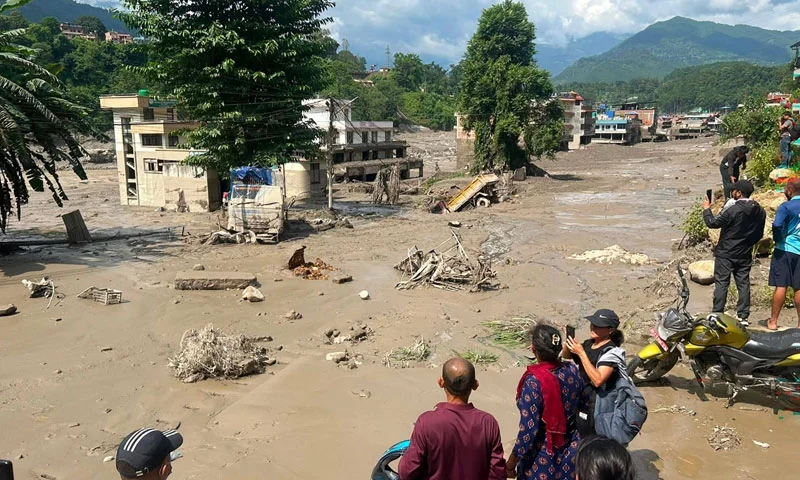
At least 22 people have died and hundreds remain missing after massive flash floods struck northern Nepal near the China border on Wednesday.
The Nepal Tourism Board listed 384 tourists and travellers as missing after the disaster. The group includes 291 foreign nationals and 93 Nepalis, according to updated local reports.
The missing include people from Nepal, India, the United Kingdom, South Africa, Australia and the Netherlands. Authorities have yet to establish the nationalities of several others.
Foreign Minister Sishir Khanal briefed Nepal’s parliament on the disaster. He said government officials and members of the security forces were also missing.
Khanal said 29 police officers and 44 Nepal Army soldiers were missing after floodwaters swept away their barracks in Rasuwa district.
The Tourism Board said authorities “are working to verify the whereabouts and safety status of the tourists and travelers who were in or traveling through the affected areas.”
Officials cautioned that the missing-person figures remain preliminary. Damaged roads, electricity networks and communication systems have made it difficult to contact people in remote areas.
Floods Destroy Roads, Bridges and Hydropower Projects
The Bhotekoshi River surged through Rasuwa and neighbouring areas on Wednesday morning.
The floods caused widespread destruction in Rasuwa, Dhading and Chitwan districts, according to Khanal.
Apocalyptic floods and a massive landslide have devastated parts of Tibet and Nepal
The scale of destruction is hard to comprehend pic.twitter.com/2hLlg3BiPO
— Surajit (@surajit_ghosh2) August 26, 2026
Government estimates showed that 19 bridges had been swept away. Around 40 kilometres of roads also suffered damage.
Officials said 13 hydropower projects were affected, while floodwaters swept away around 200 trucks.
The Kathmandu Post later reported that an entire 42-kilometre road between Betrawati and the Rasuwagadhi border had suffered damage at several points. Several concrete bridges also disappeared in the flood.
“Due to the flood, a large number of hydropower projects, government offices and road facilities were erased,” Khanal said.
The floods also left dozens of workers at hydropower facilities out of contact. The Kathmandu Post reported that 60 people linked to the Langtang Khola Hydropower Project remained unreachable.
Tourists regularly travel through the Rasuwagadhi area to reach the Langtang region, one of Nepal’s best-known trekking destinations.
Other travellers use the route while heading towards Mount Kailash and Lake Mansarovar in China.
Many of those listed as missing were travelling towards Kailash. The preliminary list includes more than 100 Indian nationals.
South Korea’s Foreign Ministry also said eight South Korean nationals remained unaccounted for. Another 10 were stranded after the floods, according to Yonhap News.
Earthquake and Avalanche Examined as Possible Trigger
Khanal told parliament that an earthquake struck the border region on Wednesday morning.
He said it triggered an avalanche that “eventually caused the collapse of glacial lakes in the Tibet region of China.”
China officially refers to Tibet as the Xizang Autonomous Region.
The US Geological Survey recorded a magnitude 4.4 earthquake near Kodari, a Nepali village bordering Tibet. The tremor struck at around 8:37am local time, according to the information cited by officials.
However, scientists were still investigating the precise sequence that produced the catastrophic flood.
An initial assessment suggested an ice avalanche may have blocked the Lhende River. Water then accumulated behind the blockage before bursting downstream.
Researchers were also examining whether a glacial lake outburst contributed to the surge. Nepal’s Department of Hydrology and Meteorology noted that the area had not received heavy rainfall before the disaster.
The region suffered another destructive glacial flood in 2025, which damaged the Nepal-China border crossing and major infrastructure.
Massive Rescue Operation Underway on Both Sides
Nepal deployed the army, police and Armed Police Force for a large search and rescue operation.
“Equipped with helicopters, drones and rafting boards, rescuers from all state forces – Nepal Police, Armed Police and Nepal Army – were deployed to the flood-hit area,” Khanal said.
Rescue teams have struggled with damaged roads, poor communications and difficult weather.
The Nepali Army had rescued at least 88 people by Wednesday evening. Twelve helicopters also joined rescue efforts, though poor weather disrupted several flights.
Authorities in Kathmandu cleared government hospitals and medical facilities operated by security agencies to receive injured survivors.
The disaster also struck the Chinese side of the border.
China’s state-run Xinhua News Agency reported that a mudslide hit Gyirong Port, a major land crossing between Nepal and China.
“The disaster has cut off roads leading to the port on the Chinese side, as well as communications and power supplies,” Xinhua reported.
Chinese authorities sent rescue personnel and emergency supplies to the area. The number of casualties on the Chinese side remained unclear.
Chinese President Xi Jinping ordered “all-out efforts” to find and rescue missing people.
Xi also called for authorities to “evacuate residents at risk and provide timely medical treatment to the injured to minimize casualties.”
“Authorities in Xizang have mobilized forces to carry out search and rescue operations. All relevant operations are underway,” Xinhua reported.
Nepal has also sought assistance from India and China. Both countries offered support as rescuers continued searching the devastated Himalayan border region.
The death toll rose to at least 22 by Wednesday evening, according to the Kathmandu Post and Associated Press. Authorities warned that the toll could change as teams reach isolated areas.