

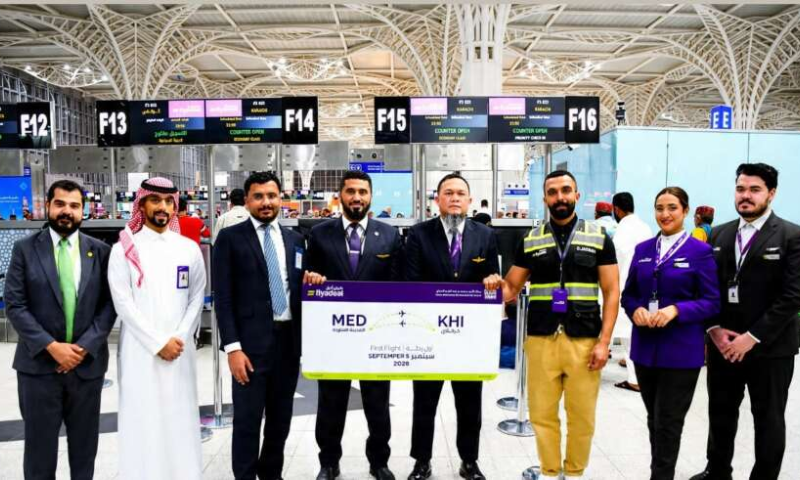
Saudi low-cost carrier flyadeal launched direct flights between Madinah and Karachi on Sunday, September 6, strengthening air links between Saudi Arabia and Pakistan. The inaugural flight from Madinah landed at Karachi’s Jinnah International Airport on Sunday. The launch gives passengers another direct option between Pakistan’s largest city and one of Saudi Arabia’s most important religious destinations. flyadeal will operate two weekly flights on the new route. The airline will use Airbus A320neo aircraft with 186 seats in an all-Economy Class configuration. Each seat offers either a USB-A or USB-C charging port. The aircraft also feature Airbus’ Airspace cabin interiors, which include larger overhead storage bins and mood lighting. The service will support religious travel, family visits, business trips and leisure journeys. It may particularly benefit passengers travelling to Madinah for religious purposes. flyadeal’s official booking platform has started listing flights between Madinah and Karachi. The route appears alongside the carrier’s existing services linking Karachi with Jeddah and Riyadh. Seventh flyadeal route to Pakistan Madinah has become the third Saudi city connected with Karachi through flyadeal’s growing international network. The airline already operates flights to Karachi from Jeddah and Riyadh. The new service takes flyadeal’s Pakistan network to seven routes. The carrier entered the Pakistani market with two routes last year and has expanded rapidly since then. Capt Abdulaziz Bahri, Chief Operating Officer of flyadeal, said growing demand had encouraged the airline to strengthen its Pakistani operations. “Launching our new Madinah–Karachi route reflects our commitment to the Pakistan market, which continues to see strong growth and demand within our international network. Starting with two routes just last year, we are delighted to inaugurate our seventh route to Pakistan. This pace underscores the depth of the economic, cultural and people-to-people ties between Saudi Arabia and Pakistan, as well as demand for flyadeal’s modern, efficient, friendly and affordable services.” Karachi serves as Pakistan’s main commercial and financial centre. It also has a large population with close family, employment and business connections in Saudi Arabia. The airline expects the route to offer greater flexibility to travellers while supporting economic and cultural links between the two countries. Fleet expansion supports Vision 2030 flyadeal operates as part of Saudia Group and ranks among the GCC’s largest low-cost airlines. Its international expansion forms part of a wider strategy to connect Saudi Arabia with high-demand regional markets. The airline plans to more than double its fleet and network by 2030. This expansion supports Saudi Vision 2030, which aims to develop tourism, aviation and international connectivity. Airbus A321neo aircraft will join flyadeal’s existing A320 fleet as the airline adds capacity. The carrier will also introduce Airbus A330-900neo widebody aircraft from 2027. Airbus confirmed in 2025 that Saudia Group had ordered 10 A330-900 aircraft for flyadeal. The deal will allow the carrier to enter longer-distance markets and serve routes with heavier passenger demand. The Madinah-Karachi service adds another important link as flyadeal continues expanding across Pakistan and the wider region.

BMW i7 Arrives in Pakistan With a Rs67.9 Million Price Tag
Dewan Motors has announced a Rs67.90 million price for the BMW i7 eDrive50 in Pakistan while extending special prices across selected ready-to-deliver electric vehicles. The limited-time offer expands the company’s earlier Mid-Year Special and now covers two electric sedans and two compact SUVs. Dewan Motors said only limited units remain available. BMW i7 becomes flagship electric sedan The i7 eDrive50 now sits at the top of Dewan Motors’ battery-electric sedan range. It serves as the electric counterpart to BMW’s 7 Series and targets buyers seeking flagship comfort without a petrol powertrain. BMW Pakistan lists a driving range of up to 625 kilometres, an output of 400kW and torque of up to 745Nm. The company claims the luxury sedan can accelerate from zero to 100 kilometres per hour in 4.7 seconds. Rear passengers can access a 31.3-inch BMW Theatre Screen and touchscreens built into the doors. Other equipment includes the Panoramic Sky Lounge LED roof, BMW Curved Display, Interaction Bar, glass controls and automatic doors. The i7 also offers wireless Apple CarPlay, BMW Intelligent Personal Assistant and Remote Software Upgrades. BMW positions the model as both a chauffeur-driven luxury car and a performance-oriented electric sedan. Four BMW electric models receive special prices The offer prices the BMW i4 M60 xDrive at Rs38 million. The performance-focused four-door model targets buyers seeking stronger acceleration while retaining everyday executive-sedan practicality. The BMW iX1 xDrive30 costs Rs24.90 million, making it the most affordable model covered by the promotion. The coupe-styled BMW iX2 xDrive30 carries a Rs25.60 million price. The iX1 and iX2 provide more city-friendly dimensions than the full-size i7. They also represent the entry point into Dewan Motors’ officially supported electric BMW range under the current offer. Dewan Motors provides certified aftersales support, genuine parts and trained technicians for its ready-to-deliver battery-electric vehicles. The package includes an eight-year battery warranty covering up to 160,000 kilometres, whichever comes first. Official support could appeal to buyers who might otherwise consider privately imported premium electric cars. Warranty coverage and specialist diagnostics matter as high-end EVs age. Policy uncertainty hangs over EV pricing Premium EV buyers still face high prices, limited charging access and uncertain resale values. Battery support and access to qualified technicians remain important ownership considerations. The government’s New Energy Vehicle Policy targets a 30pc share for new-energy vehicles in new sales by 2030. However, officials have yet to finalise the next automobile industry policy after the previous framework expired in June 2026. The delay has created uncertainty over future taxation, incentives, localisation requirements and vehicle pricing. PIDE has recommended extending the previous policy until December 31 to avoid disruption while authorities prepare the next framework. Dewan Motors’ special prices may encourage near-term purchases from available stock. Future prices could still change after the government clarifies taxes and automotive policy. For luxury buyers, the offer combines ready delivery with official warranty and aftersales backing. It also signals growing competition within Pakistan’s increasingly active premium electric vehicle market.
Why Gilgit-Baltistan’s Traditional Weather Cycle Is Breaking Down
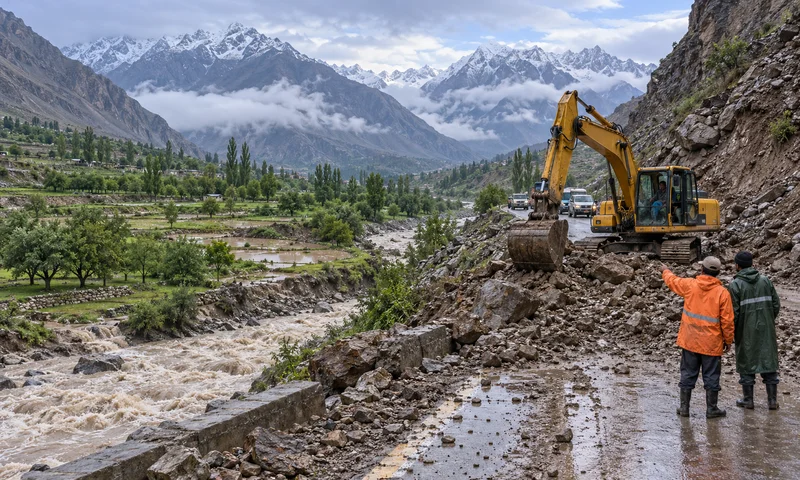
Cloudburst-triggered flash floods have disrupted life across Gilgit-Baltistan, damaging homes and farmland, blocking roads and cutting electricity supplies in parts of Ghizer and Hunza. Heavy rain generated sudden flooding early on Saturday in several Ghizer areas. Naubahar village suffered extensive damage, including harm to Gushgush Jamaat Khana. Floodwater also destroyed crops, fruit trees and agricultural land. Roads blocked as communities seek help Flooding blocked the road between Immit and Barjangle and damaged electricity transmission lines running along the route. The disruption isolated residents from surrounding areas. Affected communities urged the administration to reopen the road quickly and provide immediate assistance and compensation for their losses. A Gilgit-Baltistan police spokesperson said landslides completely closed the Karakoram Highway between Sost and Khunjerab Top. Relevant departments deployed teams and machinery to restore the critical route. Authorities advised tourists to avoid unnecessary journeys while unstable weather and landslide risks persisted. Tourism police later reopened the KKH section between Murtazaabad and Hassanabad village in Hunza after clearing landslide debris. Babusar Top receives first snowfall Intermittent rain, lightning and thunderstorms have affected Gilgit-Baltistan since August 1. Residents described the latest downpour as unusually intense and said the severe thunderstorms created panic. Gilgit resident Waseem Baigal said he had never witnessed rain and thunderstorms of such intensity. However, he reported no damage in his locality. Continuous rainfall also brought temperatures down across the mountainous region. The Diamer district administration reported the season’s first snowfall at Babusar Top on Saturday morning. Despite the snow, traffic continued moving on Babusar Road. The unusual conditions have challenged traditional expectations about the region’s seasonal transition. Resident Ali Ahmed said cold weather historically began arriving after the middle of August. “According to indigenous knowledge, ice started to freeze at high altitudes and the risk of flash floods was over. However, for the last many years, a weather shift has been experienced,” he said. Climate change intensifies disaster risks The Gilgit-Baltistan Disaster Management Authority recorded 120 floods caused by cloudbursts and melting glaciers between June and August this year. Those events destroyed dozens of homes and damaged farmland, orchards, trees, irrigation channels, roads and electricity systems. Road blockages also left residents in several communities stranded for days. Experts said Gilgit-Baltistan now faces more frequent cloudbursts, flash floods, glacial lake outburst floods, landslides, rapid glacier melting and periods of extreme heat. The region’s fragile ecosystem includes more than 8,000 glaciers and about 300 glacial lakes, according to experts cited in local reporting. Its steep mountains and scattered settlements increase the threat to communities and transport links. Climate research has linked rising temperatures with faster glacier melt and growing instability in mountain lakes. These changes can increase the frequency and intensity of sudden flooding. Resident Safdar Ali said people in Gilgit-Baltistan ranked among those most vulnerable to climate change. He said repeated climate-related disasters had created growing fear among local communities.
In Sindh, 99.1pc of Women Own No Land, Study Reveals
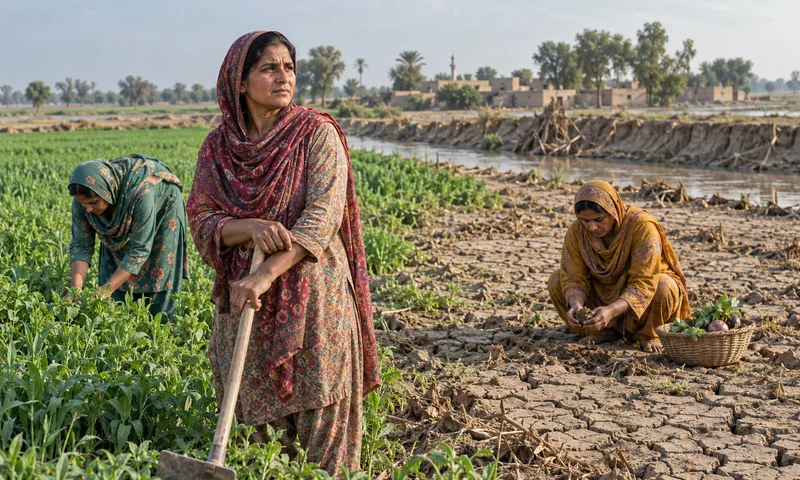
A new study has exposed a deep divide in agricultural ownership and financial power across Pakistan. Only about 2 per cent of ever-married women aged 15 to 49 own land alone or jointly. SDPI and Mobilink Bank presented the research at an Islamabad policy dialogue attended by regulators, banks and development partners. Women power agriculture but rarely own land The study found that 67pc of employed Pakistani women work in agriculture. However, official records classify only 1.5pc of agricultural households as female-headed. About 97.2pc of ever-married women in the surveyed age group had not inherited land or a house. The disparity proved even wider in Sindh, where 99.1pc did not own land individually or jointly. Read More: Pakistan Beats 16 Countries With Insurance Policy for Women Women also face limited access to financial and digital services. Around 56pc of men hold full-service financial accounts, compared with 14pc of women. Mobile-wallet ownership reaches 48pc among men but only 11pc among women. Researchers said the exclusion remains structural because conventional financial products depend on land ownership, personal mobility and digital access. Those requirements rarely reflect the circumstances of women farmers. Climate shocks push women towards debt More than nine in 10 surveyed women farmers experienced an extreme climate event during the previous five years. They reported heatwaves, floods, heavy rainfall and drought-like conditions. More than 80pc suffered crop losses or other negative effects on farming. Borrowing ranked among the two most common coping strategies in every surveyed district. Read More: Airblue Offers Cabin Crew Careers to Multan and Sialkot Women In Khushab, every woman who reported using a coping method had borrowed money. More than half had also sold livestock, potentially weakening future household income. Engr Ubaid Zia, head of SDPI’s Energy Unit, said “women are doing the agricultural work, absorbing the climate shocks, and already borrowing to survive, yet the formal financial system does not treat them accordingly.” The risks have intensified since Pakistan’s 2022 floods. A World Bank-led assessment calculated more than $30 billion in combined damage and economic losses. It estimated that resilient rehabilitation and reconstruction would require at least $16.3bn. Study proposes climate-responsive finance SDPI said half of Pakistan’s population remains largely unrecognised as active agricultural workers. Strengthening agriculture and livestock would therefore support both the rural and national economies. Researchers proposed three financial products. These include input-market loans ranging from Rs50,000 to Rs500,000 over two years, backed by a 3pc insurance premium for recurring climate shocks. They also recommended solar asset-backed financing to reduce women’s reliance on selling gold for household systems. A third proposal covers saffron entrepreneurship through a gender-transformative loan. The study advised lenders to link applications directly to women instead of male household heads. It also proposed female relationship officers to build awareness and encourage participation. SDPI said collaboration with institutions such as Mobilink Bank could sustain research through access to large customer datasets. The framework offers guidance to banks, regulators, development finance institutions and partners designing inclusive climate finance.
