


South Korea plans to conduct its first comprehensive survey of underage entertainers in 2027 and review the industry’s standard contracts. The move comes amid renewed scrutiny of the terms NewJeans members agreed to as teenagers. The Ministry of Culture, Sports and Tourism said Monday it would examine whether existing rules adequately protect young performers’ education, rest and sleep. The survey will count minors under agency contracts, record their ages and assess whether agencies respect their basic rights. The ministry has yet to settle the scope or methodology. Read More: Netflix Partners With Warner Music for Major Documentary Deal “We plan to conduct a separate survey to properly assess the current situation and continue expanding psychological counselling and legal advisory services,” said Kim Yu-mi, director of the ministry’s Popular Culture Industry Division. “We will also review whether improvements to the standard contracts are necessary,” she added. What the NewJeans contracts put under scrutiny A November 5 investigation examined the exclusive contracts all five NewJeans members signed with Ador, a Hybe subsidiary, in 2022. The members were between 14 and 17. The investigation questioned clauses requiring them to cover a substantial share of trainee expenses, including cosmetic surgery and dermatological treatments. It also examined Ador’s right to use their names, likenesses and voices after the contracts ended, including in AI-generated content. Other clauses drew scrutiny for broad restrictions on work attitudes, romantic relationships and personal management. The investigation also questioned whether the early termination formula could impose higher penalties than the government’s standard contract. Hybe and Ador disputed the concerns. They said the members, their parents and legal representatives took part in lawful negotiations. “Furthermore, the exclusive contracts themselves contain provisions protecting fundamental rights, encompassing the protections guaranteed under the government-standard supplementary agreement for minors,” the companies said in a joint statement. What South Korean law requires for young performers South Korea introduced standard exclusive contracts in 2009 to address unfair industry practices. Later revisions and supplementary agreements strengthened protections for minors. The Popular Culture and Arts Industry Development Act requires agencies to protect young performers’ physical and mental health, education, personal rights, sleep, rest and freedom of choice. Agencies must also avoid interfering with their schooling. Read More: European Film Festival Pakistan Returns to Three Cities The law generally caps production work at 35 hours a week for performers under 15. It sets a 40-hour baseline for those aged 15 and older, with limited extensions by agreement. The law also restricts work between 10 p.m. and 6 a.m., with exceptions that vary by age. Recent debuts show how young some performers are. All nine members of A2O Lite are minors, including three 13-year-olds. Their debut single “Neon” topped Melon’s Top 100 a day after its October release. A2O Soul debuted alongside them with 13 minors among its 15 members. Both groups belong to A2O Entertainment, which former SM Entertainment chief Lee Soo-man founded.
Pakistan Backs HBL Trade Finance Push in Four Markets
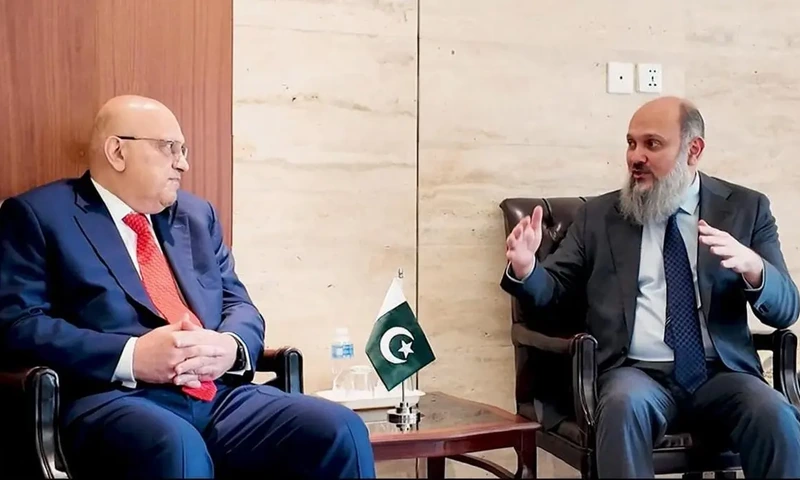
Pakistan’s Ministry of Commerce will support Habib Bank Limited (HBL) in strengthening trade finance and banking links with Bangladesh, China, the Maldives and Sri Lanka. The government wants to make cross-border transactions easier for businesses and expand Pakistan’s bilateral trade with the four markets. Federal Commerce Minister Jam Kamal Khan met an HBL delegation led by Muhammad Nassir Salim, the bank’s president and CEO. The government announced the understanding on Wednesday, November 18. The talks also covered financing for small and medium enterprises (SMEs), digital banking and ways to help Pakistani exporters reach more markets. Read More: HBL and PAFLA Plan International Payment Solutions for Freelancers “Such collaboration would help facilitate trade transactions, improve access to banking channels and support greater bilateral trade with these markets,” the government said. HBL, one of Pakistan’s largest commercial banks, already has a branch presence in all four markets, according to its 2025 annual report. Jam Kamal said banks could help Pakistani exporters arrange trade finance and handle international payments. He also highlighted their role in helping exporters enter new markets and grow in countries where they already sell. HBL raises financing hurdles for undocumented businesses The HBL delegation explained the difficulties banks face when lending to businesses that operate without formal records. It also shared its views on SME financing and digital financial services. Both sides discussed ways to widen access to banking, encourage digital payments and bring more businesses into the documented economy. Jam Kamal said formalisation could help Pakistan’s largely informal SME sector obtain institutional financing, improve product quality and compete for export orders. He cited three growing demands in overseas markets: compliance with international standards, quality assurance and the ability to trace products. Read More: How Satellites Will Help HBL Microfinance Bank Assess Farm Loans The minister also outlined government efforts to simplify business rules, remove overlapping licensing requirements and cut administrative hurdles. He said the changes aim to encourage investment and industrial growth. The talks also covered the prime minister’s priorities in SME development, agriculture and housing. Both sides discussed how financial institutions could support those sectors. Separately, the State Bank of Pakistan has introduced SMEConnect, a central portal for small-business finance applications. Since November 1, businesses have had to submit their applications through the portal. After verification, the system sends each application to the applicant’s bank or development finance institution. Commerce Ministry looks beyond the four markets Jam Kamal pointed to emerging trade and investment opportunities in Africa, Southeast Asia and the Middle East. He said the ministry was drawing up strategies by country and sector to diversify Pakistan’s exports and identify new buyers. The meeting ended with an understanding that the ministry and HBL would coordinate more closely on trade, investment and SME development. That cooperation will also cover Pakistan’s wider commercial engagement with key overseas markets.

In-Flight Internet Gets PTA Green Light: When Can Passengers Get Online?
Pakistan has cleared the way for airlines and private aircraft to offer satellite internet and telecom services in its airspace. The Pakistan Telecommunication Authority (PTA) announced on November 17 that it had finalised the licensing framework for In-Flight Telecommunication Services (ITS). The framework covers Pakistani airlines, other locally registered aircraft and foreign aircraft flying through Pakistani airspace. Licensed providers can serve Pakistani-registered aircraft using satellites that meet Pakistan Space Activities Regulatory Board (PSARB) registration requirements. Foreign aircraft crossing Pakistani airspace must obtain a no-objection certificate (NOC) from the PTA and meet its compliance requirements. The clearance requirement also applies to transit aircraft that stay in Pakistan for less than four weeks. In-flight internet starts at 3,000 metres above ground Aircraft can offer internet access only once they reach at least 3,000 metres above ground level, or about 9,840 feet. Providers serving domestic and foreign airlines must use only licensed radio systems within Pakistani airspace. The ITS licence costs $10,000 and remains valid for 10 years. Read More: Ufone, Telenor and PTA Hold Zero Trust Cybersecurity Workshop The PTA said the service would “enhance passenger experience through seamless in-flight internet connectivity, enabling access to digital services, entertainment, personal communication and work-related activities”. It gave no date for commercial service to begin. The announcement also named no participating airlines or passenger prices. Providers must route traffic through Pakistan Companies must use Fixed Satellite Gateway Earth Stations within Pakistan and route all in-flight internet and telecom traffic through them. They must also keep all user data within the country, including where they generate, store or process it. Providers must buy international IP bandwidth from a Long Distance and International (LDI) licensee in Pakistan. Read More: South Air Gilgit Flights: G-B Plans Aircraft Lease Deal Providers must follow the laws governing radio spectrum use under the Frequency Allocation Board (FAB). The board will receive complaints about satellite interference, including cases of harmful international interference affecting space services. Companies must also meet the Pakistan Civil Aviation Authority’s terms, conditions and safety standards for onboard internet and telecommunications. Satellite registration and transit clearance Pakistan published separate registration rules for geostationary communications satellites in the Official Gazette on October 29. Those rules allow a registration exemption for qualifying satellite operations aboard foreign-registered aircraft for up to four consecutive weeks. Among other conditions, the aircraft’s satellite terminal must have authorisation from its home regulator, and the service must stay onboard. The exemption covers PSARB registration only. Foreign transit aircraft still need PTA clearance to offer connectivity in Pakistani airspace. Read More: Why Is Satellite Internet Still Not Available in Pakistan? As of November 18, no operator providing satellite-based internet services held PSARB registration, according to reporting on the framework. For passengers, the rules establish when airlines can switch on in-flight internet in Pakistani airspace. The first commercial rollout date remains open.

From Chaman to Gwadar: Inside Saudi Firm’s Proposed $30 Billion Energy Deal
Saudi Arabia’s Delta Energy Saudi has signed an agreement with Pakistan’s Inter State Gas Systems (ISGS) to study energy projects that could involve about $30 billion in investment. The companies announced the agreement on Tuesday, November 17. It sets out how they will evaluate the projects and leaves financing and construction decisions for later. The programme would assess a natural gas pipeline entering Pakistan through its western border and running towards Gwadar. The port sits on the Arabian Sea in southwestern Balochistan. The companies would also examine a possible extension to Pakistan’s eastern border. The study would cover liquefied natural gas (LNG) facilities, gas processing, storage infrastructure and export terminals. Proposed gas pipeline from Chaman to Fazilka The programme also envisages a pipeline from Chaman, on Pakistan’s border with Afghanistan, across the country towards the Indian border near Fazilka. Delta Energy called the route a “core strategic commitment”. Taking it forward would require formal engagement and agreements with authorities in both Pakistan and India. Delta Energy named Afghanistan’s Kashk gas concession and other Afghan resources as potential sources of supply. The company said the programme was separate from the Turkmenistan-Afghanistan-Pakistan-India (TAPI) pipeline and did not depend on Turkmenistan. Read More: Saudi Arabia’s Vision 2030 Gains Global Attention at the UN Pakistan’s government outlined a different supply route in its account of the signing. It said the memorandum of understanding would assess a pipeline carrying gas from Turkmenistan through Afghanistan into Pakistan near Chaman. From there, the proposed line would cross Balochistan to Gwadar. The government’s outline includes an LNG terminal at the port and possible expansion to other locations. The government put the estimated investment at $25 billion to $30 billion. The Special Investment Facilitation Council hosted the signing, which drew senior officials from the council, the Petroleum Division and both companies. ISGS is a state-owned company under the Petroleum Division, while Delta Energy Saudi is part of Delta International Group. Pakistan’s other cross-border gas projects Pakistan has faced years of delays on other cross-border pipelines intended to bring gas into the country. The Asian Development Bank says the separate TAPI project aims to carry up to 33 billion cubic metres of gas annually. Under that plan, a roughly 1,800-kilometre pipeline would carry gas from Turkmenistan to Afghanistan, Pakistan and India. Read More: Profit Soars 148% as Wafi Energy Confirms Major Board Decision Gwadar also features in the separate Iran-Pakistan gas pipeline project. In February 2024, Pakistan’s Cabinet Committee on Energy approved work on an initial 80-kilometre section from the Iranian border to Gwadar. The government named ISGS to carry out that work and identified the Gas Infrastructure Development Cess as its funding source. For the Delta Energy proposal, the source of gas and the scope of any eastward extension remain open. The agreement gives the companies a framework to assess the routes and related facilities. It carries no final investment decision or commitment from either company to finance or build the infrastructure.
