


Intimate partners and family members killed an estimated 47,000 women and girls worldwide in 2025, according to a United Nations report. That amounts to 129 deaths a day, or about five every hour. The toll remains broadly in line with recent years. UN Women and the UN Office on Drugs and Crime published their 2026 Femicide Brief on November 24. The release came a day before the International Day for the Elimination of Violence against Women. Researchers drew on data from 122 countries and territories to estimate the global toll. Read More: Heatwaves Trigger Rise in Domestic Violence Against Women Worldwide, 78,000 women and girls died as a result of intentional homicide in 2025. Intimate partners or relatives accounted for about 60% of those deaths. Women and girls made up 19% of all homicide victims worldwide. Among male homicide victims, 11% died at the hands of a partner or relative. Annual estimates for killings by partners or relatives have ranged from 45,000 to 51,000 over the past several years. The agencies put the 2024 toll at 50,000. They attributed most of the difference between the two years to better country-level data. That makes it difficult to tell from the totals alone whether fewer women and girls died. Africa recorded the highest femicide toll and rate Africa had the highest estimated toll at 22,100, followed by Asia at 15,100 and the Americas at 7,400. Europe recorded an estimated 2,100 deaths, while Oceania recorded 300. The UN found cases in every region. Africa also had the highest rate, at 2.9 victims per 100,000 women and girls. The Americas followed at 1.4, then Oceania at 1.1, Asia at 0.6 and Europe at 0.5. Oceania had the smallest estimated toll, but its population-adjusted rate exceeded those of Asia and Europe. Global homicide rates have fallen faster than femicide rates. From 2010 to 2025, homicide rates fell nearly twice as fast as femicide rates in the Americas. In Europe, they fell about 1.5 times as fast. UN calls for earlier action on domestic violence The UN stressed the “urgency of ensuring that the prevention of domestic violence addresses intimate relationships, as well as relationships in wider family structures”. The brief notes that fatal violence often follows a pattern of abuse, threats or coercive control. It highlights measures such as police risk assessments, enforcement of protection orders and limits on access to firearms. Read More: Virginia Man Accused of Taping Wife to Chair to Watch Football The report also calls for better data on gender-related killings outside intimate and family relationships. Gaps in those records make it difficult to estimate the full scale of femicide worldwide. At UN headquarters in New York, UN Women installed 129 orange flags. Each flag represented one woman or girl in the estimated daily toll from partner or family violence.

Microsoft Copilot Chief Explains How AI Is Changing Coding
Microsoft’s Copilot chief says AI is taking over more of the work of writing code. Engineers, meanwhile, are spending more time designing systems, checking what AI produces and deciding how to release changes safely. Charles Lamanna, Microsoft’s executive vice president for Copilot, Agents and Platform, described the shift in a November 22 interview with Peter Yang. Lamanna compared the shift to earlier changes, from compilers replacing hand-written assembly to cloud platforms handling infrastructure. He imagined showing a programmer from 1990 what Microsoft Azure or Amazon Web Services could do. That programmer, he said, might respond, “90% of what I do has been like replaced.” Lamanna used the figure to illustrate how cloud computing changed a programmer’s work. AI coding shifts the work to design and verification On teams that rely most heavily on AI, engineers spend more time on system design, verification, testing and safe rollouts. Yang said Lamanna’s top engineers told him they had never had to think harder. AI can generate code quickly, but engineers still have to catch errors before that code reaches production. Lamanna said coordination now takes more of his time. He writes a 20-page memo every six months and uses A/B tests to settle debates. Read More: Apple Takes On Microsoft and Nvidia With Macs Built for Local AI Why Microsoft is designing software for AI agents Lamanna expects AI agents to become the primary users of many software products. He already uses Copilot Cowork to review Microsoft’s GPU capacity and plan budgets. He also cited a fourteenfold increase in the load on GitHub.com over a year. GitHub’s 2026 Octoverse report said agents drafted 110 million pull requests in September. That accounted for more than 40% of the month’s total, up from 17% in March. “Agents are very harsh customers,” Lamanna said. A person might want 10 search results. An agent can handle 1,000, he said, giving Microsoft a reason to adapt its interfaces and APIs. Microsoft CEO Satya Nadella has also floated a scenario in which 20 million agents work alongside the company’s employees. Copilot Workspaces brings teams into the loop Lamanna argued that AI tools borrow too heavily from the way programmers work alone. Sales and finance depend on frequent collaboration. Microsoft’s Copilot Workspaces, announced at Ignite, suggests colleagues and agents for jobs such as drafting a proposal or tackling a supply chain disruption. Microsoft also previewed easier access to Copilot through the Windows taskbar. Word, Excel and PowerPoint now open inside Copilot, but Lamanna expects the apps to remain important. He pointed to a simple task where direct controls make sense, such as dragging a text box eight pixels to the left. He also urged employees to think twice before sending a 10-page AI-generated document to 10 colleagues. Generating it takes seconds. Reading it still takes time.
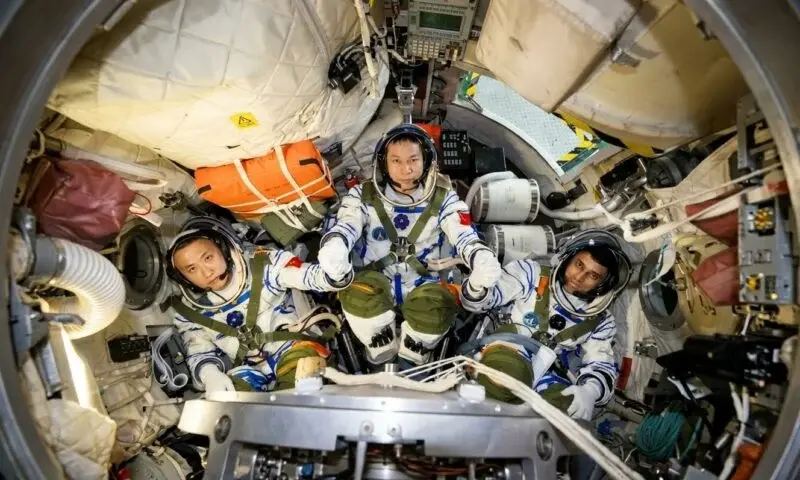
Zeeshan Ali Makes History as First Pakistani in Orbit After Shenzhou-24 Docks at Tiangong
China’s Shenzhou-24 spacecraft docked with the Tiangong space station on Wednesday, November 25, after a flight of about three and a half hours. Aboard was Muhammad Zeeshan Ali, a former Pakistan Air Force pilot who became the first Pakistani to orbit Earth. The mission also makes him the first foreign astronaut to visit China’s space station. A Long March-2F rocket lifted off from Jiuquan Satellite Launch Centre at 5:18 a.m. Pakistan time, or 8:18 a.m. in Beijing. CCTV footage showed flames and smoke rising beneath a pink sky over the Gobi Desert. About 10 minutes later, the spacecraft separated from the rocket and entered its designated orbit. The China Manned Space Agency called the launch a “complete success” and said the crew was in good condition. Ali, 40, serves as payload specialist alongside mission commander Tang Hongbo and flight engineer Wu Yi. Shenzhou-24 also marks China’s first crewed spaceflight with an international crew. Pakistan’s earlier spaceflight milestone came in October 2023, when Namira Salim reached space on a suborbital Virgin Galactic flight. What Zeeshan Ali will do aboard Tiangong Ali will spend about a week aboard Tiangong. During that time, he will install equipment, prepare samples and run experiments under the Pakistan-China research programme. For example, one experiment will study photosynthetic cyanobacteria in orbit. The #ShenzhouXXIV crew has entered the return capsule and is completing final checks ahead of liftoff.Chinese astronauts Tang Hongbo, Wu Yi, and Pakistani astronaut Muhammad Zeeshan Ali are ready for their journey to orbit.See you among the stars! ✨[📷/CMG] pic.twitter.com/sVqts1m18K— Chinese Space Station (@CNSpaceStation) November 24, 2026 Universities across Pakistan submitted more than 300 proposals to the Space and Upper Atmosphere Research Commission (SUPARCO). Chinese institutions selected four Pakistani experiments from that pool. The joint projects cover biotechnology and materials science. According to SUPARCO officials, the research addresses questions related to food security and climate change. Meanwhile, China has planned more than 90 experiments and technology tests for the wider mission. After his stay, Ali will return to Earth with two members of the outgoing crew aboard Shenzhou-23. That spacecraft docked with Tiangong in May. Tang and Wu, meanwhile, will remain in orbit for roughly six months. How Pakistan selected its first astronaut for an orbital mission Pakistan and China signed an agreement in February 2025 to select and train Pakistani astronauts for Tiangong missions. After three rounds of screening, Ali and Khurram Daud advanced to training in China. Ali spent seven months training in Beijing, where he took intensive Chinese-language classes. Ultimately, Ali secured the flight assignment and Daud became his backup. Send-off ceremony held for Shenzhou-24 astronauts#Shenzhou24 https://t.co/VPB5sgrqnO pic.twitter.com/HiD6PnXPRY— CCTV+ (@CCTV_Plus) November 24, 2026 Before liftoff, Federal Planning Minister Ahsan Iqbal joined Pakistani and Chinese delegates at the crew’s send-off. Afterwards, he called the flight a source of national pride and said he hoped young Pakistanis would pursue careers in astronautics. “This is just the beginning, not the end,” he said. Zardari and Shehbaz hail Pakistan’s space milestone President Asif Ali Zardari called the mission a “landmark achievement”. He said the experiments could advance scientific knowledge and open new opportunities for Pakistan’s space programme. Zardari also quoted Allama Iqbal’s verse, “Sitaron se aagay jahan aur bhi hain”, as he urged young Pakistanis to pursue scientific discovery. In a post on X before liftoff, Prime Minister Shehbaz Sharif said the milestone belonged to the entire nation. He said Pakistan was looking to the skies with “anticipation, pride and deep gratitude”. Sharif credited SUPARCO, universities, scientists, the armed forces and other national institutions. He also thanked Chinese President Xi Jinping for strengthening the countries’ All-Weather Strategic Cooperative Partnership. The prime minister cited their “exceptional trust, mutual respect and enduring brotherhood” and wished the crew a safe and successful flight. Tomorrow, Pakistan will look to the skies with anticipation, pride and deep gratitude.As Shenzhou-24 prepares to carry a Pakistani astronaut to China’s Tiangong Space Station, our nation stands on the threshold of a historic first. It is a moment that belongs to every…— Shehbaz Sharif (@CMShehbaz) November 24, 2026 “Pakistan-China friendship is surpassing the heights of the Himalayas, in its journey to outer space,” Sharif wrote. The partnership dates back to at least 1990, when a Chinese rocket launched Pakistan’s first satellite, Badr-1. Since then, China has launched several Pakistani satellites. The next step could take that cooperation to the Moon. SUPARCO plans to send a Pakistani-built rover aboard China’s Chang’e-8 mission, which is targeting 2028.