
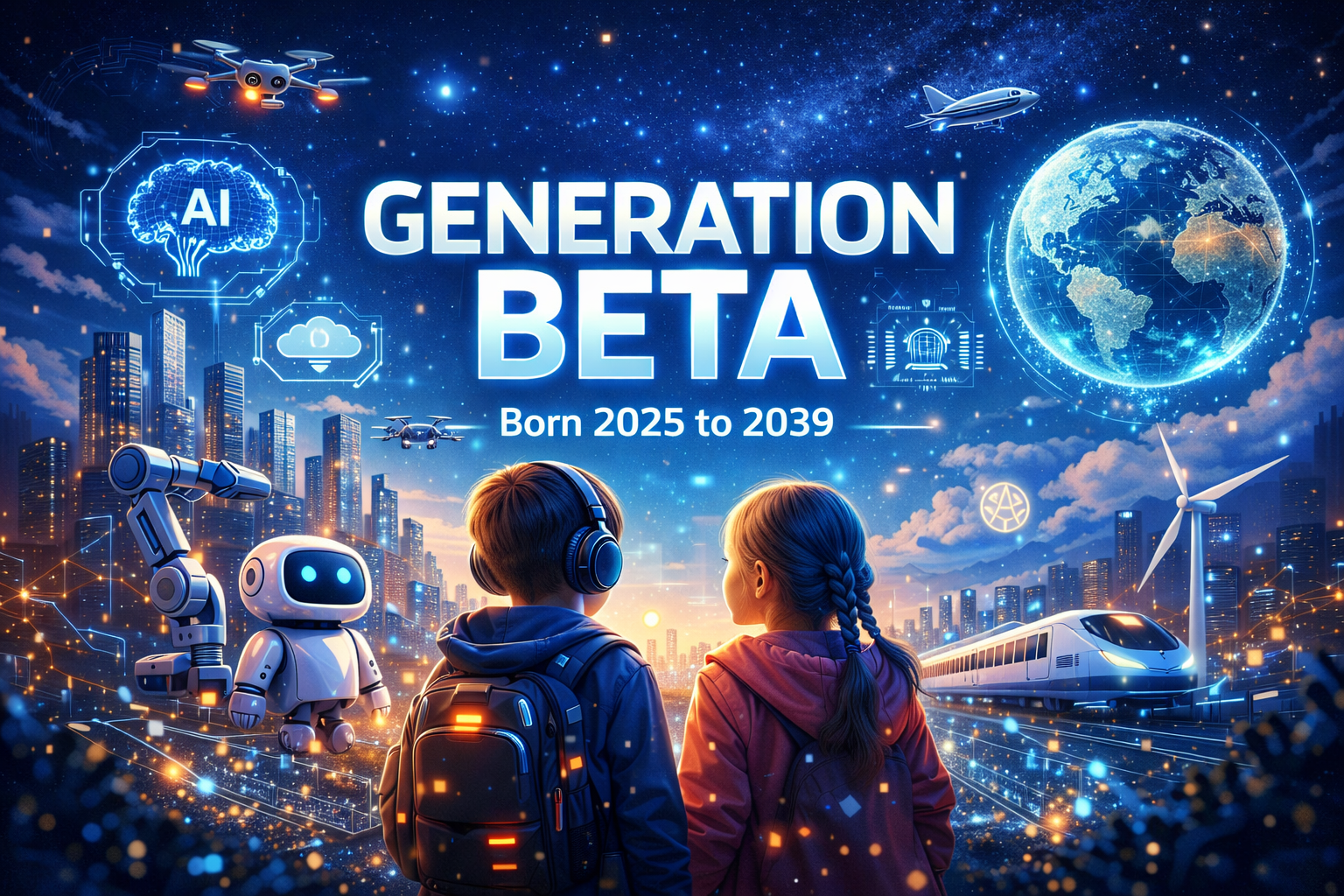
As the calendar turned to 2026, social media feeds and online forums filled with claims that a brand-new generation had arrived, Generation Beta. According to widely shared posts, all children born from 2025 to 2039 will now fall under this label. While some dismissed the idea as an internet trend, experts say the concept of Generation Beta is rooted in established demographic research, not online speculation. Who Is Generation Beta? Generation Beta refers to people born between 2025 and 2039, following Generation Alpha (born roughly between 2010 and 2024). The term has been introduced and popularised by demographic researchers, most notably Mark McCrindle, whose work on generational analysis is frequently cited by academics, policymakers, and global media outlets. It is important to note that no international authority officially defines generations. Instead, generational labels are analytical tools used by sociologists, economists, and researchers to describe groups of people shaped by similar historical, technological, and social conditions. Why the Name ‘Generation Beta’? The name follows a Greek-alphabet naming system that began with Generation Alpha. After Alpha, the next logical designation is Beta. Researchers argue that Greek-letter naming reflects a broader shift: the first generations to be born entirely in the 21st century, without lived memory of the pre-digital world. The term “Beta” does not suggest inferiority or social traits but simply indicates sequence. Experts stress that generational names are descriptive, not predictive. They help frame discussion but do not define individual personality, intelligence, or ability. What Will Define Generation Beta? Although Generation Beta is only just being born, researchers outline several factors likely to shape their upbringing: 1. Life in an AI-First World Generation Beta will be the first cohort born into a world where artificial intelligence is embedded in daily life – from education and healthcare to transportation and entertainment. Unlike Generation Z, which witnessed the rise of smartphones and social media, Generation Beta will grow up with AI assistants, automation, and predictive technologies as the norm. 2. Seamless Digital-Physical Integration For Generation Beta, the boundary between online and offline life is expected to be increasingly blurred. Smart homes, connected cities, and digital learning environments will be standard, not novel. 3. A World Defined by Global Challenges Climate change, demographic shifts, and technological disruption will form the backdrop of their childhood. Researchers suggest this may influence how Generation Beta approaches problem-solving, collaboration, and adaptability in adulthood. How Generation Beta Differs from Generation Z While both generations are considered digitally native, their formative environments are fundamentally different. Generation Z (born roughly between the late 1990s and early 2010s) grew up during: The rise of social media Rapid smartphone adoption Political and social movements amplified through online platforms Generation Beta, by contrast, will grow up in: A world already shaped by AI and automation Education systems enhanced by adaptive technology Smart infrastructure embedded in everyday life Where Generation Z adapted to digital transformation, Generation Beta will inherit it fully formed. Generation Beta is expected to make up a significant portion of the global population by mid-century, potentially influencing future economies, workplaces, and political systems. While it is too early to define their values or behaviour, researchers agree on one point: their world will be profoundly different from that of previous generations. As history shows, each generation is shaped less by its label and more by the realities it faces. For Generation Beta, those realities will include unprecedented technological integration, global interdependence, and rapid change.
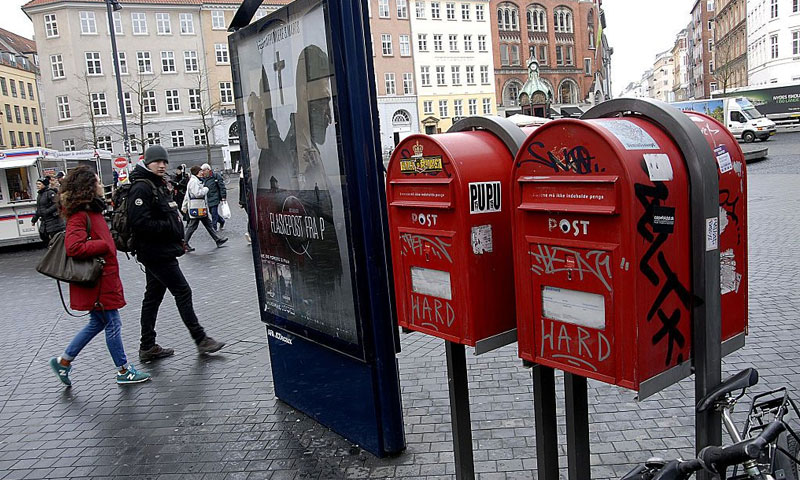
The End of an Era: Denmark Shuts Down Letter Delivery After Four Centuries
When was the last time you mailed a handwritten letter? For many people, it’s a distant memory—replaced by emails, instant messages and social media. Now, one country has formally closed the chapter on traditional mail. Denmark has become the first nation in the world to shut down its national letter delivery service, marking the end of more than four centuries of postal history. After 401 years, the country’s postal operator, PostNord, has concluded that physical letters are no longer essential—or financially sustainable—in an overwhelmingly digital society. “For the past two decades, letter volumes in Denmark have declined sharply. Most communication today is electronic,” said Isabella Beck Jørgensen, PostNord’s head of press, in an interview with ABC. “We are among the most digitalised countries in the world.” The numbers tell the story clearly. Letter deliveries in Denmark have fallen by 90 percent over the last 25 years. In 2000, nearly 1.5 billion letters were delivered nationwide. By last year, that figure had dropped to just 110 million. As volumes collapsed, costs rose. Sending a standard letter now costs more than 29 Danish krone—roughly $6.80—making traditional mail an expensive option for most households. PostNord described the decision to end letter delivery as painful but unavoidable. Around 1,500 jobs—nearly one-third of its workforce—will be cut as the company shifts its full focus to parcel delivery, a sector that continues to expand with the growth of online shopping. According to the company, public reaction has largely been accepting. “Many people honestly can’t remember the last time they sent a letter,” Jørgensen said. Still, the move has sparked concern among advocacy groups who fear parts of society could be left behind. Marlene Rishoj Cordes from DaneAge warned that elderly citizens and people in remote areas still rely heavily on physical mail. “Hospital appointments, vaccination notices and home-care decisions are often sent by letter,” she told Denmark’s TV2. “The digital shift is happening very fast.” Since June, PostNord has begun removing its 1,500 iconic red mailboxes from streets across the country. Public interest in them has been overwhelming: the first 1,000 boxes were sold for charity within just three hours, with many fetching hundreds of dollars. Some will be preserved in museums, while more are set to be auctioned next year. PostNord will continue handling letters destined for neighbouring Sweden, where digital adoption is lower. Within Denmark, however, letter delivery will now be handled entirely by private companies. Danes can still send Christmas cards or handwritten notes in 2026—but they will need to drop them off at shops or pay extra for home collection via apps or online services. Under Danish law, citizens must always have access to letter-sending services. If private providers ever withdraw, the government would be required to step in and appoint a new operator. For now, though, Denmark has quietly accepted a historic reality: the age of the handwritten letter has officially come to an end.

From First Fireworks to Final Countdown: Where the New Year Starts and Ends
As fireworks light up skies around the world and countdown clocks hit zero, the arrival of a new year is not as simultaneous as it feels. In fact, due to the way Earth is divided by time zones, it takes 25 full hours for the New Year to sweep across all inhabited parts of the planet. At the heart of this staggered celebration is the International Date Line — the imaginary boundary that marks where each new day begins and ends. While it generally follows the 180th meridian in the Pacific Ocean, the line doesn’t run straight. That’s because, as explained by the National Oceanic and Atmospheric Administration, the date line has no legal international status. Countries are free to decide which calendar day they observe — and some have used that freedom to their advantage. The First Place to Ring in the New Year The honor of welcoming 2026 first belongs to Kiritimati (Christmas Island), part of the island nation of Kiribati. Although the island lies almost directly south of Hawaii, it celebrates the New Year a full day earlier. This wasn’t always the case. Before 1995, the International Date Line actually split Kiribati, meaning different islands were living on different calendar days. That changed when the country’s president shifted the date line eastward to wrap around the nation, unifying its time zones. The decision unexpectedly placed Kiribati at the very front of the global calendar — a move that also ensured it became the first country to welcome the year 2000. As a result, Kiribati entered 2026 when it was still 5 a.m. on December 31 in the US Eastern Time Zone. Soon after, Samoa and Tonga followed, with Auckland in New Zealand becoming one of the first major cities to celebrate the New Year with large public events. The Last to Say Goodbye to 2025 On the opposite end of the timeline are Niue and American Samoa. Located just southwest of Kiribati, these islands are the final inhabited places on Earth to enter the New Year. By the time American Samoa welcomes 2026, much of the world has already been living in the new year for nearly a full day. In US Eastern Time, the moment arrives at 6 a.m. on January 1 — closing the 25-hour global New Year journey.

How Much Do American Airlines Pilots Actually Make? Salary Breakdown
A viral paystub from an American Airlines pilot has shocked the internet and sparked wide discussion about how much airline pilots actually earn especially at major U.S. carriers. A captain based in Miami flying the Boeing 737 shared their year-to-date earnings online, revealing a total compensation of nearly $458,000 for 2025, with an hourly flight pay rate above $360. The post quickly spread across social media and aviation forums, surprising many people who had no idea pilots could earn such figures. Pilot pay in the airline industry is structured differently than a typical salary, with most compensation tied to actual hours flown under federal regulations. U.S. pilots are generally capped at around 900–1,000 flight hours per year, meaning even with high hourly rates, total work time is limited making the nearly half-million-dollar figure impressive. In addition to base pay, pilots receive incentive pay, vacation pay, training and per diem allowances, which can meaningfully increase total earnings. The viral case isn’t necessarily the norm for all American Airlines pilots, but it highlights how lucrative the profession can be for seasoned captains on major aircraft. Salary data shows that first officers (co-pilots) at American Airlines typically start lower, with some estimates placing their pay from around $110,000 to $230,000 annually depending on experience and hours flown. Captains on larger jets, especially wide-body aircraft like the Boeing 777, have even higher earning potential. According to labor statistics and salary surveys, airline pilots in the U.S. have median annual earnings of about $226,600, though union contracts and company benefits can push total compensation significantly higher at major carriers, sometimes exceeding $500,000 for long-tenured captains with profit sharing and bonuses factored in. Public reaction to the pilot pay reveal has been mixed. Some commenters praised the high earnings as justified for a job that involves immense responsibility and rigorous training, while others argued that the scheduling demands, irregular hours and constant travel make the profession less appealing despite the pay. The debate also underscored a broader issue in aviation: pilot shortages and competitive hiring have driven up salaries industry-wide, as airlines strive to recruit and retain experienced flight crews. For aspiring aviators, this moment has drawn attention to a career path that offers increasing financial rewards as pilots gain seniority and, for passengers, a new data point on the professionals who safely guide flights around the globe.

Christmas Eve Rescue: Firefighters Save Squirrel Stuck in Trash Bin
In a heartwarming turn amid the holiday bustle, firefighters in upstate New York became unlikely rescuers this Christmas season when they saved a tiny squirrel trapped inside a dumpster on Christmas Eve. The Binghamton Fire Department received an unusual call late on December 24, reporting that a distressed squirrel was stuck and unable to escape on its own. With temperatures dipping and the festive spirit all around, responders knew this little animal needed help and fast. Upon arrival, firefighters found the squirrel clinging inside the trash receptacle, clearly distressed but alert. Dumpster rescues aren’t exactly part of the standard emergency call roster, but the crew treated this as a mission of compassion. Using their tools and steady hands, the team carefully reached into the container and lifted the tiny creature to safety. The squirrel, though cold and shaken, appeared to be uninjured which was a Christmas miracle for many onlookers. Social media quickly picked up the story, with locals praising the firefighters’ kindness. Photos and videos of the rescue were shared widely, showing firefighters gingerly carrying the rescued squirrel, spreading smiles during a season often filled with stress and harsh winter weather. Community members noted how the simple act of saving a small animal reflected the best of holiday generosity and goodwill. Animal welfare experts say squirrels are resourceful creatures, often foraging for food even in cold conditions, which may explain how this little one ended up exploring a dumpster. However, once inside, slick metal walls can make escape difficult. That’s when human help becomes critical. Local wildlife rehabilitators recommend leaving rescued animals in a warm, quiet place so they can recover from stress before being released back into a suitable outdoor environment when temperatures are more forgiving. This isn’t the first time firefighters have stepped beyond fighting flames to assist wildlife. Across the U.S., emergency crews regularly help birds trapped in storm drains, cats stuck in trees, and even turtles stranded on busy roadways. These moments remind communities that first responders play many roles — not just saving lives but also protecting the creatures that share our environments. For residents of Binghamton and beyond, the story of a brave little squirrel rescued from a dumpster brought unexpected joy and a reminder that kindness — big or small — matters all year round.

From Tradition to Technology: How AI Clips Are Fueling Marriage Debates in China
In a striking example of how artificial intelligence is shaping cultural conversations, Chinese parents are now turning to AI-generated videos of remorseful, single women to pressure their unmarried adult children into marrying and having children. These clips, which have gone viral on short-video platforms like Douyin and Weibo, depict middle-aged women in hospitals lamenting their life choices, portraying singlehood and childlessness as a source of deep regret even though the characters aren’t real. In one popular AI clip, a woman depicted as 58 years old tearfully says she now faces aging and sickness alone because she never married. Another scene shows a 56-year-old lamenting that ignoring her parents’ advice to settle down has left her isolated, watching families gather around other patients. These visuals are crafted to play on fears of loneliness and aging without companionship, and some parents are sharing them with their children as “educational materials” meant to highlight what they see as the “real consequences” of remaining single. The trend reflects deeper tensions in Chinese social and demographic life. China’s marriage rate has been declining sharply: in 2024, the country recorded just over 6.1 million marriages — the lowest since 1980, accompanied by a third consecutive year of population decline. As housing costs, economic pressures, and shifting personal aspirations lead many young people to postpone or forgo marriage and parenthood, older generations are increasingly anxious about the future. But the reaction among younger Chinese is often sharply critical. Many netizens recognize the clips as AI fabrications and question their ethical implications. Some have labeled the videos a “cyber siege” which is a tactic that doesn’t persuade but alienates. Comments on social media range from amusement at the clips’ unrealistic portrayals to outright rejection of their message, with some users saying such fear-mongering only reinforces their desire to remain independent. This digital phenomenon highlights the cultural clash between traditional expectations which is rooted in filial piety and the belief that marriage and children are essential to a fulfilled life and modern values that prioritize personal freedom and different life paths. It also raises important questions about how AI is being used to influence deeply personal decisions, and whether such tools may inadvertently deepen generational divides rather than bridge them.

The Story Behind 2025’s Most Unusual Word of the Year
Each year, dictionaries and linguists highlight a word or phrase that captures the spirit of the time — and for 2025, that title belongs to a simple, seemingly innocuous number: “67.” What started as an obscure slang term on youth social platforms evolved into a cultural phenomenon that linguists now say reflects how young people think, feel, and communicate today. Originally circulating on platforms like TikTok, Instagram, and X, “67” became shorthand among teenagers and Gen Z users for a vibe that’s hard to pin down with a single word. It’s not just about the literal number; it embodies a kind of ambiguous mood, often used to signal a feeling that’s “sort of right, sort of off,” or to caption moments that feel odd, existential, or ironically imperfect. This flexible use helped the term spread quickly beyond niche communities into mainstream social feeds, meme culture, and everyday texting. Linguists studying digital communication noticed that “67” was being deployed in ways similar to past internet-born terms: as an emotional shorthand, a mood label, and a playful in-joke that invites shared understanding without explicit definition. The term’s rise was so notable that major dictionaries began tracking its usage frequency throughout 2025. By analyzing billions of public social posts, lexicographers observed surges whenever viral videos or cultural moments leaned into the “67 mood” from awkward family gatherings to surreal celebrity moments. Critics and commentators have had fun speculating about why “67” resonated so widely. Some see it as a reaction to an era marked by mixed signals and fast-changing trends: a number that encapsulates everything and nothing at the same time. Others likened it to previous words of the year that captured collective emotion during periods of uncertainty and transition. Teen culture, in particular, embraced “67” precisely because it’s open-ended — a Rorschach test of feeling, shaped by context, tone, and personal interpretation. Educators and language experts note that this isn’t the first time numbers have crossed into linguistic territory. Think of how “404” became synonymous with error and absence long before smartphones dominated communication. But few numerical memes have achieved the lexical staying power of “67” in defining a full year’s digital expression. While some may dismiss “67” as just another fleeting internet fad, its journey from obscurity to official recognition suggests something deeper about how language evolves online. It’s a reminder that modern vocabulary isn’t just written in dictionaries. It’s lived, shared, and remade every day through the social platforms where people connect.
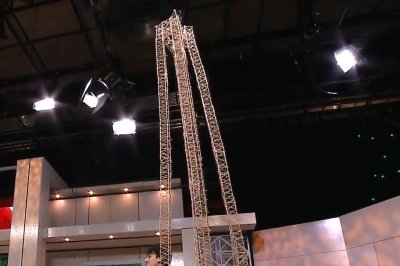
Illinois Teen Sets World Record With 17-Foot Toothpick Tower
A teenager from Illinois has just taken creativity and patience to dizzying new heights — literally. 17-year-old Ethan Ward has built what is now officially recognized as the world’s tallest toothpick tower, an astonishing structure that soars 17 feet and 32 inches high. What began as a personal passion project quickly turned into a record-breaking masterpiece that’s capturing imaginations around the globe. Ethan’s fascination with toothpick construction started years ago, fueled by a love of engineering puzzles and meticulous detail. He spent countless hours designing, testing, and refining tiny joints and load-bearing patterns long before anyone suspected he was building something worthy of international acclaim. When the final piece was placed, the towering creation stood almost 18 feet tall, a seemingly fragile yet incredibly stable testament to his skill and dedication. The feat didn’t stay under the radar for long. Footage and photos of the immense structure spread rapidly on social media, where followers were quick to express awe at both the size and complexity of the design. “This is insane — how does it even stay up?!” read one comment. Another admirer wrote, “This is next-level patience and precision. I can’t even build a bookshelf.” After months of anticipation, the Guinness World Records team confirmed that Ethan’s tower surpasses the previous record for the tallest toothpick structure. Representatives praised the teen not just for achieving a physical milestone but for demonstrating ingenuity and passion that inspires others to push the boundaries of what’s possible through focus and creativity. Ethan’s record-breaking moment has sparked renewed interest in toothpick architecture, a quirky but serious niche where enthusiasts experiment with geometric shapes, tension forces, and balance using nothing more than toothpicks and adhesive. Experts say that such constructions require not just patience, but deep understanding of weight distribution and structural integrity — skills typically taught in advanced engineering courses. Family and friends who watched Ethan’s journey attest to his quiet determination. “He’s always been fascinated by building things,” said one close relative. “But this? This really took everything he’s learned over the years and then some.” With his achievement now cemented in the record books, Ethan Ward plans to keep designing new structures, each one more ambitious than the last. Schools and community groups have already begun inviting him to speak about his process, hoping his story inspires other young creators to follow their curiosities, no matter how tiny the tools or how big the dream.

Cold Nights, Clear Skies: Why Stars Look Sharper in Winter
As winter settles in, many people find themselves pausing under the night sky, struck by how bright and sharp the stars appear. From city outskirts to open deserts, cold winter nights often deliver some of the clearest and most beautiful views of the heavens. This seasonal sparkle has a lot to do with how winter changes the air above us. Clearer Air, Brighter Views One of the biggest reasons stars look brighter in winter is the quality of the air. Cold air holds far less moisture than warm air. During summer, humidity, dust, and pollution scatter light and create haze, dulling the night sky. In winter, drier air allows starlight to travel more directly to our eyes, making stars appear sharper and more intense. Less Turbulence in the Atmosphere Winter nights also benefit from more stable atmospheric conditions. Warm air rises and cool air sinks, and during hotter months this constant movement causes stars to flicker and blur. In colder weather, the air near the ground is steadier, reducing this distortion. As a result, stars twinkle less and shine more clearly, giving the sky a calm, crisp appearance. Longer Nights, Darker Skies Another factor is the length of winter nights. With the sun setting earlier and rising later, darkness lasts longer. This extended night means less leftover twilight and more time for the sky to fully darken. Deeper darkness helps faint stars stand out and makes the overall sky appear richer and more dramatic. Winter Brings Brighter Stars Winter also happens to showcase some of the brightest stars and most striking constellations visible from Earth. The winter sky includes brilliant stars that naturally outshine many summer stars. When combined with clearer air and darker conditions, these stars can dominate the night sky, creating the impression that everything above looks brighter than usual. A Perfect Season for Stargazing All these elements come together to make winter an ideal time for stargazing. Whether viewed with the naked eye or through a telescope, the night sky often feels closer, deeper, and more detailed during cold months. While the chill may keep some people indoors, those who brave the cold are often rewarded with unforgettable celestial views. So the next time you step outside on a cold winter night and notice the stars glowing more brightly than usual, you’re witnessing nature at work—clear air, calm skies, and seasonal wonders aligning perfectly overhead.

Chinese Child Accidentally Damages $280,000 Gold Crown at Beijing Exhibition, Triggers Online Debate
A young boy in China accidentally damaged a highly valuable gold crown during a visit to an exhibition in Beijing, igniting widespread discussion online about parental responsibility and museum safety measures. According to the South China Morning Post (SCMP), the crown — a 2-kilogram golden phoenix headpiece worth nearly $280,000 was knocked over while the child was taking photographs with his family. The ornate piece fell and shattered after the protective display case toppled. The incident was publicly disclosed by Zhang Kaiyi, a social media influencer with more than 13.6 million followers, who shared details and footage of the mishap online. Zhang revealed that the crown was handcrafted by her husband, Zhang Yudong, as a deeply personal wedding gift, adding significant emotional value to the artwork beyond its monetary worth. A child accidentally knocked over a glass display case at a museum in Beijing, China, causing a 2-kilogram gold crown to fall out and be damaged.pic.twitter.com/XHDQEXgzJN — Massimo (@Rainmaker1973) December 17, 2025 Video clips circulating on social media show the boy standing beside his mother as she wipes the glass display case. Moments later, the case loses balance, causing the crown inside to fall and break. Zhang, who is currently seven months pregnant, said the incident left the couple distressed. She explained that the crown symbolised their love and commitment and that its destruction felt emotionally devastating. The couple also expressed concern that the accident might be a bad omen for their marriage and her pregnancy. However, Zhang later shared another video addressing messages from online users, including one who reassured her that damage to meaningful objects can symbolically “block bad luck” rather than invite it. She stressed that her intention in sharing the video was not to accuse or blame the child or his parents. Zhang also confirmed that the crown was insured, helping to mitigate the financial loss. The incident has since fuelled a broader debate on social media. While some users argued that parents should be held accountable for supervising their children in public spaces, others criticised the exhibition organisers for inadequate display safety. One user quoted by SCMP commented, “I’ve often seen fingerprints on display cases at national museums. Touching display cases seems to be common behaviour.” Another observer pointed out that professional exhibitions usually test the stability of display stands beforehand, adding, “When setting up exhibitions, pedestals are often shaken to ensure exhibits remain secure even if visitors behave carelessly.” The episode has reopened discussions around visitor conduct, museum display standards, and the shared responsibility of parents and institutions in protecting valuable cultural artefacts.
