

China has taken a significant step in the global technology race by approving the first batch of Nvidia’s H200 artificial intelligence (AI) chips for import, according to multiple sources familiar with the matter. The approvals were granted during a visit to China by Nvidia CEO Jensen Huang, marking a notable shift in Beijing’s stance toward cutting-edge U.S. tech products. The H200, Nvidia’s second most powerful AI processor, delivers roughly six times the performance of the earlier H20 model — previously the most advanced AI chip allowed into China. This high computing power makes the H200 critical for large-scale AI workloads, including machine learning research, deep learning models and data centre operations. Chinese tech giants are expected to be the first beneficiaries of the nod. ByteDance, Alibaba and Tencent have reportedly received approvals for several hundred thousand H200 units, with additional companies now waiting for subsequent rounds of green lights. The approval comes after the U.S. government formally authorised exports of H200 chips to China earlier in January 2026. That decision reversed a long-standing ban on advanced AI chips, allowing Nvidia to seek sales in the lucrative Chinese market under certain conditions, including national security reviews and usage limitations. Until now, Chinese customs had blocked H200 shipments despite the U.S. export clearance, creating uncertainty for Nvidia and its supply chain. Chinese firms had already ordered more than two million H200 chips, far exceeding the company’s inventory, highlighting the scale of demand. Experts see the move as part of a broader balancing act by Beijing. On one hand, China wants to access top-tier AI hardware to support research and development and compete with global peers like OpenAI. On the other, the government remains committed to nurturing its own semiconductor industry, which has been growing quickly but still lags behind U.S. designs in many categories. Despite the clear demand, some observers note that import approvals come with conditions. Beijing is reportedly discussing rules that could require companies to purchase a proportion of domestically made chips alongside foreign imports, a move intended to protect local manufacturers. The approvals also occur amid political pushback in the United States. Some U.S. lawmakers have voiced concerns that exporting advanced AI technology could help China narrow the technology gap, with proposals under consideration to give Congress more oversight over AI chip exports. For now, China’s decision to allow the import of Nvidia’s H200 AI chips reflects a nuanced strategy — one that seeks to satisfy immense internal demand for AI capabilities while preserving momentum toward semiconductor self-sufficiency.

New AI-Powered Sarco ‘Suicide’ Pod Designed for Couples to Die Together
A controversial euthanasia device is once again drawing global attention after its inventor revealed plans for a new version designed specifically to allow couples to die together, raising fresh ethical questions around assisted suicide and consent. The updated design, currently under development, would enable two people to end their lives simultaneously using the same capsule. The device would only activate if both individuals press their buttons at the same time, a feature intended to ensure mutual and voluntary participation. The Sarco euthanasia pod was developed by Philip Nitschke, an Australian physician who has been campaigning for assisted suicide since the 1990s. First introduced in Switzerland in 2019, the pod allows a person to die without medical supervision by releasing nitrogen gas, rapidly reducing oxygen levels inside the capsule. Nitschke said the idea for a couples-only version emerged after repeated inquiries from partners wishing to die together. He cited interest from several couples, including one from Britain who reportedly told him they wanted to “die in each other’s arms.” The proposed model—dubbed the “Double Dutch” Sarco—would be larger than the original and incorporate artificial intelligence to assess whether both users possess the mental capacity to make the decision. Instead of a conventional psychiatric assessment, prospective users would complete an online evaluation administered by an AI avatar. “One of the parts of the device that hadn’t been finished but now is, is the artificial intelligence,” Nitschke said. “You do the test online with an avatar, and if you pass, the avatar confirms you have mental capacity.” The Sarco pod has faced legal scrutiny before. In 2024, a 64-year-old American woman became the first publicly documented person to use the device at a forest retreat in Switzerland. Authorities temporarily seized the pod and detained individuals present while investigating the death. Although early reports suggested the possibility of intentional homicide, Swiss prosecutors later ruled out international homicide charges, allowing the case to be closed. The announcement of a couples-focused version has intensified debate among ethicists and medical professionals, with critics warning that romanticizing joint suicide could have serious societal consequences. Supporters, however, argue that the design adds safeguards by requiring explicit consent from both parties. As development continues, the proposed device is expected to reignite global discussion over assisted suicide, emerging technology, and the ethics of couples choosing to die together.
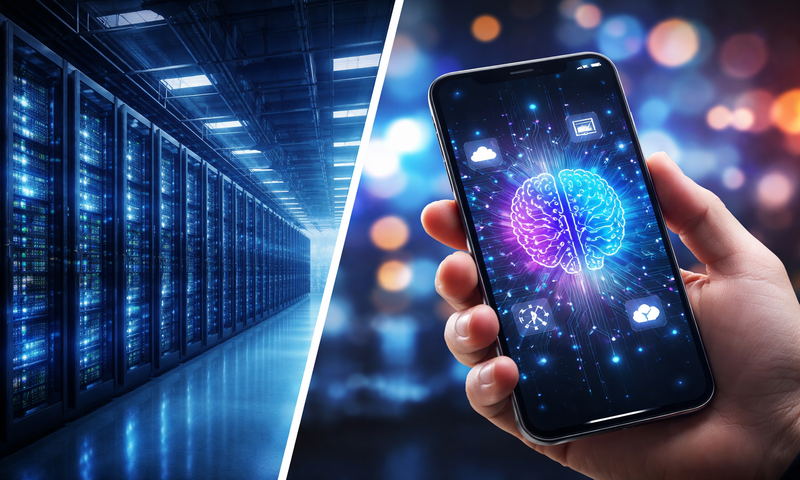
From Cloud to Pocket: How AI Processing Is Moving Away From Data Centres
For more than a decade, the global digital economy has been built around a simple assumption: bigger data centres mean better technology. Vast warehouses packed with servers have powered everything from video streaming and online banking to artificial intelligence. But that model is now facing its most serious challenge yet. The question gaining traction across the tech world is no longer whether data centres will grow — but whether they will remain the centre of AI at all. A Challenge from the Pocket The debate was recently reignited by Aravind Srinivas, chief executive of AI company Perplexity, who argued that the dominance of large data centres could one day be undercut by something far smaller: the smartphone. Speaking on a podcast, Srinivas suggested that as artificial intelligence becomes more efficient and personalised, powerful AI tools could run directly on consumer devices. Instead of constantly sending data back and forth to distant servers, processing could happen locally — on phones, laptops, routers, or even set-top boxes. This would represent a fundamental shift away from the centralised computing model that currently defines AI. Early Signs of a Shift The idea is no longer theoretical. Apple’s latest devices already process some AI tasks directly on-device through Apple Intelligence, using specialised chips to improve speed and privacy. Microsoft has followed a similar path with Copilot+ laptops, which include built-in AI processing capabilities. Yet these remain premium products. Most consumer hardware still lacks the power needed to run advanced AI locally, meaning large data centres remain essential — for now. The Scale of the Data Centre Machine Today’s data centres are enormous operations. Often covering the size of multiple football fields, they house thousands of servers performing everything from cloud storage to AI training. Almost every online service relies on them in some way. Tech giants continue to double down on this infrastructure. Billions of dollars are being invested globally, with around 100 new data centres currently planned or under construction in the UK alone. Their energy consumption is vast, and environmental concerns are growing. Nvidia chief executive Jensen Huang has described these facilities as “AI factories”, arguing that rapid advances in artificial intelligence would not be possible without them. The Case for Smaller, Localised Alternatives Despite the investment surge, a quieter counter-movement is taking shape. Instead of fewer data centres, some experts envision many smaller ones. Consultants and engineers argue that compact “edge” data centres located close to population centres could reduce latency, improve efficiency, and cut energy waste. Some experimental projects already exist — from small data centres heating public swimming pools to household-sized units warming private homes. The idea is simple: if computing generates heat, why waste it? Advocates say future cities could integrate small data centres into public buildings, housing estates, or unused commercial spaces, linking them into networks when large-scale processing is required. Even Space Is Being Considered Others are looking far beyond city limits. Companies are exploring the possibility of placing compact data centres in orbit, where cooling and energy efficiency could be improved. While still experimental, the idea reflects growing discomfort with the ever-expanding footprint of ground-based mega facilities. Is the “Bigger Is Better” Model Cracking? For years, the AI industry believed that scaling was everything — more data, more computing power, better results. But that assumption is now being questioned. As AI models become more specialised, they may require less brute-force computing. Critics argue that not every AI system needs the vast capabilities of today’s large language models. A tool designed for medical diagnosis, for example, does not also need to generate poetry or pop lyrics. If AI becomes smaller, smarter, and more targeted, the pressure to centralise everything inside massive data centres could ease. A Gradual Shift, Not a Collapse Few experts believe large data centres will disappear anytime soon. Demand for cloud services and AI continues to grow. But their role may evolve — from being the sole engine of AI to one component in a far more distributed system. The future may not belong exclusively to either giant data centres or handheld devices, but to a hybrid world where processing happens wherever it makes the most sense. And in that world, the dominance of the mega data centre may no longer be guaranteed.

Meta Appoints Former Trump Adviser Dina Powell McCormick as President and Vice Chairman
US technology giant Meta has announced a major leadership appointment, naming Dina Powell McCormick as its new President and Vice Chairman, marking a significant expansion of her role within the company. In an official statement released on Monday, Meta said Powell McCormick will join its senior management team after previously serving on the company’s board of directors. The move comes as Meta intensifies its long-term focus on advanced artificial intelligence, large-scale computing infrastructure, and what it describes as the pursuit of “personal superintelligence.” Meta founder and CEO Mark Zuckerberg said Powell McCormick’s global experience and policy background make her a strong fit for the company’s next phase. “Dina’s leadership experience, combined with her deep relationships across governments, finance, and international institutions, positions her uniquely to help guide Meta’s strategy as we scale our most ambitious technologies,” Zuckerberg said. In her new role, Powell McCormick will help shape Meta’s overall strategic direction and oversee execution at the highest level. She will also work closely with teams responsible for compute capacity and infrastructure — areas that have become central to Meta’s AI ambitions. The company added that she will lead efforts to secure new strategic capital partnerships and explore innovative funding models aimed at expanding Meta’s long-term investment capabilities. The appointment drew a public reaction from US President Donald Trump, who congratulated Powell McCormick in a post on his social media platform Truth Social. Calling the decision “a great choice,” Trump praised her past service, saying she had represented his administration “with strength and distinction.” Powell McCormick previously served as deputy national security adviser during Trump’s first term. Earlier in her career, she held senior roles in the George W. Bush administration, including assistant secretary of state and senior White House adviser, building a long résumé spanning diplomacy, national security, and global finance. She stepped down from Meta’s board in December 2025, a move that fueled speculation about a broader operational role — speculation now confirmed with her elevation to one of the company’s top leadership positions. Her appointment underscores Meta’s growing emphasis on blending political, financial, and technological expertise as it positions itself at the forefront of the next wave of artificial intelligence development.

AI-Written Wedding Fails Legal Test, Ruled Invalid by Dutch Court
A court in the Dutch city of Zwolle has ruled that a couple’s marriage was never legally valid, after finding that their wedding vows—written with the help of artificial intelligence—failed to meet the country’s legal requirements. The couple believed they were officially married following a small ceremony held in April 2025. Wanting something personal and informal, they chose not to use a licensed civil officiant and instead asked a close friend to conduct the service. To prepare for the occasion, the friend relied on an AI chatbot to help draft the wedding vows. While the ceremony appeared heartfelt, the court later found that a crucial legal element had been overlooked. In its ruling on Tuesday, the court said Dutch law requires couples to explicitly declare that they accept and will comply with the legal duties and obligations that come with marriage. That declaration must be clearly stated during the ceremony for a marriage to be legally recognised. Because the AI-generated vows focused on personal expressions of love rather than the required legal commitment, the court concluded that the marriage did not meet the formal standards set by law. The judges noted that while couples are free to personalise their ceremonies, legal requirements cannot be replaced or omitted, regardless of how sincere or well-intentioned the event may be. The decision has sparked discussion in the Netherlands about the growing role of artificial intelligence in personal and legal matters, and whether technology-driven convenience can sometimes clash with long-standing legal frameworks. For the couple, what they believed was a binding union turned out to be symbolic rather than lawful—highlighting that, at least for now, love alone, even when beautifully written by AI, is not enough in the eyes of the law.
