
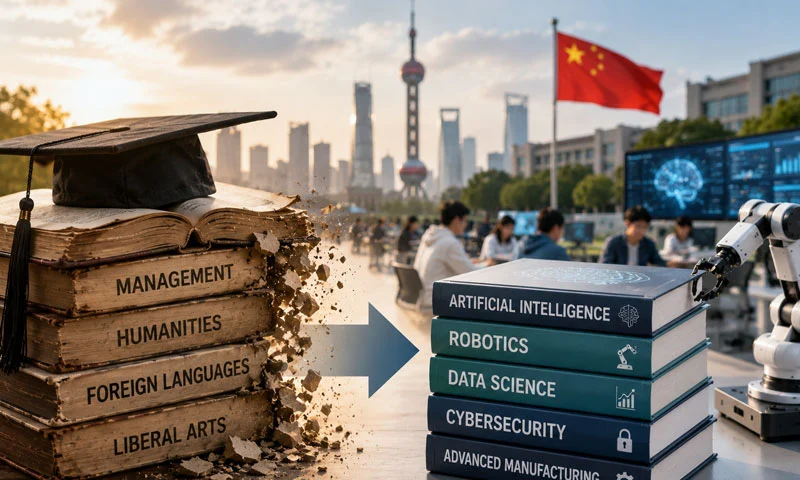
China is undertaking one of the largest overhauls of its higher education system in recent years as universities eliminate thousands of degree programmes and introduce new courses focused on artificial intelligence, robotics and advanced technologies. The changes reflect growing concern that rapid advances in AI are transforming the job market faster than traditional academic programmes can adapt. According to a report by the South China Morning Post, Chinese universities are removing courses considered outdated and replacing them with programmes aligned with Beijing’s long-term economic and technological goals. The move comes as AI increasingly automates tasks in sectors such as finance, consulting, marketing and management. As a result, students are becoming more cautious about investing in degrees that may offer uncertain career prospects. A similar trend has emerged in the United States. Several universities have reportedly reduced tuition fees for MBA programmes in response to weaker demand and growing concerns about the future value of traditional business qualifications. China, however, is pursuing reforms on a much larger scale. Officials want universities to produce graduates with skills that support national priorities, including artificial intelligence, advanced manufacturing, semiconductor development and robotics. Graduate Job Market Pressures Drive Reform The overhaul also highlights growing challenges in China’s labour market. More students are graduating from universities than ever before, but many struggle to find jobs that match their qualifications. Youth unemployment remains above 16 percent, according to official figures, increasing pressure on policymakers to align education with employer needs. Universities have concentrated many of the cuts in arts, humanities, foreign language and management-related disciplines. Officials and educators argue that these fields have become oversaturated while demand grows for technology-focused expertise. At the same time, institutions are launching programmes designed to support China’s next phase of industrial development. One of the fastest-growing fields is embodied intelligence, which combines artificial intelligence with physical machines such as robots. At least nine Chinese universities have already introduced majors in embodied intelligence as Beijing accelerates efforts to integrate advanced AI systems into factories, logistics networks and other sectors of the economy. More Than 12,000 Programmes Eliminated The current reforms build on a broader restructuring effort that has been underway for several years. Data from China’s Ministry of Education shows universities revoked or suspended approximately 12,200 undergraduate programmes between 2021 and 2025. During the same period, universities introduced around 10,200 new programmes. Overall, more than 30 percent of university programmes underwent some form of adjustment. Despite supporting the direction of the reforms, education experts caution that simply replacing one degree with another may not solve deeper challenges. Many programmes now facing closure were introduced only a few years ago and never had enough time to mature. Experts argue that universities should focus on building flexible education systems that allow students to adapt to changing industry demands throughout their careers. They also recommend greater emphasis on transferable skills, critical thinking and interdisciplinary learning. As competition in artificial intelligence intensifies globally, China’s latest reforms demonstrate how governments are increasingly redesigning higher education to prepare students for an economy shaped by automation, digital technologies and rapid innovation.

From Banker to Billionaire: The Rise of British-Pakistani Ilyas Khan
British-Pakistani technology entrepreneur Ilyas Khan has joined the ranks of billionaires after quantum computing company Quantinuum made a blockbuster debut on the Nasdaq, valuing the firm at more than $15.6 billion. The company raised $1.68 billion through its initial public offering, making it the largest stock market listing by a quantum computing company to date. Quantinuum sold 28 million shares at $60 each in the offering. The stock opened at $58 when trading began on June 9. According to company filings, Khan owns approximately 15 percent of Quantinuum. Forbes estimated the value of his stake at around $2.2 billion following the listing. The successful debut marks a major milestone for the rapidly growing quantum computing sector, which has attracted increasing attention from investors, governments and technology giants. Quantinuum emerged in 2021 through the merger of Honeywell Quantum Solutions and Cambridge Quantum Computing, a company Khan founded in 2014. The merger combined Honeywell’s advanced quantum hardware with Cambridge Quantum’s software capabilities, creating one of the industry’s most prominent players. From Banking to Quantum Computing Pioneer Born in Lancashire, England, Khan studied South Asian Studies at the School of Oriental and African Studies (SOAS) in London before beginning a career in banking. After leaving the financial sector, he launched several technology ventures and also founded the Hong Kong-based Asia Literary Review. Khan later pursued a mathematics degree through the Open University, where he developed a deep interest in quantum mechanics. “Quantum is the nature of reality; everything around us is quantum,” Khan said in a recent interview with SOAS. That fascination ultimately led him to establish Cambridge Quantum Computing, a startup focused on developing software for quantum computers. Honeywell had already invested in the company before the merger and contributed $300 million as part of the deal that created Quantinuum. Today, Khan serves as the company’s vice chairman and chief product officer. Quantum Race Gains Momentum Quantinuum operates at the centre of a technology race that many experts believe could reshape computing over the coming decades. Unlike conventional computers that rely on silicon-based chips, Honeywell’s quantum systems use trapped ions controlled by lasers to perform calculations. Supporters of the technology argue that quantum computers could solve problems beyond the reach of today’s most powerful machines. Potential applications include drug discovery, advanced materials research, logistics optimisation and cybersecurity. Interest in the sector has surged as major companies including Google, Microsoft, Amazon and IBM invest heavily in quantum technologies. The Trump administration also recently identified Quantinuum as one of nine quantum technology startups eligible for support through a programme that could provide up to $2 billion in grants and equity investments. Despite growing optimism, the sector remains highly competitive and volatile. Investors continue to watch closely for breakthroughs that could accelerate commercial adoption. For Khan, however, the Nasdaq debut represents the culmination of a journey that began with curiosity about the fundamental nature of reality and evolved into one of the biggest success stories in the emerging quantum computing industry.

Is This the Beginning of the Age of Robot Soldiers?
A California technology startup is betting that humanoid robots could one day become a common sight on future battlefields, taking on dangerous military tasks that currently place human soldiers at risk. Foundation Robotics, a two-year-old company based in San Francisco, is developing a humanoid robot called Phantom for both civilian and military applications. While many robotics firms focus on warehouses, factories and household assistance, Foundation says it is the only US company building humanoid robots specifically for defence operations. The company’s founder and chief executive, Sankaet Pathak, envisions robots carrying out supply missions, reconnaissance, casualty recovery and hazardous inspections. He also sees a future where they take on combat roles. “Frontline weaponisation” is how Pathak describes that possibility. He argues that robotic soldiers could reduce risks to human troops and lower collateral damage by operating with greater precision in complex environments such as urban warfare. Foundation’s current robot, Phantom MK-1, remains a prototype. The machine weighs around 80 kilograms and can walk, balance and interact with objects. However, it lacks a battery, cannot withstand harsh weather and cannot recover after falling. The company is now building Phantom MK-2, which Pathak says will operate for up to six hours, survive difficult environmental conditions and regain its footing after a fall. Military Testing and Technological Challenges Foundation has secured $24 million in research contracts linked to military projects. The company says the US military is testing its technology for handling tasks, while the Ukrainian military is evaluating two units. According to Pathak, the US programme does not involve firing weapons. Ukraine’s testing includes weaponisation studies. The robot operates through an artificial intelligence system called Cortex. Cameras mounted in its helmet provide 360-degree vision and help the machine assess its surroundings. A reasoning model interprets assigned goals, while a world model predicts how the environment may respond. Pathak believes countries must invest in the technology to remain competitive. He argues that China is pursuing similar capabilities and says Western nations cannot afford to fall behind. The startup also attracted attention earlier this year when Eric Trump joined as an investor and adviser. Despite the enthusiasm, robotics experts remain cautious. Dean Fankhauser, founder of robotics advisory firm Robozaps, says military organisations clearly see potential in humanoid systems. However, he believes the technology still faces major obstacles. “If there was a war in Taiwan today, the likelihood that China is going to militarise these humanoids and fight effectively is fanciful,” he said. Experts note that current commercial humanoid robots still struggle with basic tasks that humans perform easily. Ethical Concerns and Global Debate Beyond technical challenges, ethical concerns continue to fuel debate. Nicole van Rooijen, executive director of the campaign group Stop Killer Robots, warns that autonomous weapons could lower the threshold for conflict and make accountability harder to establish. “The answer to the current technological arms race,” she argues, is stronger international regulation. Researchers also question whether humanoid robots represent the best solution for military operations. Some experts believe quadruped robots and drones may perform many battlefield tasks more efficiently. Robert Griffin of the Florida Institute for Human and Machine Cognition says unpredictable environments remain a major challenge. “You get an impression of human-level capability by seeing the human form… but [these autonomous systems] don’t know how to handle open-ended uncertainty yet,” he said. For now, humanoid robot soldiers remain largely experimental. Yet growing military investment and rapid advances in artificial intelligence suggest that the debate over robots in warfare is moving from science fiction toward reality.

Meta Gives Its AI Access to More of Your Online Activity
Meta Platforms has announced a major update to how it personalises content across Facebook and Instagram, revealing that it will now use data shared by other businesses to tailor not only advertisements but also users’ feeds and interactions with its artificial intelligence tools. The move marks a significant expansion of Meta’s personalisation strategy as the company intensifies efforts to integrate AI across its platforms and compete with rivals in the rapidly evolving artificial intelligence market. In a blog post published on Tuesday, Meta said it already uses off-platform activity, such as purchases made on external websites and interactions with online services, to deliver targeted advertisements. Under the new policy, the company will also use that information to customise content recommendations and AI-generated responses. Meta stressed that it is not collecting additional data as part of the change. “We aren’t collecting any new data as part of this update,” the company said. “This is about using information that businesses already send to us to further improve your experience.” The update means users could see content that reflects their activity beyond Facebook and Instagram. Meta provided an example of a consumer who recently purchased a tent online and may subsequently see camping-related videos in their Reels feed. AI and Content Personalisation Meta spokesperson Emil Vazquez told technology publication The Verge that the company previously relied primarily on activity within its own ecosystem, including likes, follows, comments and viewing behaviour, to personalise content recommendations. The latest change broadens that approach by incorporating data supplied by businesses through Meta’s advertising and tracking infrastructure. The development also follows Meta’s growing use of artificial intelligence across its platforms. Last year, the company began using conversations with its AI assistant to personalise advertising experiences. Industry analysts view the latest update as part of Meta’s wider strategy to make its AI tools more relevant and responsive by leveraging a broader range of user signals. The company has invested billions of dollars in AI infrastructure and recently introduced several AI-powered products aimed at improving user engagement and advertising effectiveness. Privacy Controls Remain Available Alongside the update, Meta has simplified the controls governing access to off-platform information. Users who do not want Meta to use information shared by other businesses for advertising, feed recommendations or AI responses can disable the “Activity from other businesses” setting. According to Vazquez, the rollout will occur globally but several regions will not receive the feature initially. The excluded markets include the European region, the United Kingdom, Brazil, Thailand, South Africa, Turkey, South Korea, Ecuador, Nigeria and Kenya. The announcement is likely to reignite debates surrounding digital privacy, data collection and the growing role of AI in shaping online experiences. While Meta argues the changes will improve relevance and convenience, privacy advocates have long questioned how major technology companies use consumer data across platforms and services. As competition intensifies among technology giants, personalisation powered by artificial intelligence is becoming a key battleground. Meta’s latest move signals that data shared beyond its platforms will play a growing role in that strategy.

82% of Pakistanis Use AI While Shopping Online, Visa Study Finds
Pakistani consumers are rapidly embracing artificial intelligence (AI) and social commerce as part of their online shopping experience, but many remain cautious about allowing AI to make purchases on their behalf, according to Visa’s latest Stay Secure study. The annual survey, conducted by Wakefield Research and released by Visa, highlights the growing role of AI-powered tools in digital commerce while underscoring persistent concerns about trust, fraud and online security. The findings come as Pakistan’s digital economy continues to expand, driven by rising internet penetration, smartphone adoption and increasing use of digital payment platforms. According to the study, 82% of consumers in Pakistan have used AI tools to assist with shopping. The most common uses include comparing prices, checking reviews and finding gift ideas. Around 56% use AI to compare prices, while 53% rely on it to review product ratings. Another 47% use AI tools to generate gift recommendations. Consumers appear largely satisfied with the technology. The survey found that 93% believe emerging technologies, including AI-powered tools, make online shopping faster and easier. AI is also influencing how consumers discover brands. About 55% of respondents said they typically encounter new retailers and products while shopping online. Trust Remains a Key Challenge Despite growing acceptance of AI, consumers remain reluctant to hand over complete purchasing decisions to automated systems. Only 42% said they would trust AI agents to complete checkout on their behalf. The findings suggest that while shoppers welcome AI assistance during the decision-making process, they still prefer maintaining control over financial transactions. At the same time, many consumers see AI as a powerful tool against fraud. The survey found that 65% believe AI has made scams easier to identify, while 87% expect artificial intelligence to play a critical role in protecting consumers from fraud in the future. Visa executives say trust will remain central to the next phase of digital commerce. “In Pakistan, we are seeing strong momentum as consumers embrace digital commerce, with AI and social platforms becoming an increasingly integral part of how people discover and shop,” said Leila Serhan, Senior Vice President and Group Country Manager for North Africa, Levant and Pakistan at Visa. “As digital ecosystems evolve, consumers are looking for experiences that not only offer greater convenience but also deliver confidence and control at every step of the journey,” she added. Social Media Shopping Expands Amid Fraud Concerns The report also highlights the rapid growth of social commerce in Pakistan. According to the findings, 82% of consumers have purchased products directly through social media platforms. However, fraud risks continue to grow alongside online shopping activity. More than half of respondents, 55%, reported experiencing a financial scam during the past 12 months. Among those affected, 44% said the scam occurred through social media platforms. The study also identified growing concerns regarding children’s online safety. Around 77% of respondents said children struggle to recognize scams, while 33% reported that a child in their lives had fallen victim to a scam while gaming or shopping online. Visa said consumers increasingly expect payment providers, online marketplaces and regulators to play a leading role in fraud prevention through real-time alerts, secure payment systems and trusted checkout experiences. “As commerce moves toward more agentic, AI-powered experiences, the study shows that consumers are embracing the convenience AI can bring to shopping but remain cautious when it comes to AI completing purchases on their behalf,” Serhan said.
The End of Keyboards? Tech Giants Are Building Computers That Work for You
The world’s biggest technology companies are intensifying efforts to create computers that can complete complex tasks with little human input, betting that a new generation of AI agents will transform how people interact with their devices. For years, digital assistants such as Siri, Alexa and Google Assistant promised to simplify everyday computing. In practice, most users relied on them for basic tasks such as setting alarms, playing music or checking the weather. Now companies including Nvidia, Microsoft and Google believe advances in generative AI can finally unlock a more capable generation of digital assistants that understand instructions, make decisions and carry out multi-step tasks independently. “The goal eventually is to figure out, ‘Hey, how do I just tell the computer essentially what I want it to do, and then have it do it?’” said Bob O’Donnell, founder and chief analyst at technology research firm Technalysis. The shift comes as AI adoption accelerates worldwide following the launch of OpenAI’s ChatGPT in late 2022. Since then, technology firms have invested billions of dollars in AI infrastructure, software and hardware designed to support increasingly autonomous systems. New Hardware Powers the AI Push Nvidia, Microsoft and Google unveiled several new AI-focused products in recent days as competition intensifies. Nvidia introduced the RTX Spark chip for Windows laptops on June 1. The company says the processor can run powerful AI agents directly on a device without relying on cloud computing. Dell, HP and Lenovo plan to launch laptops powered by the chip later this year. At the same time, Microsoft is redesigning parts of Windows and expanding AI capabilities across its software ecosystem. The company recently announced Scout, a new Microsoft 365 agent built using OpenClaw technology. Microsoft says Scout can work across files stored on a user’s computer, cloud services and workplace applications such as Outlook and Teams. The agent could monitor emails, track conversations and help organise work with minimal supervision. Google is also developing new AI features that can suggest actions based on what appears on a user’s screen. Future versions of Google’s software could propose scheduling meetings or managing tasks when users hover over relevant information. Promise Meets Practical Challenges Supporters argue that AI agents could fundamentally change how people use computers. Nvidia CEO Jensen Huang recently demonstrated how AI agents could move between design applications to assist with planning a house. Meanwhile, developers increasingly use OpenClaw to conduct research and complete complex workflows while communicating with the system through messaging apps. “Things are quite different now because more people have now become quite used to using like Chat GPT or Gemini or Anthropic,” said David Naranjo, associate director at Counterpoint Research. Despite the excitement, analysts caution that widespread adoption may still take years. High hardware costs remain a challenge. Many consumers also question whether AI systems can reliably handle important tasks without making costly mistakes. “There’s a whole host of issues that need to be resolved before this becomes mass market,” said Jitesh Ubrani, research manager at International Data Corporation. “But are we on the right track? Yes.” Analysts say businesses will likely adopt AI agents faster than consumers because local AI processing offers greater security and lower long-term operating costs. The success of the technology may ultimately depend on whether users trust computers to make decisions on their behalf.

Experts Warn AI Could Deepen Gender Inequality in Pakistan
Experts at a gender and economy conference in Lahore warned that artificial intelligence could either unlock major economic opportunities for women or deepen existing inequalities if Pakistan fails to expand digital education and skills training. The discussion took place during a panel on “Health & Gender” moderated by Warda Riaz at LUMS. Panelists included Fyeza Jehan, Usman Ali, Adnan Khan and M. Farhan Majid. Speakers stressed that women’s economic empowerment depends heavily on education, access to information and bargaining power within society. One panelist said affordable learning opportunities and digital skills programmes could help women overcome structural barriers that continue to limit workforce participation and entrepreneurship. “There is a risk that communities with lower skills will be unable to benefit from new technologies,” the panel noted during the discussion. The experts warned that countries failing to invest in digital capacity-building may fall further behind in productivity and global competitiveness. AI Could Transform Women-Led Businesses The panel highlighted how digital tools and AI systems are rapidly reshaping business operations around the world. Referring to survey findings conducted with the Asher Blair Foundation, speakers said women entrepreneurs from nearly 80 countries showed strong interest in adopting generative AI tools. According to the findings, many women business owners wanted to use AI for accounting, payroll management and routine administrative work. Experts said AI could help women-led enterprises reduce time-consuming manual tasks while improving efficiency and productivity. The panel also referenced estimates suggesting Pakistan’s women-focused digital economy could represent a market worth nearly $500 million. That estimate is linked to Pakistan’s female population of around 73 million, highlighting the scale of untapped economic potential. Pakistan has one of the lowest female labor force participation rates in South Asia. The World Bank estimates female participation remains below 25 percent, despite rising smartphone and internet usage. Digital access for women also remains uneven, particularly in rural areas where internet access, digital literacy and educational opportunities remain limited. Digital Divide Could Hurt Long-Term Growth Experts warned that Pakistan’s weak education indicators and low literacy rates could limit the country’s ability to benefit from AI-driven economic transformation. They argued that unequal access to technology may create broader macroeconomic problems in the future. According to the discussion, economies with lower digital adoption could face slower productivity growth and greater dependence on imports. Meanwhile, digitally advanced economies may continue scaling faster through automation and AI integration. The panelists urged policymakers, educational institutions and private companies to invest urgently in women’s digital education and technology-focused training. They said inclusive access to AI skills would play a critical role in ensuring equitable economic growth across Pakistan. Analysts worldwide have increasingly warned that AI may widen social and economic inequality if governments fail to invest in education and workforce adaptation. For Pakistan, experts said the challenge now lies in ensuring women are not excluded from the next phase of technological and economic change.

Meta to Cut 8,000 Jobs as Zuckerberg Admits Uncertainty About Future
Meta CEO Mark Zuckerberg delivered a stark message to employees during an internal town hall meeting, confirming another major round of layoffs while refusing to rule out deeper cuts in the future. The company plans to lay off around 8,000 employees starting May 20, according to details shared during the meeting. The reductions represent nearly 10 percent of Meta’s global workforce. Meta also plans to eliminate roughly 6,000 open positions before filling them, further signaling the company’s aggressive cost-cutting strategy as it shifts resources toward artificial intelligence. Read More: Meta Is Tracking Every Click and Keystroke to Train AI to Replace You Since 2022, Zuckerberg has overseen the elimination of nearly 25,000 jobs across the company. During the town hall, Zuckerberg acknowledged uncertainty surrounding Meta’s future workforce size. “I wish that I could tell you that I have a crystal ball plan for the next three years,” he told employees. “I don’t. I don’t think anyone does.” The remarks marked Zuckerberg’s first direct address to employees since March 2026. AI Investments Drive Restructuring Zuckerberg linked the layoffs to Meta’s growing investment in AI infrastructure and computing power. Explaining the company’s spending priorities, he said Meta has “two major cost centres: compute infrastructure and people-oriented things.” “As the company prioritises investing more in AI, we do need to take down the size of the company somewhat,” he added. Meta has spent billions of dollars expanding its AI capabilities as competition intensifies with rivals such as OpenAI, Google and Microsoft. The company recently accelerated investments in AI chips, large language models and data center infrastructure. Analysts say those projects require enormous long-term spending. Meta’s Chief Financial Officer Susan Li also acknowledged uncertainty over the company’s ideal workforce size. She said Meta still does not know its “optimal” long-term growth level because AI technology continues to evolve rapidly. Employees Question Layoffs Despite Strong Profits The latest cuts have increased anxiety among employees, especially after Meta reported strong financial results in recent quarters. Workers reportedly criticized management on internal message boards and questioned why the company continues to cut jobs despite record-breaking profits. Several employees also raised concerns about Meta’s growing workplace monitoring systems. According to reports, Meta is now tracking employee keystrokes and mouse movements to help train AI systems. One employee reportedly described the practice as “dystopian” during internal discussions. The layoffs continue a broader restructuring trend across the global technology sector. Companies including Amazon, Google and Microsoft have also reduced staff while redirecting billions toward AI development. Industry analysts say major technology firms now face pressure to balance profitability with the enormous costs of building next-generation AI systems. For Meta employees, however, Zuckerberg’s comments reinforced growing fears that further cuts may still lie ahead.

ChatGPT and Gemini See Explosive Growth After Image Features
New image-generation features are driving a sharp rise in downloads for AI mobile apps, signaling a shift in user demand, according to a report by Appfigures. The study found that releases of image models generate 6.5 times more downloads than traditional updates tied to conversational AI. Earlier growth often followed chatbot improvements or features such as voice interfaces. Now, visual capabilities appear to lead user interest. Apps like ChatGPT and Gemini recorded tens of millions of new downloads after launching image-generation tools, the report said. Gemini and ChatGPT lead download surge For Gemini, the launch of its image model Nano Banana triggered a major spike. The app gained more than 22 million additional downloads in the 28 days after introducing the Gemini 2.5 Flash image model last August. This increase pushed downloads to more than four times their usual level during that period. ChatGPT also saw strong growth. The app added over 12 million incremental installs in the 28 days following the release of its GPT-4o image model in March last year. Appfigures noted that this figure was about 4.5 times higher than the downloads generated by other model releases, including GPT-4o, GPT-4.5, and GPT-5 updates focused on text or general capabilities. Other platforms followed similar trends, though at a smaller scale. Meta Platforms recorded about 2.6 million extra downloads after launching its AI video feature Vibes in September 2025. Downloads rise, but revenue tells a different story Despite the surge in installs, the report warned that higher downloads do not always translate into revenue growth. Instead, image features often attract new users who want to test visual capabilities. Many do not convert into paying subscribers. For example, Nano Banana generated only about $181,000 in estimated consumer spending in the 28 days after its release. This came despite a larger download spike than ChatGPT’s image model launch. Meta’s Vibes feature also increased downloads but did not deliver meaningful revenue gains. Among the apps analyzed, only ChatGPT turned user interest into significant income. Its GPT-4o image model generated an estimated $70 million in consumer spending during the same 28-day window. The report suggests that monetization strategies remain uneven across the sector. Companies continue to experiment with pricing models and premium features. Curiosity and innovation drive user behavior Appfigures also examined DeepSeek R1, which drove 28 million downloads after its January 2025 release. However, the report said this case did not follow the same pattern. DeepSeek gained attention as a breakthrough moment. It drew interest due to its low-cost training methods rather than image-generation features. Analysts say curiosity remains a powerful driver of downloads in the AI space. Breakthrough innovations can quickly attract millions of users, even without strong monetization. The findings highlight a broader trend. Visual AI tools are becoming a key battleground for user growth. Companies now focus on image and video capabilities to attract attention in an increasingly crowded market.

China Greenlights Nvidia H200 Chip Imports as Tech Demand Soars
China has taken a significant step in the global technology race by approving the first batch of Nvidia’s H200 artificial intelligence (AI) chips for import, according to multiple sources familiar with the matter. The approvals were granted during a visit to China by Nvidia CEO Jensen Huang, marking a notable shift in Beijing’s stance toward cutting-edge U.S. tech products. The H200, Nvidia’s second most powerful AI processor, delivers roughly six times the performance of the earlier H20 model — previously the most advanced AI chip allowed into China. This high computing power makes the H200 critical for large-scale AI workloads, including machine learning research, deep learning models and data centre operations. Chinese tech giants are expected to be the first beneficiaries of the nod. ByteDance, Alibaba and Tencent have reportedly received approvals for several hundred thousand H200 units, with additional companies now waiting for subsequent rounds of green lights. The approval comes after the U.S. government formally authorised exports of H200 chips to China earlier in January 2026. That decision reversed a long-standing ban on advanced AI chips, allowing Nvidia to seek sales in the lucrative Chinese market under certain conditions, including national security reviews and usage limitations. Until now, Chinese customs had blocked H200 shipments despite the U.S. export clearance, creating uncertainty for Nvidia and its supply chain. Chinese firms had already ordered more than two million H200 chips, far exceeding the company’s inventory, highlighting the scale of demand. Experts see the move as part of a broader balancing act by Beijing. On one hand, China wants to access top-tier AI hardware to support research and development and compete with global peers like OpenAI. On the other, the government remains committed to nurturing its own semiconductor industry, which has been growing quickly but still lags behind U.S. designs in many categories. Despite the clear demand, some observers note that import approvals come with conditions. Beijing is reportedly discussing rules that could require companies to purchase a proportion of domestically made chips alongside foreign imports, a move intended to protect local manufacturers. The approvals also occur amid political pushback in the United States. Some U.S. lawmakers have voiced concerns that exporting advanced AI technology could help China narrow the technology gap, with proposals under consideration to give Congress more oversight over AI chip exports. For now, China’s decision to allow the import of Nvidia’s H200 AI chips reflects a nuanced strategy — one that seeks to satisfy immense internal demand for AI capabilities while preserving momentum toward semiconductor self-sufficiency.
