

A powerful winter storm sweeping across large parts of the United States has triggered widespread disruption, forcing the cancellation of thousands of flights and knocking out electricity to hundreds of thousands of homes as dangerously cold weather advances eastward. More than 4,000 flights were cancelled on Saturday, with disruptions expected to worsen as the storm spreads across the eastern two-thirds of the country. By early Sunday, power outages had already affected over 230,000 customers, stretching as far west as Texas, according to outage monitoring data. Weather forecasters warned that a combination of heavy snow, sleet, freezing rain and extreme cold would persist through Sunday and into the coming week, raising the risk of prolonged travel disruption and infrastructure strain. Describing the storm system as “historic,” U.S. President Donald Trump approved federal emergency disaster declarations for multiple states, including South Carolina, Virginia, Tennessee, Georgia, North Carolina, Maryland, Arkansas, Kentucky, Louisiana, Mississippi, Indiana and West Virginia. “We will continue to monitor and stay in touch with all states in the path of this storm,” Trump said in a social media post, urging Americans to remain safe and prepared. Widespread Emergency Declarations and Power Concerns At least 17 states and Washington, D.C. declared weather emergencies, according to the Department of Homeland Security (DHS). DHS Secretary Kristi Noem said tens of thousands of people across southern states were without power as utility crews raced to restore service. The hardest-hit states included Louisiana, Mississippi, Texas, Tennessee and New Mexico, where outages continued to rise into Sunday. https://x.com/dwnews/status/1876253635744514424 To prevent grid failures, the U.S. Department of Energy (DOE) issued emergency orders allowing grid operators in Texas and the mid-Atlantic region to deploy backup power resources, including at data centers and major facilities, even if doing so exceeded normal regulatory limits. Airlines and Airports Brace for Continued Disruptions Airlines across the country scrambled to adjust schedules as conditions deteriorated. By late Saturday night, more than 9,400 additional flights scheduled for Sunday had already been cancelled, according to flight-tracking data. Major carriers warned passengers to expect abrupt changes. Delta Air Lines reported further cancellations across Atlanta and the East Coast, while relocating cold-weather specialists to assist de-icing operations at southern airports. JetBlue said it had cancelled about 1,000 flights through Monday, while United Airlines confirmed it had proactively grounded flights in areas forecast to receive the worst conditions. Images from affected airports showed de-icing crews working around the clock as ice and snow accumulated on aircraft. Forecast Warns of “Crippling” Conditions The National Weather Service warned that the storm could bring widespread and long-lasting ice accumulation across the Southeast, where even moderate icing can lead to what forecasters described as “crippling to locally catastrophic impacts.” Meteorologists also warned that record-low temperatures and dangerous wind chills could push further into the Great Plains by Monday, increasing risks to public safety. Officials urged residents to stock up on food and fuel, limit travel where possible, and prepare for prolonged outages as the storm continues to move east.
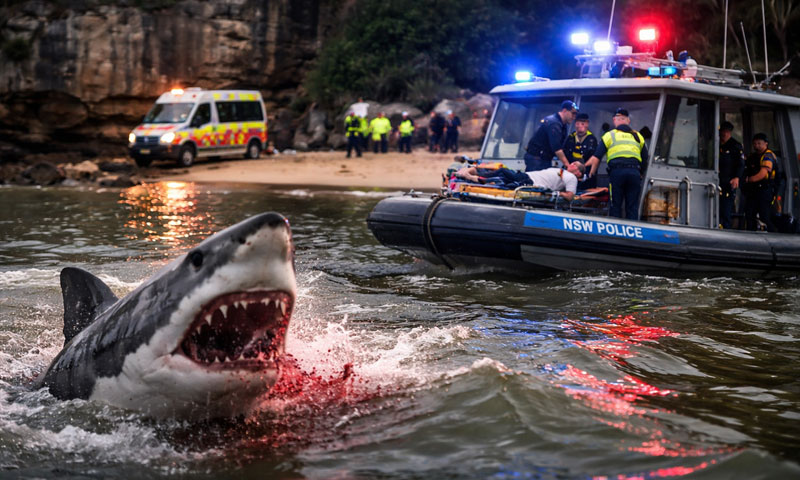
Australian Shark Attack: What Happened to the Boy Injured in Sydney Harbour
A young boy remains in critical condition after being attacked by a shark inside Sydney Harbour, authorities confirmed on Monday, with recent heavy rainfall believed to have created conditions conducive to the incident. The boy, estimated to be between 12 and 13 years old, was swimming with friends late Sunday afternoon near a beach in Vaucluse, around nine kilometres from Sydney’s central business district. Police said he had been jumping from a six-metre rock into the water when the shark struck. Emergency services were alerted shortly after the attack. The boy was pulled from the water by his friends, suffering severe injuries to both legs. He was later transported to hospital, where he remains in intensive care. New South Wales Police Superintendent Joseph McNulty said officers and paramedics acted swiftly, crediting their response — along with the actions of the boy’s friends — for saving his life. “He’s in for the fight of his life now, and the actions of emergency services yesterday gave him that chance,” McNulty told reporters. Police said days of heavy rainfall had caused large volumes of freshwater runoff to enter the harbour, reducing water clarity and creating brackish conditions. Authorities believe this environment may have attracted a bull shark, a species known to thrive in such waters. “We believe the combination of the brackish water, the fresh water, and the splashing created a perfect storm for this type of shark attack,” McNulty said. He also praised the boy’s friends for their bravery, describing their actions as “gallant” in the moments following the attack. Officers transferred the unconscious child onto a police vessel, where they administered first aid and applied two tourniquets to control severe bleeding. The boat then sped across the harbour to a nearby wharf, where ambulance paramedics were waiting to continue emergency treatment. The boy was taken to Sydney Children’s Hospital, where he remains surrounded by family and friends. Shark Attacks in Australia Australia has recorded more than 1,280 shark-related incidents since records began in 1791, with over 250 resulting in fatalities, according to national databases tracking human-shark encounters. On average, the country experiences around 20 shark attacks each year, with fewer than three proving fatal. Experts note that these figures remain small compared to other beach-related dangers, such as drownings. Scientists say a combination of increasingly crowded coastal waters and rising ocean temperatures may be influencing shark behaviour and migratory patterns, potentially contributing to a rise in encounters with humans. The latest incident comes amid heightened public concern following several recent fatal attacks off the New South Wales coast, including the death of a surfer at a popular northern Sydney beach in September and the killing of a woman by a bull shark at a remote beach north of the city two months later.

Yango App Now Offers Direct Access to Police, Ambulance Services in Punjab
Ride-hailing platform Yango has entered into a partnership with the Punjab Safe City Authority (PSCA) to strengthen safety measures for both passengers and drivers across Punjab. Under the new integration, Yango users can now directly contact the official 15 police emergency helpline from within the app during an active ride. Calls placed through the app will be routed to the PSCA’s Emergency Response Centre with a priority tag, ensuring faster handling in critical situations. Once an emergency call is initiated, essential information is automatically shared with authorities. This includes the caller’s real-time location, personal and contact details, partner driver and vehicle information, as well as pickup and drop-off points. The automated data transfer is designed to remove delays caused by manually explaining locations or vehicle details during stressful situations. In addition to police assistance, the feature provides direct access to other emergency services such as ambulance support and the Virtual Women Police Station, offering an added layer of protection for female passengers. The system has been developed to address common challenges faced during emergencies, where valuable response time is often lost while riders attempt to communicate basic details to authorities. Yango Pakistan Head of Public Relations Nuzair A. Virani said the integration aims to assist users who may feel unsafe or unable to contact law enforcement during a ride. He explained that the automatic sharing of live location and ride data allows police to respond swiftly and take timely action. Virani added that, considering the country’s prevailing law-and-order conditions, the feature is expected to benefit both drivers and passengers by improving overall ride security. Yango Pakistan Country Head Miral Sharif said safety remains a core priority for the company. She emphasized that close coordination with law enforcement and Safe City authorities is vital for building a reliable and secure urban mobility ecosystem.
