
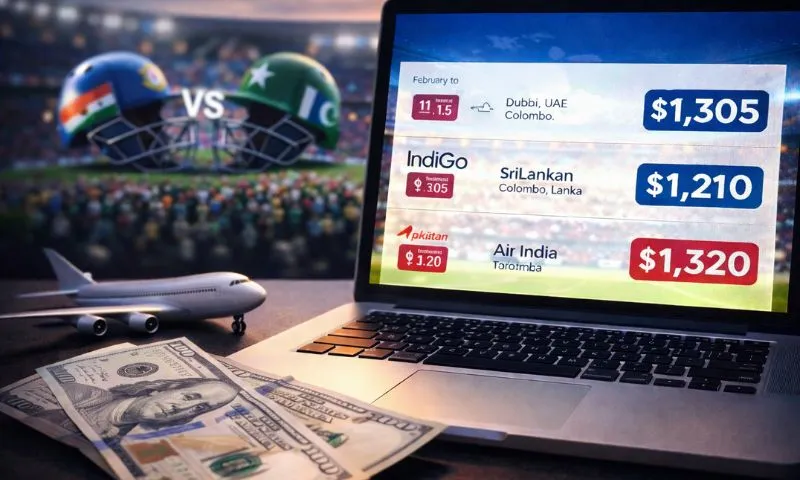
As anticipation builds for the high-voltage India vs Pakistan match at the ICC Men’s T20 World Cup 2026, airfares to Colombo, Sri Lanka have surged sharply, putting travel out of reach for many fans. Flights from the UAE and India to Colombo are now selling at premium prices as demand peaks ahead of the February 15 showdown. According to travel listings, round-trip economy fares from Dubai to Colombo have climbed to as high as $1,320, a steep rise from typical prices. SriLankan Airlines is offering tickets close to $1,210, while Air India fares are approaching $1,305 for the same travel window. Even low-cost carrier IndiGo, usually known for budget pricing, is charging elevated rates for flights timed around the match. Under normal circumstances, one-way economy tickets between major Indian cities and Colombo range between $160 and $420. However, for travel dates between February 14 and 16, prices have multiplied due to overwhelming demand. From Chennai, one-way economy fares are now listed at around $620, while flights from Bengaluru and Hyderabad show similar increases. Travel agents say availability is shrinking fast as fans rush to secure seats. Indian media outlets also report a rapid spike in prices following confirmation that the match would go ahead as scheduled. Round-trip fares from Mumbai to Colombo surged to approximately $720 to $820, with some listings crossing $900 on premium schedules. Flights from Delhi are priced between $545 and $680, significantly higher than seasonal averages. The surge follows days of uncertainty around the fixture. Pakistan had initially indicated it would not participate in the match due to political and diplomatic concerns. However, after consultations involving the Pakistan Cricket Board, Bangladesh Cricket Board, and government officials, Islamabad confirmed that Pakistan would play the match in Colombo. The decision immediately triggered a wave of bookings, pushing airfares higher within hours. Aviation analysts say this pricing pattern is typical for global sporting events but becomes more extreme for India-Pakistan matches due to unmatched fan interest. The rivalry consistently draws one of the largest television and stadium audiences in world cricket, making travel demand unusually intense. Hotels in Colombo are also reporting higher occupancy rates, particularly near the match venue. Tour operators in Sri Lanka expect the fixture to deliver a strong boost to tourism revenue during the tournament window. Airlines and booking platforms are advising fans to finalize plans quickly, as fares may climb further closer to match day.

Pat Cummins Ruled Out of T20 World Cup; Australia Makes Bold Squad Changes
Australia has confirmed a significant shake-up to its squad for the ICC Men’s T20 World Cup 2026, with captain Pat Cummins ruled out of the tournament due to injury. The decision comes ahead of their campaign in Sri Lanka, where Australia will begin their title defence later this month. Cummins, who captained Australia to victory in the 2021 edition of the T20 World Cup, suffered a knee injury during the 2025–26 Big Bash League and has been unable to regain full fitness. Cricket Australia stated that the fast bowler will focus on rehabilitation and is unlikely to feature in the shortest format until later in the year. Cummins’ absence leaves a leadership and bowling void in the squad, prompting selectors to fine-tune their lineup. In a notable selection move, Matt Short, who impressed in the Big Bash and was in strong form earlier in the year, was dropped from the final T20 World Cup squad despite being named in initial training squads. Selectors cited a combination of balance, team composition and match conditions as reasons behind his omission, saying they “felt the team needed a different mix of skills for Sri Lanka’s pitch conditions.” Also missing out is experienced top-order batter Matt Renshaw, who has not played limited-overs international cricket since 2021. Renshaw was part of Australia’s Test setup and strong first-class performances had put him in contention, but selectors opted for other options in the 15-member side. The exclusion of Steve Smith, a world-class batters and former captain, has attracted particular attention. Smith is not part of the T20 World Cup selection, even as he continues to feature prominently in Australia’s Test and ODI teams. Cricket pundits have noted that Smith’s skillset is traditionally more suited to longer formats and that selectors preferred players with explosive skills tailored to T20 cricket’s demands. Australia has named a balanced squad that includes dynamic all-rounders, pace-bowling depth, and power hitters suited to spin-friendly Sri Lankan pitches. James Faulkner and Pat Cummins’ vice-captain backup and pace spearhead replacements are expected to shoulder leadership and bowling duties in the fast bowler’s absence. Cricket Australia’s head coach reiterated confidence in the group, saying that while losing Cummins is “disappointing,” the side has the depth and experience to compete at the highest level. Australia’s campaign begins against West Indies in Colombo, and fans will be watching closely to see how the team adapts without its inspirational skipper and veteran match-winners.

More Than Just a Match: What’s at Stake in Pakistan vs India U19 World Cup Game
The Pakistan Under-19 cricket team is set to face traditional rivals India Under-19 in a high-pressure Super Sixes encounter at the ICC Men’s Under-19 World Cup 2026 on 1 February, a match that could determine both teams’ paths to the knockout stages. The tournament is being held in Zimbabwe and Namibia, featuring 16 of the world’s best young cricket teams. This fixture pits two youth powerhouses against each other at the Queens Sports Club in Bulawayo. Pakistan currently sits third in Super Six Group 2 with four points from three matches, while India leads the group with a perfect record, boasting six points and an impressive net run rate (NRR) of 3.337. India U19’s Form and Momentum India’s U19 side has looked formidable throughout the tournament. They have won all their Super Six matches so far, including a dominant 204-run victory over Zimbabwe, showcasing an explosive batting lineup and consistent bowling. Earlier in the Super Six stage, India routed Bangladesh by 18 runs and beat New Zealand comfortably, highlighting depth and balance in their squad. The team’s ability to win big has marked them as tournament favorites and a major challenge for Pakistan. Pakistan U19’s Road So Far Pakistan’s road to this marquee clash has been strong. They have won two of their three Super Six matches, defeating New Zealand by eight wickets and Zimbabwe by eight wickets in commanding fashion. Earlier in the tournament, Pakistan qualified for the Super Sixes by finishing in the top three of their initial group, led by spirited performances and well-timed partnerships. The U19 side is also buoyed by recent success, having won the 2025 ACC Under-19 Asia Cup by defeating India in a dominant final. Strategic Importance of the Showdown This Ind-Pak U19 clash carries significant implications. A win for Pakistan could secure their place in the semi-finals while maintaining momentum before the knockout stages. For India, a victory would cement their position at the top of the Super Six table and reinforce their status as title contenders. Fans around the cricket world have marked this fixture as one of the highlights of the tournament, with demand for tickets and viewership high. The match is live-streamed and broadcast globally for supporters across the cricketing nations. As the two rivals prepare for battle in Bulawayo, all eyes will be on how Pakistan’s young guns respond to India’s dominant form. With semi-final spots at stake, this match promises intensity, skill, and the drama typical of Indo-Pak cricket at any level.

T20 World Cup 2026: Visa Delays, Team Withdrawal and Health Scare Expose India’s Hosting Failures
The ICC Men’s T20 World Cup, scheduled to be held from February 7 to March 8, 2026, and co-hosted by India and Sri Lanka, has been surrounded by a series of off-field controversies in the build-up to the tournament, raising questions about logistics, governance, and preparedness. Pakistan’s India Travel Stance Shapes Tournament Planning Pakistan’s participation in the tournament has once again been influenced by its long-standing position of not travelling to India due to strained bilateral relations. As a result, Pakistan’s matches have been scheduled in Sri Lanka, continuing the neutral-venue arrangement previously adopted by the International Cricket Council for ICC events hosted in India. While this decision ensures Pakistan’s participation, it has also reinforced the perception that the tournament’s operational planning is being shaped as much by geopolitical realities as by sporting considerations. Bangladesh Refusal Leads to Scotland’s Inclusion A major controversy emerged when Bangladesh refused to travel to India for its scheduled matches, citing security concerns. According to Reuters, Bangladesh requested that its matches be relocated to Sri Lanka, the co-host nation. The ICC, however, rejected the request after stating that independent security assessments had found no credible threat. Following Bangladesh’s continued refusal, the ICC announced on January 24, 2026, that Scotland would replace Bangladesh in the tournament. The move clarified that Scotland’s inclusion was not part of an expansion of the event, but rather a replacement necessitated by Bangladesh’s non-participation. Visa Delays Raise Concerns for Players of Pakistani Heritage Visa-related delays emerged as another significant point of concern in the build-up to the tournament, particularly affecting players with Pakistani heritage. According to ESPNcricinfo, Scotland received assurances from the ICC that efforts were under way to facilitate visas for its squad, yet uncertainty persisted as the tournament approached. Attention was specifically drawn to Safyaan Sharif, whose situation became emblematic of the broader issue. Sharif, a Scotland international of Pakistani heritage, was reported to be awaiting visa clearance, raising concerns within the Scotland camp about preparation, travel timelines, and potential last-minute disruptions. The issue has not been limited to a single player or team. Reports have indicated that visa delays have affected individuals of Pakistani origin involved in cricketing activities linked to India in various contexts, including players representing other countries and officials connected to ICC events. These delays have contributed to unease among teams and boards ahead of a major international tournament partially hosted in India. While no official discrimination has been alleged by the ICC, the recurring visa uncertainties have highlighted the administrative challenges faced by players with Pakistani backgrounds when travelling to India. The situation has also drawn attention to the reliance on diplomatic and consular processes for sporting participation in politically sensitive environments. For the ICC, the matter has added another layer of complexity to tournament operations. Although assurances have been provided regarding visa facilitation, the delays have reinforced concerns about equal access, logistical fairness, and timely clearances for all participating players — particularly in an event that is meant to operate under neutral and inclusive principles. Accreditation Dispute Involving Bangladeshi Journalists The controversy extended beyond players to media access. Bangladeshi outlets reported that journalists seeking to cover the tournament were denied accreditation. The Daily Star reported that accreditation applications from Bangladeshi journalists had been rejected. Indian media later carried the ICC’s response, which described the situation as a reworking of the accreditation process following criticism and public backlash. Nipah Virus Adds a Public Health Dimension Adding to the list of concerns, reports of Nipah virus cases in India have introduced a public health dimension to the tournament’s lead-up. UK government health monitoring reported two confirmed Nipah cases on January 13, 2026, in Kolkata, with investigations ongoing. International health reporting has highlighted heightened alert measures and the virus’s high fatality risk, as cited by global health authorities. At present, however, the situation remains classified as a health concern requiring vigilance, rather than a disruption to the tournament. No official announcement has been made indicating any alteration to the event’s schedule due to the outbreak. While the tournament is set to proceed as scheduled, the narrative surrounding the T20 World Cup 2026 has already been shaped by a series of controversies that continue to draw scrutiny from cricket boards, players, and media organisations worldwide.
Scotland’s World Cup Dream Faces Visa Test Ahead of T20 World Cup
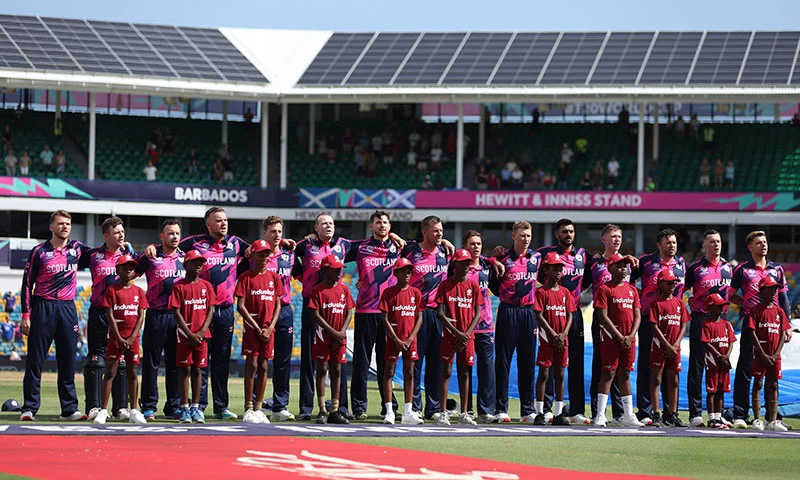
Scotland’s surprise entry into the T20 World Cup 2026 has brought excitement—and urgency—as the team races to secure visas for its players ahead of the tournament in India and Sri Lanka. The situation has drawn particular attention due to visa sensitivities involving players of Pakistani heritage, including fast bowler Safyaan Sharif. Scotland replaced Bangladesh in the upcoming global event, earning a late but historic place in the marquee tournament. However, the short turnaround has left officials focused on logistical hurdles rather than on-field preparations. Sharif, one of Scotland’s key pace bowlers, was born in Huddersfield, England, to a Pakistani father and a British-Pakistani mother. He moved to Scotland at the age of seven and has since become a mainstay of the national side. His background has placed him at the center of visa-related concerns as the squad prepares to travel to India. Introducing your Scotland squad heading to the ICC Men's #T20WorldCup in India and Sri Lanka 🤩➡️ https://t.co/cmtJB52phQ pic.twitter.com/2EQgZb5CdH— Cricket Scotland (@CricketScotland) January 26, 2026 Speaking on Monday, Trudy Lindblade, Chief Executive of Cricket Scotland, said the board is working closely with tournament authorities to resolve the matter. “We are all committed to working with the ICC to make that happen,” Lindblade said. “The visa piece is always slightly unknown, and it doesn’t matter whether you’ve got three days or whether you’ve got 45 days.” She added that securing travel clearance for players has been the organization’s top priority since Scotland’s qualification was confirmed. “Certainly that’s been our focus in the last 48 hours—just getting those visas done so our players are all ready to go,” Lindblade said. “They’re in the middle of submitting their visas, and we’ll be on the ground in India as quickly as we can.” According to Lindblade, International Cricket Council has provided assurances on matters within its control and is coordinating with the Board of Control for Cricket in India and local authorities to support all participating teams. “There’s a team working very hard not just to help us, but to help 19 other teams going to a World Cup,” she said. “Right now, though, we are their intense focus.” The issue follows recent comments from Ali Khan, who said several USA players of Pakistani origin were initially denied visas for travel to India. Tournament officials later clarified that the issue was due to procedural delays rather than outright rejection. With the clock ticking, Scotland remains hopeful that all squad members will receive clearance in time, allowing the team to focus fully on its first appearance at a T20 World Cup hosted across India and Sri Lanka.
Can the ICC Sanction Pakistan if It Boycotts the T20 World Cup? What the Rules Actually Say
Speculation over Pakistan’s possible boycott of the ICC Men’s T20 World Cup has intensified after sections of Indian media claimed that the International Cricket Council (ICC) could impose severe and unprecedented sanctions on Pakistan if it withdraws from the tournament. However, a closer examination of ICC regulations and past precedents suggests that many of the reported threats may be overstated or legally unfounded. The debate escalated following public remarks by Pakistan Cricket Board (PCB) Chairman Mohsin Naqvi, who voiced support for Bangladesh after it refused to participate in the tournament citing security concerns and was subsequently replaced by Scotland. Indian media reports claimed that if Pakistan follows the same path, the ICC could respond with harsh punitive measures, including isolating Pakistan cricket internationally. Today, Naqvi also met Prime Minister Shehbaz Sharif and briefed him in detail on the ICC’s handling of Bangladesh’s case, as well as other related developments. According to Mohsin Naqvi it was agreed that any final decision from Pakistan regarding participation in the T20 World Cup would be taken after further consultations, with an announcement expected either on Friday or early next week. What Indian Media Claims According to unnamed sources quoted by Indian outlets, the ICC is allegedly prepared to impose “never-before” sanctions on Pakistan, including: Preventing foreign players from participating in the Pakistan Super League (PSL) Cutting ICC revenue allocations to the PCB Stripping the PSL of international recognition Excluding Pakistan from the Asia Cup Suspending bilateral series involving Pakistan These reports have framed the situation as an existential threat to Pakistan cricket. However, cricket governance experts argue that several of these claims do not align with how international cricket is actually governed. What the ICC Can — and Cannot — Do Under existing structures, the ICC does not issue No Objection Certificates (NOCs) for players to participate in domestic leagues such as the PSL. That authority lies entirely with players’ respective home boards. Similarly, the ICC does not control bilateral series schedules, which are mutually agreed upon by individual cricket boards. Nor does it govern the Asia Cup, which falls under the Asian Cricket Council (ACC) — currently chaired by the PCB itself. Therefore, claims that the ICC could unilaterally block the PSL, suspend bilateral cricket, or remove Pakistan from the Asia Cup are not supported by the governing framework of international cricket. Government Decisions and Established Precedents Crucially, if Pakistan’s participation is halted by the Government of Pakistan — rather than a unilateral PCB decision — the ICC’s scope for punitive action becomes extremely limited. Multiple precedents already exist where teams declined to tour certain countries based on government advice, without facing sanctions. India’s refusal to travel to Pakistan for several ICC and ACC events is one such example, including the adoption of neutral-venue or hybrid models that were approved by governing bodies. In Bangladesh’s case, their removal from the T20 World Cup stemmed from their refusal to play under the published schedule, despite ICC security assessments finding no specific threat. However, the ICC’s response was administrative — replacing the team — rather than punitive. Why Claims of “Automatic Sanctions” Are Misleading Experts note that portraying ICC sanctions as automatic or inevitable is misleading. The ICC’s primary enforcement mechanism is limited to tournament participation itself. Beyond that, its authority over domestic leagues, continental events, and bilateral cricket is constrained. As a result, assertions that Pakistan would face sweeping punishments across all formats and competitions lack legal grounding under current ICC rules. Pakistan’s Position PCB Chairman Mohsin Naqvi has reiterated that Pakistan will not take a unilateral decision, stressing that any call regarding World Cup participation will follow directives from the federal government. “Our stance will be what the government of Pakistan instructs me,” Naqvi said, adding that a final decision would be made after consultations at the highest level. While a Pakistan boycott of the T20 World Cup would undoubtedly carry political, commercial and sporting consequences, the narrative that the ICC can independently impose crippling sanctions across Pakistan cricket is not supported by existing regulations or historical precedent. Ultimately, any decision — whether to participate or withdraw — will likely hinge on government guidance, regional dynamics, and broader diplomatic considerations rather than fear of automatic ICC punishment.

Deadly Virus Outbreak Puts T20 World Cup in India at Risk, Pakistan May Reconsider Participation
The ICC Men’s T20 World Cup 2026, scheduled to begin in India on February 7, is facing growing uncertainty after the emergence of a deadly Nipah virus outbreak in the country, raising serious concerns over player safety, travel, and tournament logistics. Health authorities in India have confirmed multiple cases of a new strain of the Nipah virus in West Bengal, a region close to Kolkata — one of the host cities for the upcoming World Cup. According to Indian media and health officials, at least five people have tested positive so far, including two nurses and a doctor, all reported to be in critical condition. More than 100 individuals have been placed under quarantine as surveillance and containment measures are intensified. The outbreak has triggered alarm beyond India’s borders. Several regional countries have stepped up health screening for travellers arriving from affected areas. Thailand has begun screening passengers from West Bengal at major airports including Suvarnabhumi, Don Mueang and Phuket, while China has included Nipah virus disease in its updated list of monitored infectious diseases alongside COVID-19 and HIV/AIDS. South Korea has already classified Nipah as a top-tier infectious disease requiring immediate reporting and isolation. Medical experts warn that the Nipah virus poses a significant threat due to its high fatality rate — estimated between 40 and 75 percent — and the absence of any proven treatment or vaccine. The virus, which spreads from bats to humans and can also transmit through close human contact, primarily attacks the brain and lungs, often leading to encephalitis and respiratory failure. According to the World Health Organization and regional disease control agencies, symptoms include fever, headaches, confusion, drowsiness and coma. While transmission is considered relatively limited compared to airborne viruses, health officials stress that hospital-based and household spread remains a serious risk. The outbreak comes at a sensitive time for international cricket. The World Cup has already been mired in controversy after Bangladesh refused to travel to India, citing security concerns. The ICC rejected Bangladesh’s request to relocate its matches to Sri Lanka and replaced them with Scotland — a decision that sparked debate across the cricketing world. The Pakistan Cricket Board later supported Bangladesh’s position, stating that Pakistan’s participation would be subject to approval from the Government of Pakistan. Sources have also indicated that Pakistan may reconsider playing matches in India if health and security risks escalate. With teams, officials, broadcasters and fans expected to travel from across the globe, experts caution that any further spread of the virus could complicate visa processing, travel arrangements, biosecurity protocols and emergency planning for the tournament. While Indian authorities have moved quickly to contain the outbreak, the situation remains fluid. The coming weeks are likely to be critical in determining whether the T20 World Cup can proceed as scheduled or whether contingency plans will need to be activated to safeguard participants and spectators.
India Stayed Away From Pakistan, Bangladesh Shown the Door — ICC Under Fire
The International Cricket Council (ICC)’s decision to replace Bangladesh with Scotland at the Men’s T20 World Cup 2026 has reignited debate over how global cricket’s governing body applies security assessments, venue policies and travel refusals across major tournaments. Bangladesh were excluded from the event after the Bangladesh Cricket Board (BCB) declined to play its scheduled matches in India, citing security concerns and requesting that their fixtures be moved to Sri Lanka, a co-host of the tournament. The ICC rejected that request, stating that independent security reviews found no “credible or verifiable” threat, and that altering the schedule so close to the tournament’s start was not feasible. Criticism and Comparisons With Past ICC Decisions The ICC’s hard line has drawn criticism from former players and administrators, who argue that the approach contrasts sharply with past instances where tournament structures or venues were modified due to one team’s refusal to travel. Much of the criticism centres on the 2025 ICC Champions Trophy, where an ICC-approved framework allowed India and Pakistan matches to be played at a neutral venue during the 2024–27 broadcast cycle. Critics say that precedent raised expectations that Bangladesh might be offered a similar compromise rather than being removed from the competition. Former Pakistan captain Shahid Afridi publicly questioned why India’s security concerns were accommodated in the Champions Trophy framework while Bangladesh’s request was rejected. Former Australia international Jason Gillespie also raised concerns, asking why Bangladesh could not be permitted to play outside India, referencing the same precedent. How Bangladesh Were Replaced The ICC engaged in discussions with the BCB for more than three weeks after Bangladesh formally objected to playing in India. Despite multiple rounds of dialogue, Bangladesh did not confirm participation under the published schedule. After a final deadline passed without confirmation, the ICC invoked its governance and qualification procedures and confirmed Scotland — the next-highest ranked eligible T20I side — as Bangladesh’s replacement. Key Precedents: When Cricket Events Changed Venues or Formats The controversy has revived scrutiny of several past ICC and Asian Cricket Council (ACC) decisions where tournaments were altered due to security or travel disputes: Champions Trophy 2025 (Neutral Venue Model)India declined to travel to Pakistan, leading the ICC to approve a neutral-venue framework for India–Pakistan matches during the 2024–27 cycle. Asia Cup 2023 (Hybrid Model)Pakistan retained hosting rights, but India’s refusal to travel resulted in a hybrid model, with matches split between Pakistan and Sri Lanka. The International Cricket Council (ICC)’s decision to replace Bangladesh with Scotland at the Men’s T20 World Cup 2026 has reignited debate over how global cricket’s governing body applies security assessments, venue policies and travel refusals across major tournaments. Bangladesh were excluded from the event after the Bangladesh Cricket Board (BCB) declined to play its scheduled matches in India, citing security concerns and requesting that their fixtures be moved to Sri Lanka, a co-host of the tournament. The ICC rejected that request, stating that independent security reviews found no “credible or verifiable” threat, and that altering the schedule so close to the tournament’s start was not feasible. Criticism and Comparisons With Past ICC Decisions The ICC’s hard line has drawn criticism from former players and administrators, who argue that the approach contrasts sharply with past instances where tournament structures or venues were modified due to one team’s refusal to travel. Much of the criticism centres on the 2025 ICC Champions Trophy, where an ICC-approved framework allowed India and Pakistan matches to be played at a neutral venue during the 2024–27 broadcast cycle. Critics say that precedent raised expectations that Bangladesh might be offered a similar compromise rather than being removed from the competition. Former Pakistan captain Shahid Afridi publicly questioned why India’s security concerns were accommodated in the Champions Trophy framework while Bangladesh’s request was rejected. Former Australia international Jason Gillespie also raised concerns, asking why Bangladesh could not be permitted to play outside India, referencing the same precedent. How Bangladesh Were Replaced The ICC engaged in discussions with the BCB for more than three weeks after Bangladesh formally objected to playing in India. Despite multiple rounds of dialogue, Bangladesh did not confirm participation under the published schedule. After a final deadline passed without confirmation, the ICC invoked its governance and qualification procedures and confirmed Scotland — the next-highest ranked eligible T20I side — as Bangladesh’s replacement. Key Precedents: When Cricket Events Changed Venues or Formats The controversy has revived scrutiny of several past ICC and Asian Cricket Council (ACC) decisions where tournaments were altered due to security or travel disputes: Champions Trophy 2025 (Neutral Venue Model)India declined to travel to Pakistan, leading the ICC to approve a neutral-venue framework for India–Pakistan matches during the 2024–27 cycle. Asia Cup 2023 (Hybrid Model) Pakistan retained hosting rights, but India’s refusal to travel resulted in a hybrid model, with matches split between Pakistan and Sri Lanka. Champions Trophy 2009 (Relocated) Originally awarded to Pakistan, the tournament was postponed and later moved to South Africa amid security concerns. Cricket World Cup 2011 (Pakistan Matches Removed) Following the 2009 Lahore attack on the Sri Lanka team, Pakistan lost the right to host World Cup matches. Cricket World Cup 1996 (Walkovers) Australia and West Indies refused to travel to Sri Lanka, resulting in walkovers — one of the most cited examples of travel refusal in World Cup history. Cricket World Cup 2003 (Kenya Fixture) New Zealand refused to play in Kenya due to security concerns, requested a venue change, and were denied; Kenya were awarded the points. Why the Debate Is Intensifying The current backlash stems from the contrast between the ICC’s refusal to relocate Bangladesh’s matches and earlier cases where schedules were adjusted, venues changed or neutral solutions adopted to accommodate team concerns. Supporters of the ICC’s decision argue that late-stage changes can disrupt tournament planning and undermine governance consistency. The ICC has repeatedly stated that it will not amend schedules without verified threats, warning that doing so could set precedents affecting future events. With Bangladesh now excluded and Scotland stepping in,

ICC Officially Replaces Bangladesh with Scotland at Men’s T20 World Cup 2026
The International Cricket Council has officially confirmed that Scotland will replace Bangladesh at the ICC Men’s T20 World Cup 2026, after the Bangladesh Cricket Board declined to participate under the tournament’s published match schedule. The decision was formally announced on Saturday, ending weeks of uncertainty surrounding Bangladesh’s participation. The ICC said Bangladesh would no longer compete in the tournament after the BCB refused to send its team to India, citing security concerns, despite repeated assurances from the governing body. Scotland have been drafted into Group C, where they will join England, Italy, Nepal and the West Indies. The tournament is scheduled to begin on February 7. In its official statement, the ICC said it had rejected the BCB’s request to relocate Bangladesh’s matches from India to Sri Lanka — a co-host of the tournament — after determining that there was no credible or verifiable security threat to the Bangladesh team. The ICC said the decision followed an extensive engagement process lasting more than three weeks, during which it held multiple rounds of discussions with the BCB through video conferences and in-person meetings. “As part of this process, the ICC reviewed the concerns raised by the BCB, commissioned and considered independent security assessments from internal and external experts, and shared detailed security and operational plans,” the statement said. According to the ICC, these plans covered federal and state-level security arrangements, as well as enhanced and escalating protocols for teams, officials and supporters. The assurances were reiterated at several stages, including discussions involving the ICC Business Corporation Board. “The ICC’s assessments concluded that there was no credible or verifiable security threat to the Bangladesh national team, officials or supporters in India,” the statement added. Given these findings and the proximity of the tournament, the ICC said it was not feasible to amend the event schedule. The board also cited broader implications for governance and consistency in global events. Following an ICC board meeting on Wednesday, the BCB was given a 24-hour deadline to confirm whether Bangladesh would travel to India as scheduled. When no confirmation was received within that timeframe, the ICC proceeded with its established governance and qualification procedures to identify a replacement team. Scotland were selected as they are the next-highest ranked T20I side to narrowly miss out on direct qualification. They are currently ranked 14th in the ICC T20I rankings, ahead of teams such as Namibia, the United Arab Emirates, Nepal, the United States, Canada, Oman and Italy. With this decision, Bangladesh will miss the ICC Men’s T20 World Cup 2026, while Scotland earn a late entry into the tournament through ICC’s official replacement process.
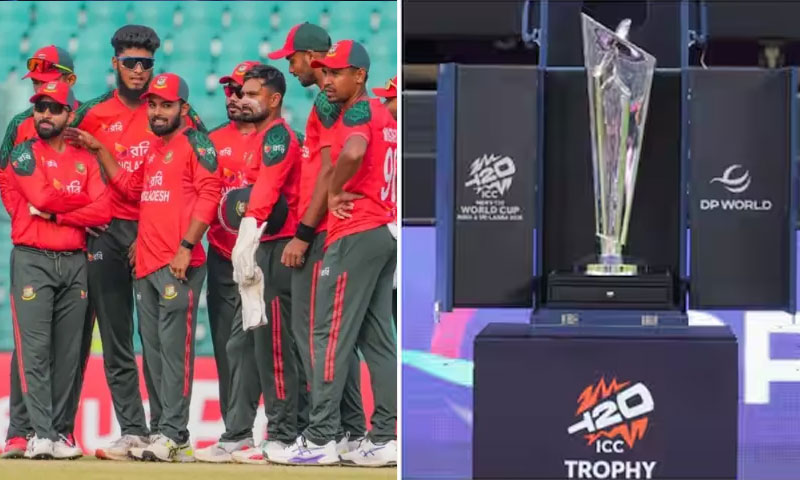
ICC Faces Heat as Bangladesh Rejects India Venue for 2026 T20 World Cup
The Bangladesh Cricket Board has formally decided that its national team will not travel to India to participate in the 2026 ICC Men’s T20 World Cup, citing unresolved security and governance concerns. The decision was taken during an internal board meeting held on January 22, just weeks ahead of the tournament’s scheduled start. The move came a day after the International Cricket Council held talks with BCB directors and issued a clear ultimatum. During that meeting, the ICC informed Bangladesh that Scotland would replace them in the tournament if they chose to withdraw, with February 7 set as the final cutoff date for confirmations. Announcing the decision, BCB President Aminul Islam Bulbul stressed that Bangladesh remains committed to playing the World Cup, but not on Indian soil. He rejected suggestions that the issue stemmed from a single incident and criticised the ICC for failing to offer a workable solution. Bulbul pointed specifically to the recent controversy involving pacer Mustafizur Rahman, who was dropped from the Kolkata Knight Riders squad ahead of the 2026 IPL season. He said the episode reflected deeper structural problems rather than an isolated case, contradicting the ICC’s position. “We will continue to communicate with the ICC. We want to play the World Cup, but we won’t play in India. We will keep fighting,” Bulbul said. “There were some shocking calls in the ICC board meeting. The Mustafizur issue is not a single incident. India were the sole decision-makers in that matter.” The BCB president added that Bangladesh had formally requested its matches be moved to a neutral venue, but the ICC declined. “ICC denied our request to shift our matches away from India. We are not sure about the state of world cricket anymore. Its popularity is going down,” he said. “They have locked out 200 million people. Cricket is going to the Olympics, but if a country like ours cannot participate freely, that is the ICC’s failure.” The standoff now places the ICC under pressure, with Scotland standing by as a potential replacement. Bangladesh, meanwhile, has made it clear that its withdrawal is conditional, not final, and that it remains open to participation if matches are relocated outside India. With just days remaining before the deadline, the dispute has triggered wider debate about governance, neutrality, and power dynamics in global cricket.
