
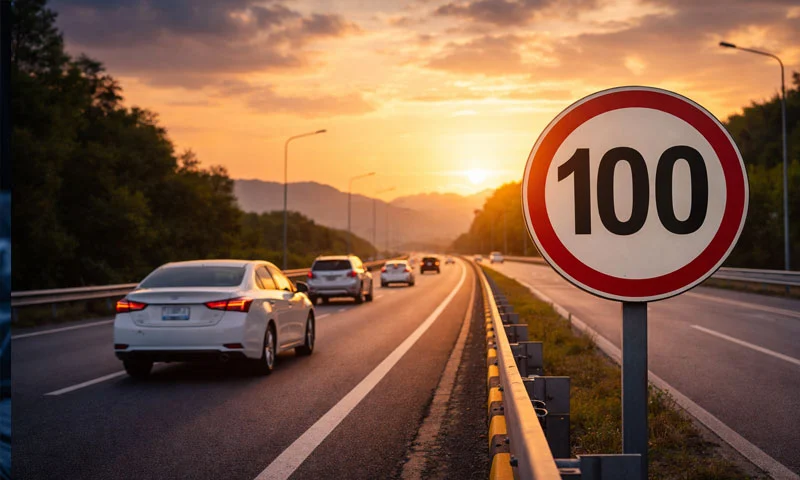
Pakistan has enforced new speed limits on motorways and national highways as part of a broader strategy to conserve fuel and manage rising energy costs. The move comes amid increasing pressure on fuel imports and a nationwide push for austerity. Under the revised rules, the maximum speed for cars and light transport vehicles on motorways has been reduced from 120 km/h to 100 km/h. On national highways, the speed limit for these vehicles has been lowered from 100 km/h to 80 km/h. Lower Limits for Buses and Heavy Vehicles The government has also tightened limits for public service and heavy transport vehicles. On motorways, buses and heavy vehicles are now restricted to 90 km/h, down from 110 km/h. On highways, their speed limit has been reduced to 65 km/h from the previous 80 km/h. Officials say these changes aim to reduce fuel consumption and improve road safety across the country. Strict Enforcement and Fines Begin Authorities have started strict enforcement of the new rules. Motorway Police have already issued fines to drivers exceeding the updated limits. In one reported case, a driver was fined Rs2,500 for driving at 115 km/h on a motorway. Officials have warned that violations will continue to result in penalties, especially during the busy travel season. Fuel Crisis Drives Policy Shift The reduction in speed limits is directly linked to Pakistan’s ongoing fuel crisis. The country relies heavily on imported oil, and recent global tensions have pushed up fuel prices significantly. Lower driving speeds are expected to improve fuel efficiency and reduce overall consumption. Experts say that even a small reduction in speed can lead to noticeable fuel savings over long distances. Impact on Travel and Commuters The new limits are expected to increase travel time slightly, especially on long motorway routes such as Lahore to Islamabad or Karachi to Hyderabad. However, authorities argue that the benefits of reduced fuel use and improved safety outweigh the inconvenience. The policy also comes ahead of peak travel periods like Eid, when millions of Pakistanis travel between cities. A Wider Push for Energy Conservation The speed limit changes are part of a larger set of measures introduced by the government to manage fuel demand. Other steps include reducing public sector energy use and promoting efficient transport practices. The National Highways and Motorway Police has urged drivers to comply with the new rules and contribute to national fuel conservation efforts.

ADAS in Pakistan: How Smart Cars Struggle on Chaotic Roads
Advanced Driver Assistance Systems (ADAS) promise to make driving easier and safer. Features like adaptive cruise control, lane keeping assist, and automatic emergency braking look great on paper — and in showrooms. Global brands increasingly offer these systems even on cars sold in Pakistan. But reality on Pakistani roads often tells a very different story. At its core, ADAS is designed to support drivers, not replace them. Cameras, radar, and sensors interpret the traffic environment and help avoid mistakes. In countries with structured roads and disciplined drivers, these systems can cut accidents and fatigue. In Pakistan, ADAS-equipped cars are becoming more common. Premium SUVs like the MG HS, Haval H6, Honda HR-V, Kia Sportage, and Deepal models include features such as lane departure warnings, blind-spot detection, and adaptive cruise control. Despite this growth, Pakistan’s road conditions often negate ADAS strengths. The biggest issue is simple: our infrastructure and behaviour don’t match the tech’s needs. Lane-keeping systems depend on clear, visible lane markings. But on city streets and rural roads across Pakistan, markings are often faint or missing altogether. When the camera can’t spot clear lines, the system becomes confused or simply shuts off. The chaotic mix of vehicles — motorcycles weaving through traffic, auto rickshaws darting unpredictably, and pedestrians crossing anywhere — triggers false warnings. Forward collision alerts and emergency braking can kick in suddenly, even when no real danger exists. Many drivers find these repeated alarms more distracting than helpful, so they turn ADAS off completely. Pakistan’s traffic culture also plays a role. Many drivers lack formal training and often break basic rules, from improper overtaking to ignoring signals. ADAS systems assume a baseline of predictable behaviour — something rare on many urban and suburban routes here. Still, ADAS isn’t useless in Pakistan. On national motorways (M1, M2, M3) and long open highways, where lane markings are clearer and traffic moves steadily, adaptive cruise control and lane assist can reduce fatigue and help maintain safer driving patterns. The true takeaway is straightforward: technology alone can’t fix safety issues rooted in infrastructure and driver behaviour. ADAS creates potential, but in Pakistan it works best when drivers treat it as an assistant, not an autopilot — and when roads and adherence to rules improve. Until then, the clash between tech and reality will continue.
