

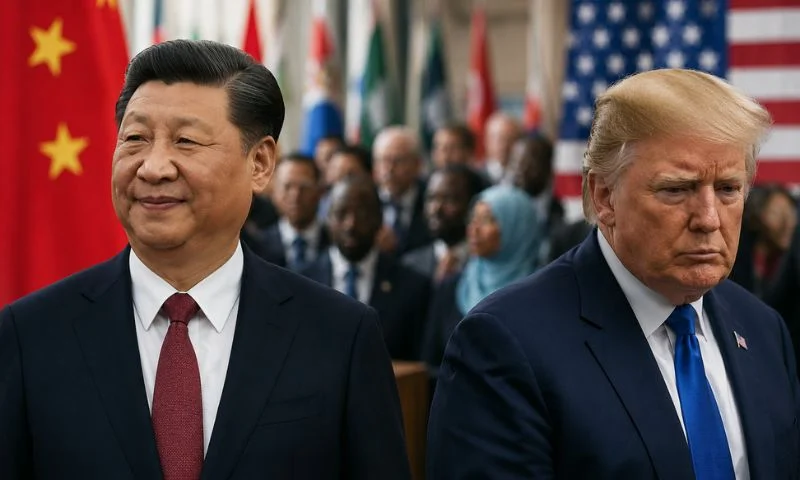
China is viewed more favourably than the United States globally, marking a reversal, a Pew Research Center survey found. China received better ratings than the US in 25 of 36 countries and territories, including Canada and Mexico. Only six countries viewed the US more positively. Pew surveyed 42,151 adults across 35 countries, plus the West Bank and East Jerusalem, from February to May. Margins of error ranged from 2.3 to 5.5 percentage points. China gains as US standing falls During the survey, the US and Israel launched a war against Iran. Pew researcher Laura Silver linked the conflict to worsening perceptions of Washington. “There was just an actual relationship between the outbreak of the war and the sense that the US is just not contributing to peace and stability and that people have less confidence in Donald Trump,” she said. Silver cited Trump’s demands to control Greenland, the US raid that captured Venezuela’s leader Nicolás Maduro and Washington’s handling of the Israeli-Hamas war in Gaza. “The US has done a lot in terms of global engagement in recent months to years that is not being perceived positively internationally,” she said. China benefited as memories of COVID-19 faded. “By comparison, we know that China is seen to be a more reliable partner in many places. It’s more likely to be seen to contribute to global peace and stability,” Silver said. Xi leads Trump in 22 countries People in 22 surveyed places rated Xi Jinping more favourably than Donald Trump. These included Canada, Mexico, France, Germany and the UK, although confidence in both leaders remained low. Pew said China had never held a significant advantage during 20 years of tracking global opinion. Canada recorded a shift. Positive views of the US fell from 57% in 2023 to 33%, while China’s rating rose from 14% to 44%. Trump imposed tariffs on Canadian goods last year and suggested Canada could become “the 51st state.” France, Germany, Spain, Italy, Sweden and the Netherlands shifted towards China. In the UK, the two powers now receive similar ratings. Three years ago, Washington held a 32-point advantage. US and China respond to findings White House spokesperson Olivia Wales said, “President Trump has done more for global stability than anyone else,” citing actions that “obliterated Iran’s nuclear facilities” and “eliminated hundreds of narcoterrorists.” “President Trump is the leader of the free world, and thanks to his bold leadership the United States of America has never been stronger,” Wales said. China’s embassy in Washington said the poll “demonstrates that China’s governance achievements and development progress are widely recognised.” Israel led the six countries favouring the US. About eight in 10 Israelis viewed Washington positively, compared with 19% for China. Japan, India, South Korea, the Philippines and Poland completed the group, although their US ratings have declined. The US still led China on government respect for personal freedoms, but the gap has narrowed. Pew said this was “driven largely by the fact that people in nearly every country surveyed have become less likely to say the US government respects its people’s personal freedoms” since 2021.
Trump Arrives in Beijing for Historic High-Stakes Summit With Xi Jinping
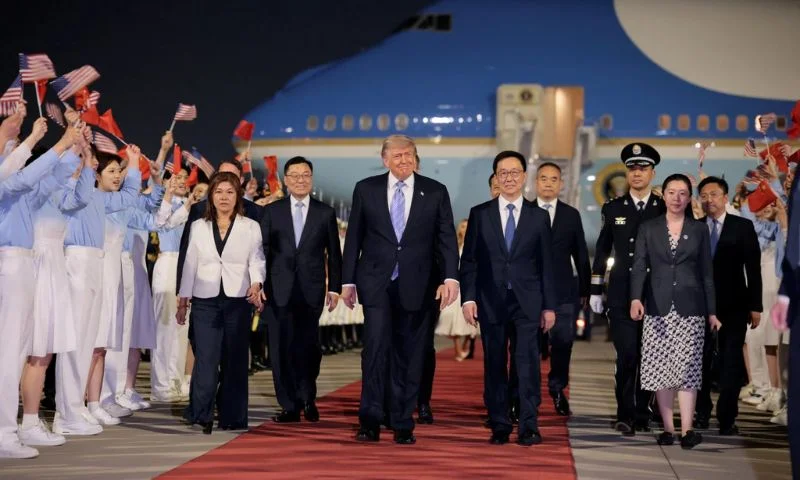
US President Donald Trump arrived in Beijing on Wednesday evening for a historic visit expected to shape the future of US-China relations at a time of growing geopolitical and economic uncertainty. Trump descended the steps of Air Force One to a carefully choreographed welcome ceremony that included Chinese Vice-President Han Zheng greeting him on the tarmac. Chinese officials rolled out a red carpet as military guards and senior diplomats welcomed the US delegation. Analysts described the high-level reception as a deliberate signal from Beijing, especially because Trump received a lower-level welcome during his 2017 visit. Read More: Elon Musk and Tim Cook to Join Trump on High-Stakes China Visit The summit with Chinese President Xi Jinping marks the first visit to China by a sitting US president in nearly a decade. Trump’s trip comes during a fragile period in relations between the world’s two largest economies, with tensions centered on trade, semiconductors, Taiwan and artificial intelligence. The visit was originally scheduled for March. However, the ongoing US-Israel war with Iran delayed the summit after regional instability disrupted diplomatic planning and global markets. Tech Titans and Trade Talks Take Center Stage Several major American business leaders joined Trump’s delegation to Beijing. Among them were Elon Musk, Tim Cook and Jensen Huang. Executives from Boeing, Goldman Sachs, Tesla, BlackRock and other major firms also accompanied the president. Trump signaled ahead of the visit that expanding US business access to China would become a major priority during talks with Xi. “I will be asking President Xi, a Leader of extraordinary distinction, to ‘open up’ China so that these brilliant people can work their magic,” Trump wrote on Truth Social before landing in Beijing. He added that it would be his “very first request” during discussions with Xi. Trade remains a central issue between Washington and Beijing after years of tariff battles and technology restrictions. The White House wants China to increase purchases of US agricultural goods, aircraft and energy products. China, meanwhile, hopes Washington will ease restrictions on advanced semiconductors and AI-related exports. Nvidia and other technology companies have faced growing pressure because of US export controls on advanced AI chips. Iran War and Taiwan Add Pressure to Summit several private discussions between Trump and Xi will be around the ongoing conflict involving Iran. China relies heavily on Iranian oil imports and maintains deep economic ties with Tehran. The United States reportedly wants Beijing to use its influence to help prevent further escalation in the Middle East and restore stability around the Strait of Hormuz. Taiwan is also expected to remain a major flashpoint during the talks. The Trump administration recently approved a major arms package for Taiwan while sending mixed signals about Washington’s long-term military commitments in the region. Analysts say the symbolism of the Beijing visit matters almost as much as policy outcomes. Chinese authorities organized elaborate diplomatic events across the capital, including ceremonies linked to Beijing’s historic Temple of Heaven. Observers say Beijing wants to project confidence and show that China now approaches Washington from a position of greater strength than during Trump’s first presidency. Despite low expectations for dramatic breakthroughs, both sides appear eager to prevent tensions from escalating further.
