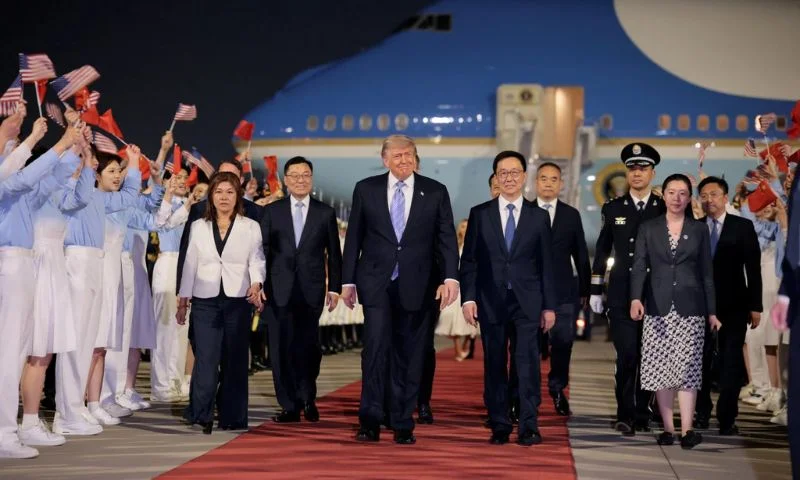
US President Donald Trump arrived in Beijing on Wednesday evening for a historic visit expected to shape the future of US-China relations at a time of growing geopolitical and economic uncertainty.
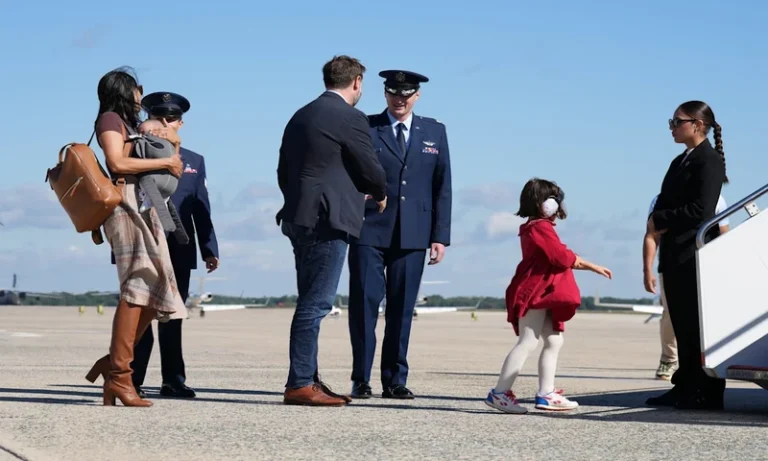
Trump descended the steps of Air Force One to a carefully choreographed welcome ceremony that included Chinese Vice-President Han Zheng greeting him on the tarmac.
Chinese officials rolled out a red carpet as military guards and senior diplomats welcomed the US delegation.
Analysts described the high-level reception as a deliberate signal from Beijing, especially because Trump received a lower-level welcome during his 2017 visit.
Read More: Elon Musk and Tim Cook to Join Trump on High-Stakes China Visit
The summit with Chinese President Xi Jinping marks the first visit to China by a sitting US president in nearly a decade.
Trump’s trip comes during a fragile period in relations between the world’s two largest economies, with tensions centered on trade, semiconductors, Taiwan and artificial intelligence.
The visit was originally scheduled for March. However, the ongoing US-Israel war with Iran delayed the summit after regional instability disrupted diplomatic planning and global markets.
Tech Titans and Trade Talks Take Center Stage
Several major American business leaders joined Trump’s delegation to Beijing.
Among them were Elon Musk, Tim Cook and Jensen Huang.
Executives from Boeing, Goldman Sachs, Tesla, BlackRock and other major firms also accompanied the president.
Trump signaled ahead of the visit that expanding US business access to China would become a major priority during talks with Xi.
“I will be asking President Xi, a Leader of extraordinary distinction, to ‘open up’ China so that these brilliant people can work their magic,” Trump wrote on Truth Social before landing in Beijing.
He added that it would be his “very first request” during discussions with Xi.
Trade remains a central issue between Washington and Beijing after years of tariff battles and technology restrictions.
The White House wants China to increase purchases of US agricultural goods, aircraft and energy products.
China, meanwhile, hopes Washington will ease restrictions on advanced semiconductors and AI-related exports.
Nvidia and other technology companies have faced growing pressure because of US export controls on advanced AI chips.
Iran War and Taiwan Add Pressure to Summit
several private discussions between Trump and Xi will be around the ongoing conflict involving Iran.
China relies heavily on Iranian oil imports and maintains deep economic ties with Tehran.
The United States reportedly wants Beijing to use its influence to help prevent further escalation in the Middle East and restore stability around the Strait of Hormuz.
Taiwan is also expected to remain a major flashpoint during the talks.
The Trump administration recently approved a major arms package for Taiwan while sending mixed signals about Washington’s long-term military commitments in the region.
Analysts say the symbolism of the Beijing visit matters almost as much as policy outcomes.
Chinese authorities organized elaborate diplomatic events across the capital, including ceremonies linked to Beijing’s historic Temple of Heaven.
Observers say Beijing wants to project confidence and show that China now approaches Washington from a position of greater strength than during Trump’s first presidency.
Despite low expectations for dramatic breakthroughs, both sides appear eager to prevent tensions from escalating further.